January 5, 2017 (Thursday)

Today is my rail trip from Winnipeg (Manitoba) to Edmonton (Alberta). The trip was expected to take 19 hours, leaving at 11.45am today and arriving at 6.25am tomorrow, so I booked a single sleeper compartment again. I received an email last night, however, from Via Rail to advise that the train had left Toronto late and so I was advised that there may be a delay in Winnipeg.

I had packed the night before, so I had breakfast, bought a newspaper and some water and snacks for the train, and took a taxi to the railway station, arriving at around 9.30am. The train was originally scheduled to arrive at 8am, and not surprisingly given the email, it had not arrived by the time I checked my suitcases.

The train was expected to arrive at 10am. Then 12 noon. It eventually arrived at 1.40pm, with a depart time of 2.45pm. Really I wasn’t too concerned. I had a couple of magazines and some audiobooks, so I was set. Plus because we didn’t leave on time (when I would have had lunch), one of the Via Rail staff arranged for me to get some food and drink. There turned out to be an issue with one of the switches and one of the wheels, so there was to be a short delay as a couple of parts were sourced.

We got onto the train around 2.30pm, still waiting for the parts to arrive. There was some heavy traffic and bad weather that caused some delays. We had dinner at 6pm on the train, and I went to bed to read at 7pm still waiting to hear when we’d leave Winnipeg. The staff did everything they could to make us comfortable and to keep us regularly informed about how things were progressing. They were great. Some of the more regular passengers said that delays happen all the time, especially in winter, with snow etc. Eventually the train started to roll at 8.40pm, but then stopped and started a few times. We ended up leaving the station at 9.35pm, around 10 hours late. Which was fine with me because it meant I would get to Edmonton at a reasonable time, not 6.22am. Plus I believe the same with the train as with planes, I’d much rather be delayed and ensure that whatever I am travelling on is mechanically sound so I will not get stuck in the middle of nowhere, or worse. So I switched off the light to go to sleep.

January 4, 2017 (Wednesday)

Today I slowed down just a little bit because Winnipeg had a high wind chill level, taking the minus 27C up to something close to minus 40C. Therefore when I headed outside it did not take too long for my face and head to hurt – my face and head only being covered up by a scarf, a beanie and a hoodie from my jacket, as against the three layers on the rest of my body. Again like an instant ice cream headache. So I walked behind various buildings to keep away from the wind and then headed across to the closest skywalk to get to the Manitoba Art Gallery.

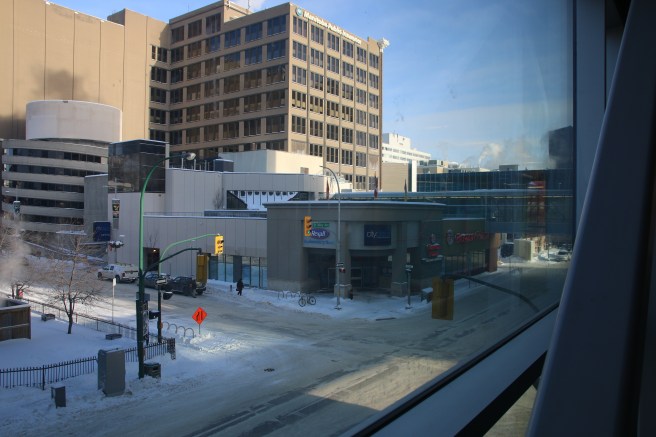
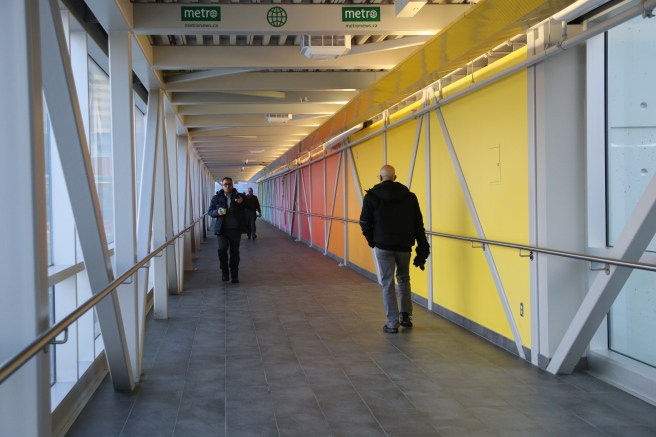
Where Montreal and Toronto have underground cities (tunnels linking various buildings with shops and train stations so you can walk through much of the downtown without getting out into the snow, rain and cold), Winnipeg has skywalks. These are walks that are linking buildings at second floor level, a level above the street, also with shops in some places, however Winnipeg’s is significantly smaller in scope than the other two mentioned above. The first photo below shows one of the skywalks (above and to the right of Boston Pizza) taken from another skywalk link, with the second photo being inside one of the links. Not as busy as the larger cities, but still as useful.

4jana

4janb

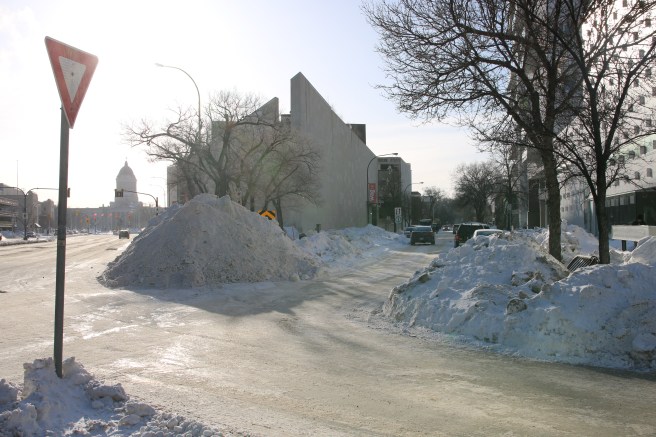
But it worked for me. I got to the art gallery in about 10 minutes. Below is a photo of the Art Gallery, the building in the middle. This photo is of interest to me because it shows (a) piles of snow on the sidewalks that usually get pushed away within 48 hours in the eastern cities like Quebec City, Montreal and Toronto but apparently not so much in Winnipeg from what I have read, and (b) the Union Station is the building to the left with the dome. Interestingly, Winnipeg and Toronto’s railway stations are both called Union Station.

4janc

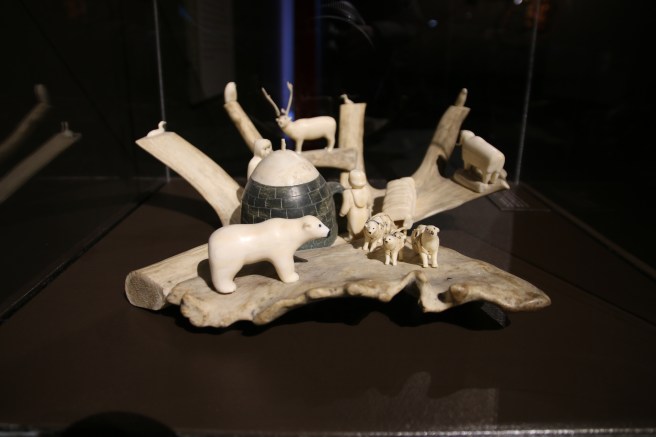
I went inside and bought my ticket and then headed into the first exhibit, on the first floor. This was of Inuit Sculptures. Inuit inhabitants of the Canadian Arctic initially carved functional items for themselves, however as trading occurred and extended over the 19th and 20th centuries, they started to carve articles for sale/ trading. The most common material they used to carve was stone, and the type depended upon what they could hand quarry. Because some had minimal access to useable stone, they carved with materials such as ivory, antler and whale bone. The Manitoba Art Gallery has one of the largest collections of Inuit carvings and has plans to commence a new gallery to display these and the rest of its collection more appropriately. More about that later. Some of this work is very intricate.

4jand

4jane

After that exhibit, I went back into the lobby to have a look at a couple of the large tapestries the gallery had on its walls. These 16th century tapestries are called the Bisham Abbey collection, as they once adorned the walls of the Bisham Abbey in Buckinghamshire, on the country estate of King Henry VIII. Herewith an example of one.

4janf

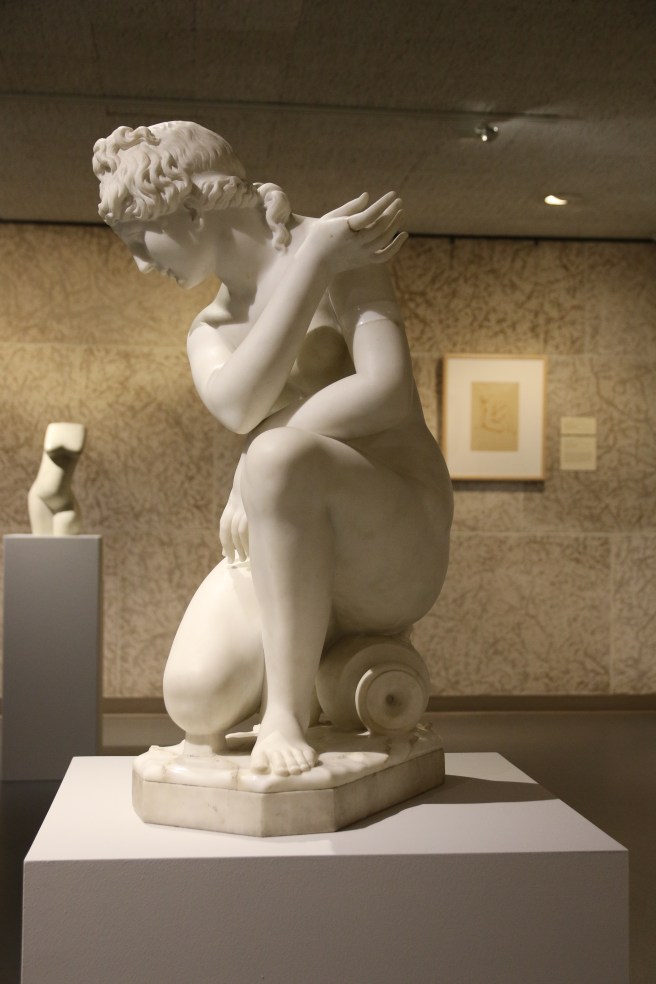
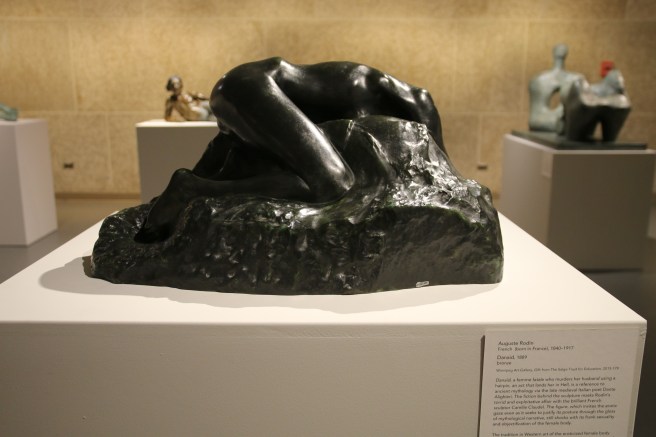
I then headed up to the second floor to see an exhibition of sculptures under the title “Starting with Rodin”, by Francois Auguste Rodin and those taught / inspired by him. There were around 30 sculptures in the exhibition. The first photo is of two marble items by Rodin, ”Tete de danseuse” and “Small Torso”, with a story of Rodin having sculpted these (and others) for a planned Museum of decorative Arts in Paris, which never went ahead. The next is a marble sculpture entitled “Crouching Venus” by Italian Pierre Barzanti. The most important item, in the exhibition in the bronze sculpture “Danaid” by Rodin. Danaid is a femme fatale who murders her husband using a hairpin, and is an apparent reference to ancient mythology via the Italian poet Dante Alighieri.

4jang

4janh

4jani

After this, I reviewed the plans and model for the new art gallery which is due to commence construction in the next 18 months. It has a number of really good features, the best for me being the Visual Vault. Knowing that galleries own significantly more artworks than are displayed at any one time, the gallery (apart from the usual exhibition spaces) will have a cylindrical galls-walled art storage facility which will display thousands of artworks, and where the public can visualise curatorial and conservation activities. An interesting way for the public to see more than the usual displays.

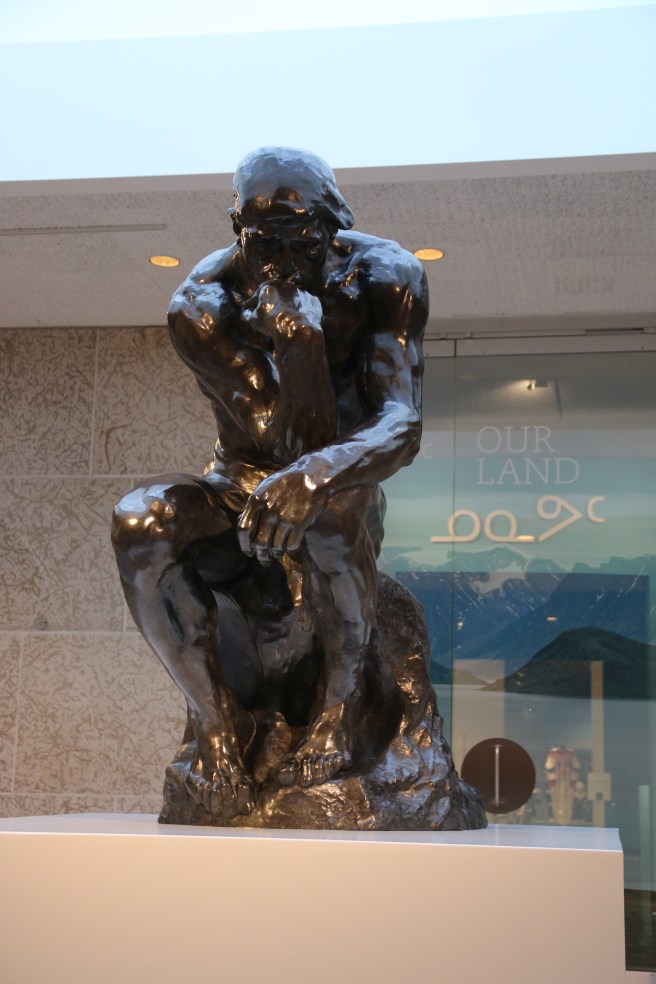
After that, I headed up to the third floor, where there are two exhibition spaces, one I would say has about one third of the floor, the other with two thirds, as well as the lobby space. The lobby space itself is taken up with a large size model of “The Thinker” by Rodin, this one believed to have been created by Rodin students or ancestors after his death from the original plaster cast moulds Rodin used from the original sculpture to make other casts.

4janj

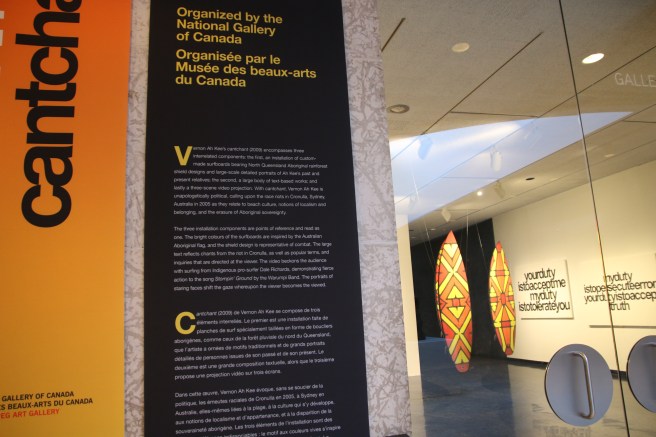
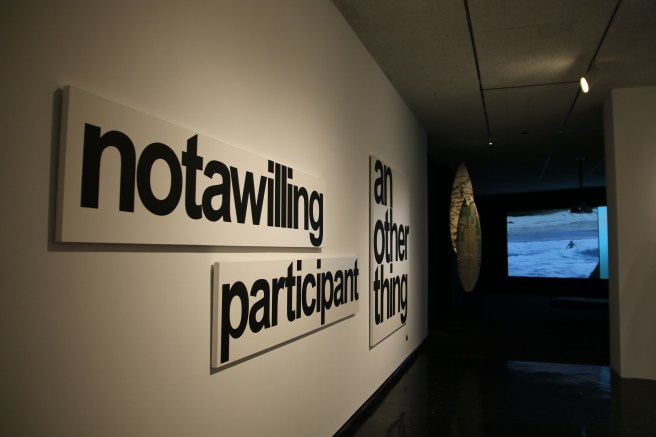
The smaller exhibition space starts with a smallish area that is set aside for an installation by Vernon Ah Kee called “cantchant”. It’s an Australian Aboriginal display, some surfboards painted in the colours of the Australian Aboriginal flag, plus some signs on the wall, going through to a room with a very large split screen showing film of Dale Richards, an Australian surfer, surfing.

4jank

4janl

The remainder of that side of the exhibits is a storyline both visual and electronic of Inuit, Metis and First Nation artists and the sorts of art that they create. There was a fascinating range of modes and styles, and stories of artists and their communities, as well as the cooperatives that they use to promote their artworks. The artworks and the videos were quite fascinating.

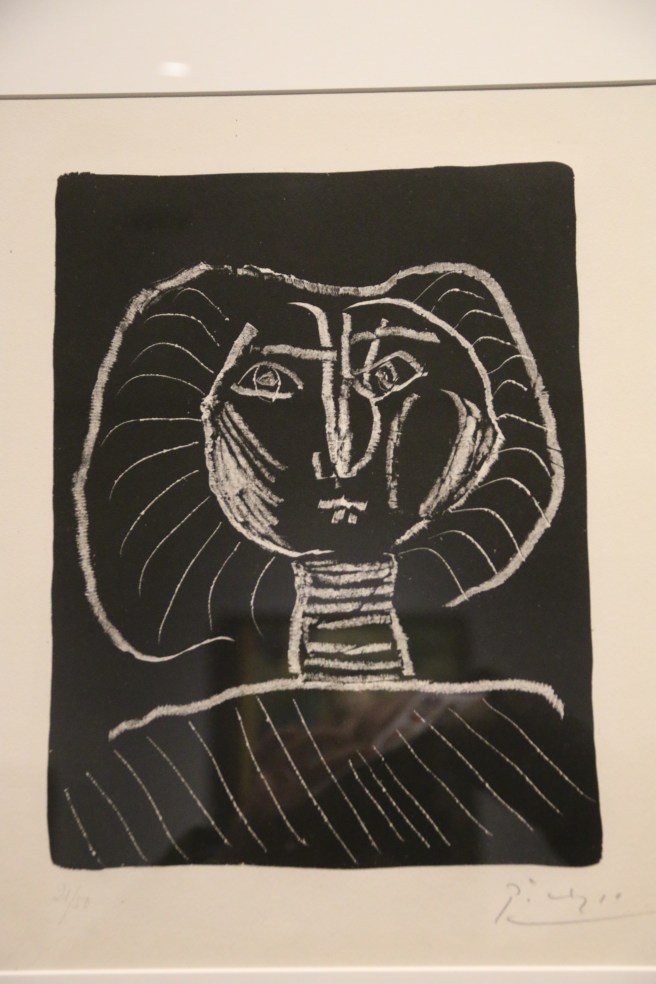
The larger of the two exhibition spaces on that floor consists of a large number of paintings as well as some sculptures, by Canadian artists. This took me a good hour to go through. The painting themes ranged from religious art through to portraits, old style landscapes, newer techniques, and to ones that look like they were done at day care by a 3 year old. There was even a Pablo Picasso lithograph on paper “Tete de femme fond noir” (below). Below is also a photo of a very small portion of this display.

4janm

4jann

By then I headed back to the hotel for a quick break before then heading off to my final visit in Winnipeg, The Forks.

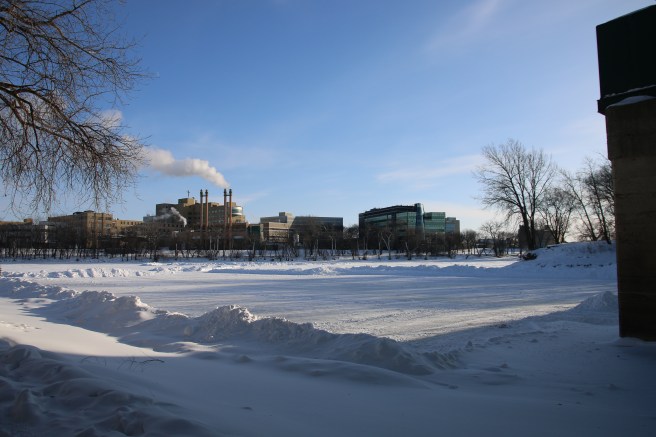
The Forks is a small area on the river where the river splits into two. It is just behind and past Canadas Human Rights Museum. It is a little difficult to see given the river is frozen and covered in snow, however in the below photo, the Red River comes from the left and “forks” into two to the right of the photo. The Red River continues on the far side of the concrete bridge pylon (and then heads passed the buildings in the photos middle) and the Assinboine River comes off on the close side of the concrete bridge pylon.

4jano

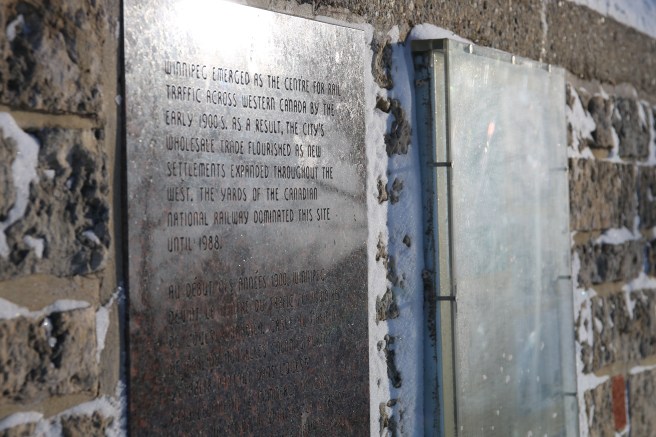
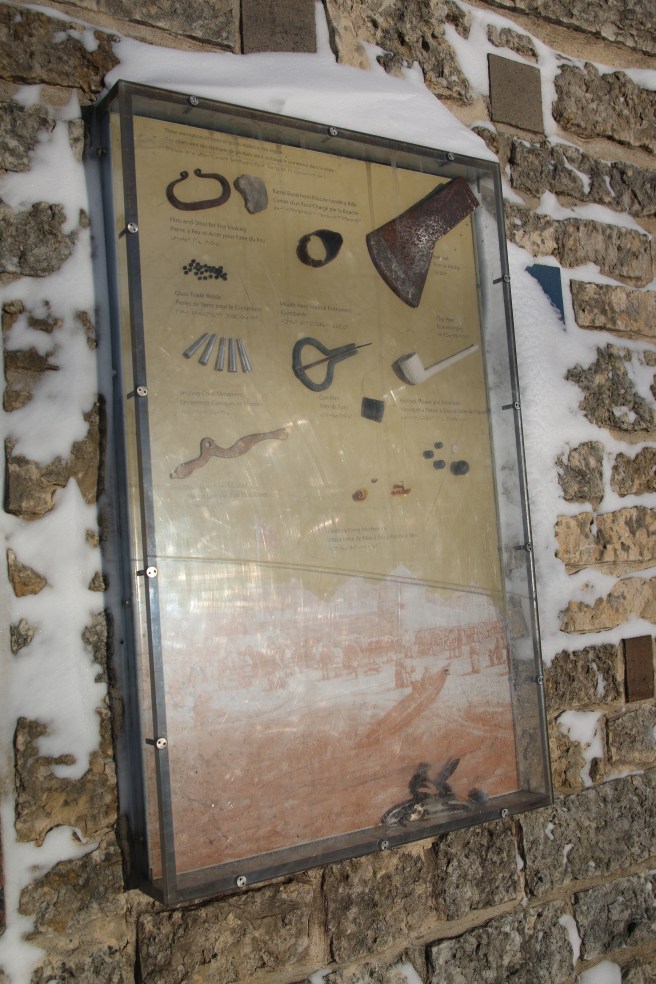
This is an area of historical significance, with artefacts showing that early aboriginal groups arrived in the area over 6000 years ago. Artefacts uncovered included hunting and fishing tools. The site was visited and transversed through by multiple peoples, and was used as a meeting place and a trading site. As it is now with its markets, restaurants, ice skating rinks and walking trails with stone plates of historical information, along with models of some of the artefacts located. Some parts even expose the sedimentary changes on the river walls over the 6000 years and earlier.

4janp

4janq

It started to cool down quickly, so I headed back to my hotel to pack in readiness to travel to Edmonton tomorrow morning.

January 3, 2017 (Tuesday)

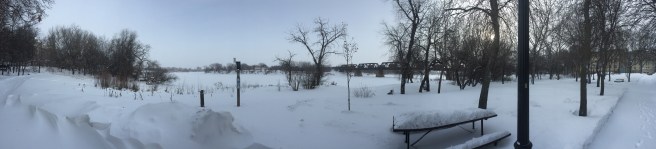
Today I headed over to the Manitoba Museum. I took a pathway along the frozen river. The main river is the Red River, with the smaller offshoot coming off the fork being the Assiniboine River. The name comes from the Assiniboine peoples who were one of the First Nations from areas including the central area of Canada including Manitoba, the province of which Winnipeg is the Capital.

3jana

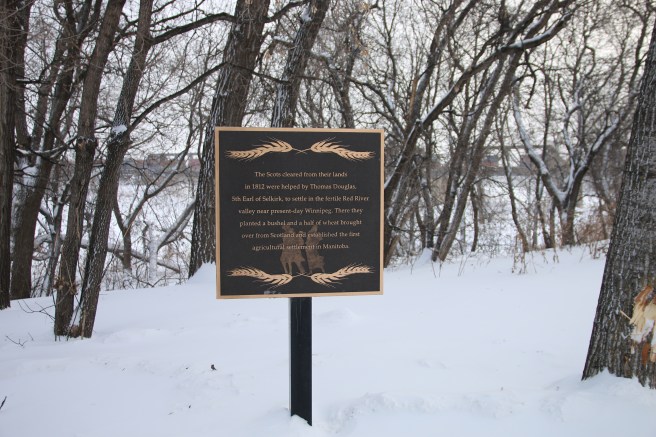
On the way, I passed a plaque / sign on the riverfront relating to Scots being cleared from their land in 1812. It turns out that in the 18th century to early in the 19th century period, there was a series of clearances (the Highland Clearances), or forced displacement, of of Scottish people from their traditional land tenancies, which resulted in a change from small scale agriculture to large scale sheep raising by the aristocratic landowners. These Scottish peoples were moved to the coast, as well as North America (including Canada) and Australasia. Thus, some of these peoples settled in the Red River valley close to where Winnipeg is settled.

3janb

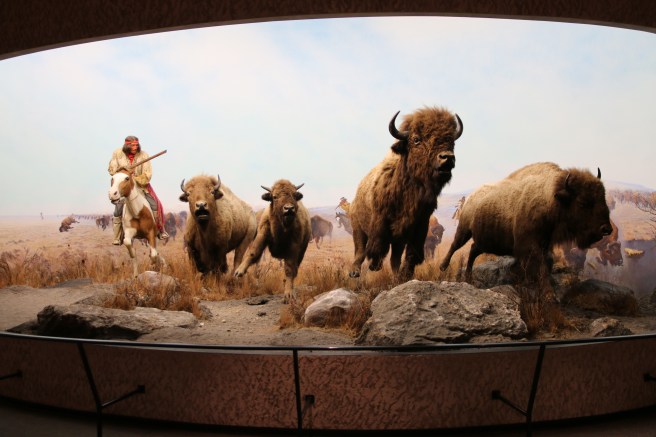
Winnipeg sits within the Canadian Prairies, which covers the provinces of Alberta, Saskatchewan and Manitoba. The museum has a large range of exhibits, with a walkthrough of the main gallery being a bit like an Ikea showroom, where the walkthrough is defined and you just start and follow the triangles. This is the exhibit right at the start, and represents the Red River Buffalo Hunt, which the Metis’ undertook on the open plains to catch, kill and process buffalos. In many cases, the whole families took part, some to hunt the buffalos, the others to process the meat and skins. Metis is a French word derived from a Latin word meaning “to mix”. They were described as generally a mix of First Nation mothers and French Canadian fathers from the early 1800s, and by the mid 1800s they were the largest mix in the province.

3janc

It’s a precursor to the whole gallery which is very visual as well as having some of the newer technology electronics. But mostly it’s displays, and some of them are quite large installations.

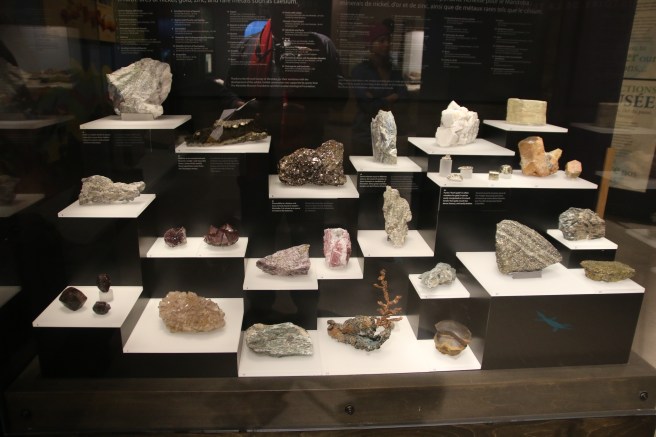
The gallery then moved into minerals. The geology of Canada is made up of various minerals, the backbone of North America, which are between 1.7 and 3 billion years old. There is a display of minerals from “the Canadian Shield” representing this backbone.

3jand

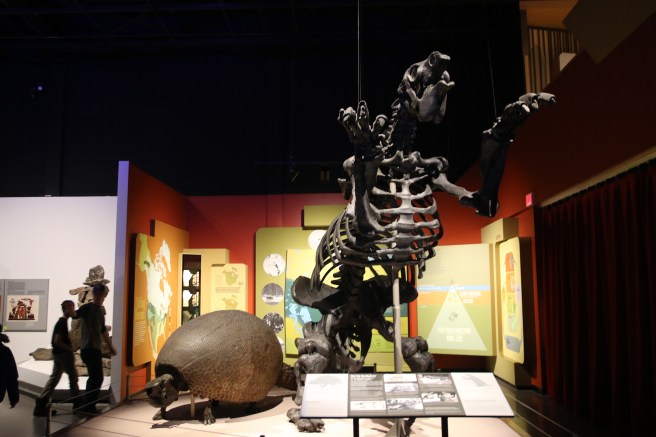
After this, the next section related to fossils found within the rocks that archaeologists and others have uncovered. There were some very interesting displays including large fossils, or at least examples of them, in this section. After a display with questions around the extinction from 65.5 million years ago, the displays moved onto the Ecosystem, and where herbivores and carnivores fit. There were also some neat childrens’ areas, including one where they are taught to use a brush and trowel to look for artefacts in soil. Then I turned a corner and got scared by these skeletons.

3jane

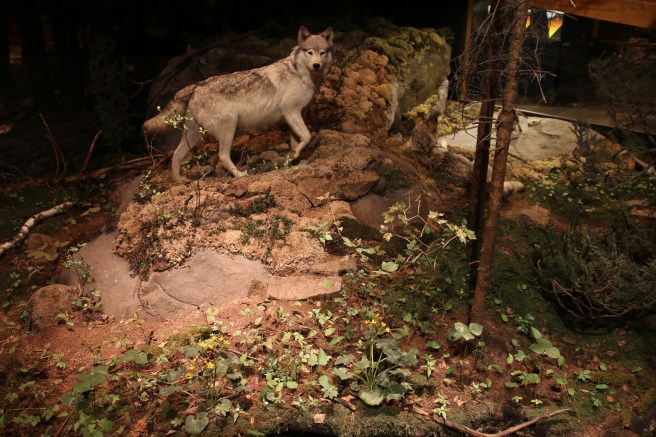
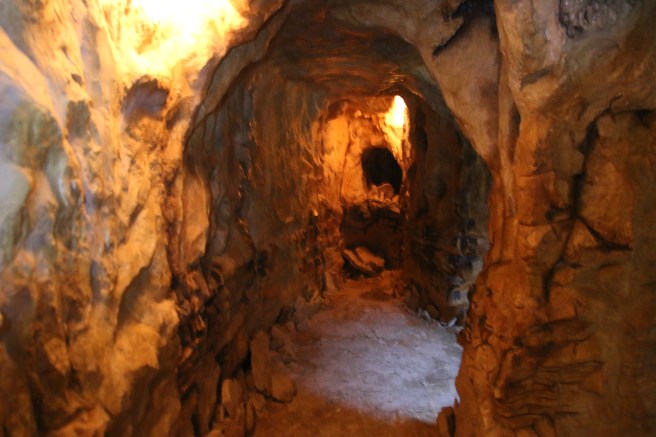
Then next few displays were around current day animals and their hunting of other animals, the various lifestyles of the First Peoples including hunting, cooking, and use of tools in their daily life. Much like the similar displays in Halifax and Montreal. But I really liked some of their installation style displays that showed different parts of daily life. One was a cave with torches available to walk through and look for bats.

3janf

3jang

3janh

At the end of this gallery was a replica ship, the Nonsuch, which was built as a merchant ship in 1650 and travelled in 1668-1669 under the Captaincy of Zackariah Gillam. It was the first ship to travel into the Hudson Bay – the large Bay to the north of Manitoba and Ontario – the path of which then became a regular trade stop. The model was open to the public but the queue was pretty long so I just looked over the side and headed to the next gallery.

3jani

The following gallery was based around the changing environment and the exploitation of various parts such as forestry and mining. There were a number of interesting displays including models and equipment / vehicles used in this area. This followed onto the interrelationship between the First Peoples and settlers, including the development of treaties. It included information about First Peoples fighting for the country in the World Wars.

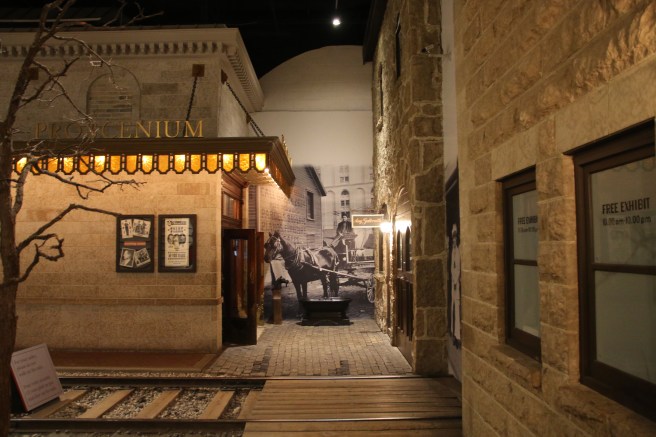
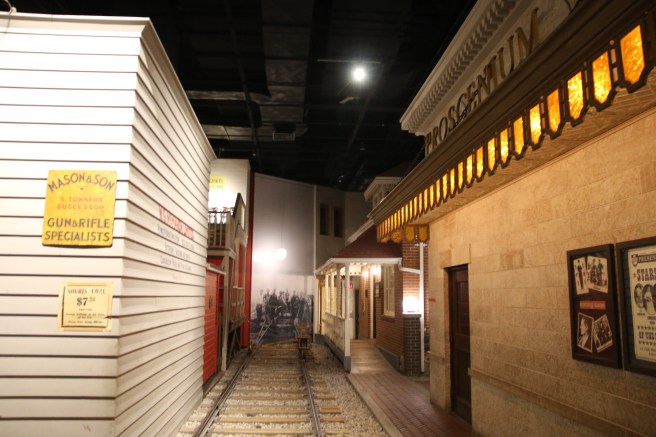
Interestingly, the next gallery was made up of a mockup of a street and a railway with two stories of buildings that were full sized to walk through, but the buildings themselves were narrow. It included a church, barber, grocery store, pub, and a number of other buildings and shops. It was really neat.

3janj

3jank

3janl

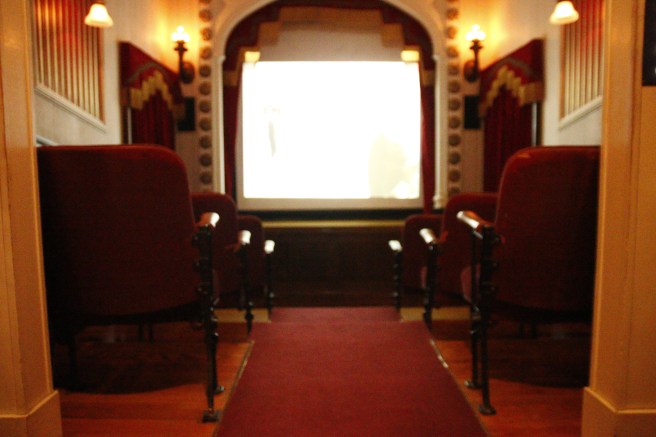
I sat in the movie theatre for about 10 minutes to watch a couple of Charlie Chaplin films. I always enjoy laughing at his exploits.

That was the end of the museum. All in all, a very interesting series of exhibits with a lot of interesting things to learn about the history of the lands and its peoples, and well worth a few hours to visit. I then headed over to the collocated Planetarium and Science Discovery Centre. I saw a 25 minute film on the Planetarium roof / screen narrated by Harrison Ford called “Are We Alone”. It was interesting but definitely created for a younger audience. However the visuals were great.

I then went into the Science Centre, which again was more for families but I did get to play with some of the exhibits. There were a huge number of different things kids could play with, and definitely some parents using the exhibits to teach their kids some things around water flow and nature.

So then it was after 3pm and getting even colder, so I headed back to my hotel to have a Canadian Crown Royal whiskey and dry or two. I then watched more of the current affairs shows in between watching the USA beat Russian on goal shots in the Junior Ice Hockey semi-finals.

Then it was 10pm and I turned off the TV and went to bed.

January 2, 2017 (Monday)

The train was due to arrive at Winnipeg Station at 8am, so I got up at 6.45am, had breakfast and a shower, converted the bed back to the lounge, packed my bag to disembark and then headed to the dome car to grab some video on my GoPro. At around 8am the train was stopped around 20 minutes short of Winnepeg. We were advised that there was to be a delay of around an hour, as the train coming the other way had been delayed significantly, and was at Winnipeg Station being prepared for the leg from Winnipeg to Toronto.

In the end, we didn’t reach Winnipeg Station ourselves until 11.30am, 3 and a half hours delayed. But given the level of snowfall and storms in the central and eastern parts of Canada, these delays aren’t surprising.

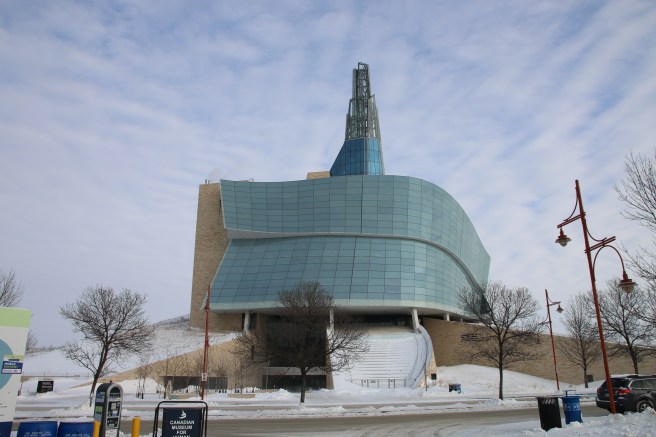
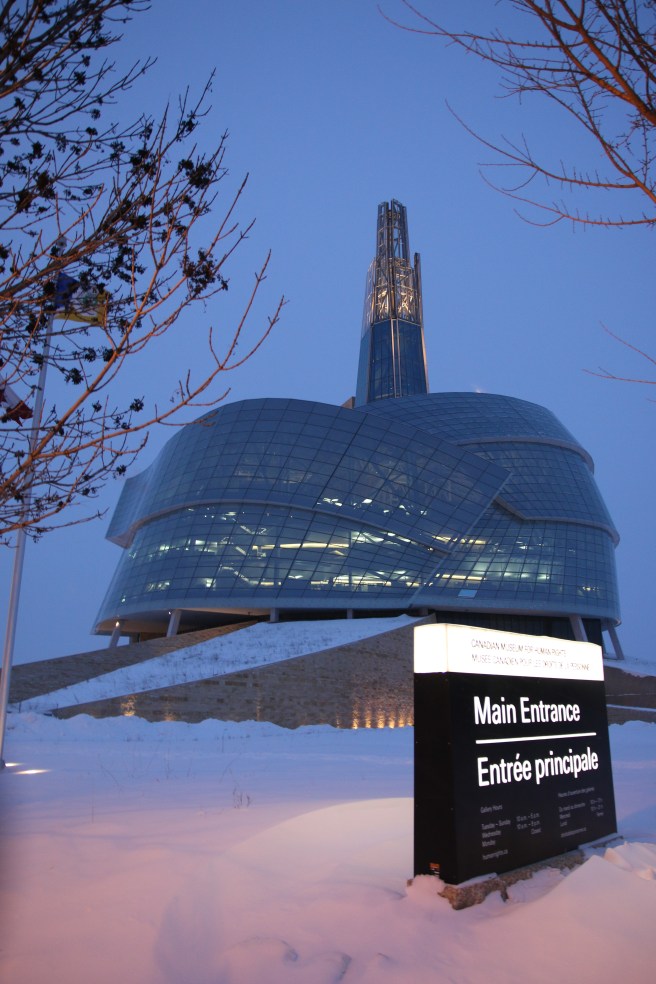
I got to the hotel at 12.30pm, and checked in. I then went for a walk to the Canadian Museum of Human Rights. It was only 3 blocks away but it took me some time. It was soooooo cold. It felt like it was colder than Anchorage Alaska. The temperature was -19C, but with the wind it felt much worse. This is the museum.

2jana

2janb

The museum itself was fascinating. The museum has 6 levels of galleries, with stairs then up to an 8th floor viewing room. On the ground floor is one of the temporary exhibitions (which you can always tell as they are the ones you aren’t allowed to take photos at).

This exhibition is called “1867 – Rebellion and Confederation” and is in line with the 150th Confederation of Canada celebration. The exhibition gives a long history of the period up to Confederation on 1 July 1867. It starts in the 1830s when the area consisted of Upper Canada, Lower Canada, Nova Scotia, New Brunswick, Newfoundland and Prince Edward Island. The issue with the regions was that they had different values and power was in the hands of a small privileged group of mainly British citizens (including the Governor General and his advisors), these regions being British colonies.

The exhibition then provides visual and audio-visual presentations around groups of reformers wanting to bring democracy and shared values. The reformers’ demands were variously rejected and so this led to rebellion and battles in 1837. The loyalists (keeping the status quo) won and this led to 1500 arrests, 250 deported (including to Australia) and 50 rebels were hung. Over time this situation led to the “Act of Union” in 1840, passed by the British Parliament. The Act established the Province of Canada, created a single Parliament, but also caused significant opposition due to banishment of French language for official use, and suspending specific French responsibilities etc. Over 15 year, the groups worked within the Act to remove the most onerous sections. This led down the path to the Confederation in 1967.

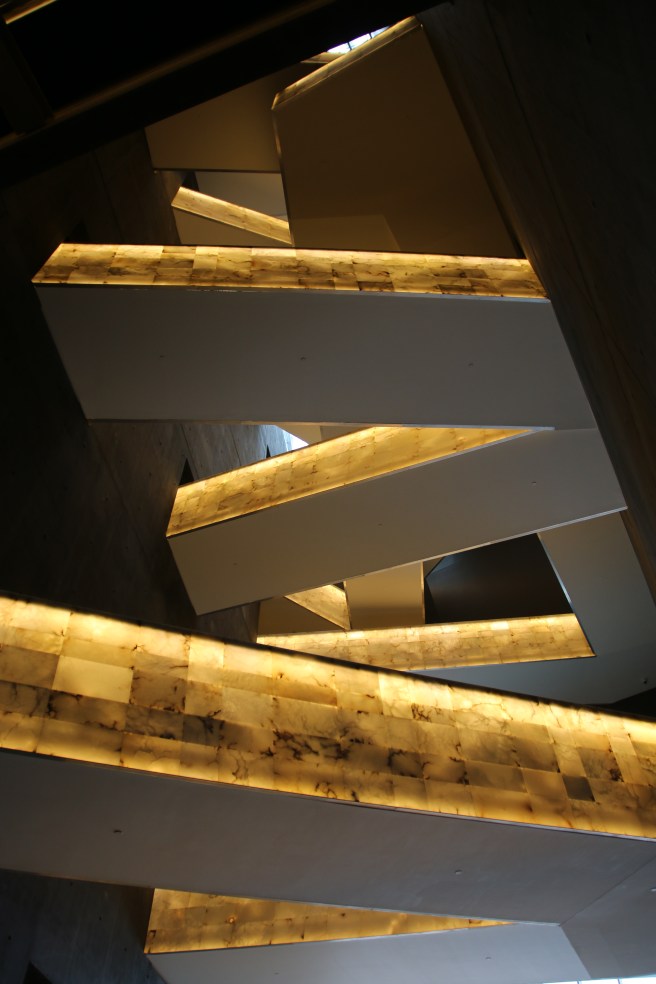
The museums levels are linked by a series of ramps. These ramps are made from Alabaster with lighting behind, to “light the visitors’ path through the rights museum”.

2janc

The second level gallery’s displays are around “What Are Human Rights”. This includes different displays as well as video of 6 specific people who talk through what they believe are human rights and why. The museum itself does not provide one specific answer to this questions. Different people have different ideas. There are also stories from around the world of peoples who have been active against those people and organisations (including Governments) who have sought to reduce rights, including freedom of speech. An example here is a Chilean arpillera (vivid patchwork stitched onto sacks) to protest against Augusto Pinochet’s dictatorship (1973 to 1990).

2jand

Also on this floor are displays entitled “Indigenous Perspectives” being the concepts of rights for the First Nations, Metis and Inuit peoples; and “Canadian Journeys”, which provide stories of different Canadians’ experiences in human rights.

The level 3 gallery “Protecting Legal Rights in Canada” covered legal aspects of Canadian human rights and how they have changed over time with legal changes. The gallery has a circular desk with 13 or 14 touch screens to enable the visitor to see and hear the digital living tree of changes.

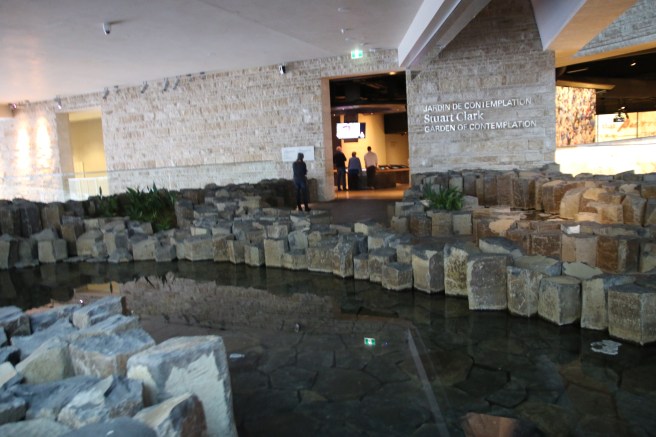
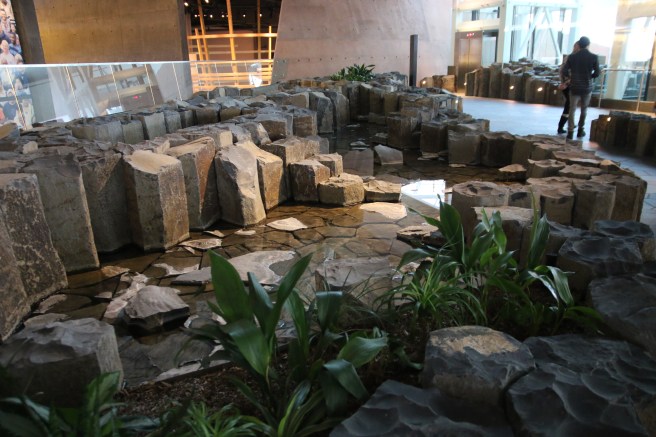
It also has a garden of contemplation in the middle. The rocks are basalt imported from overseas. Basalt was chosen as it is one of the types of stone that are found on all continents on earth.

2jane

2janf

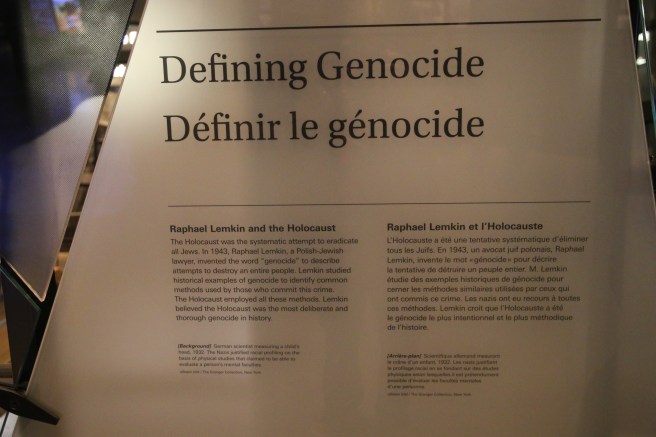
The level 4 gallery has a range of topics including “Examining the Holocaust” and relates to the build up of issues from the end of WWI through to WWII but has terrible stories of what occurred to Polish, Jewish and other groups over this time; “Turning Points for Humanity” which is based around the 1948 Universal Declaration of Human Rights and peoples working tirelessly to convert this into reality; “Breaking the Silence” which is around people speaking out about mass atrocities, and has a special set of digital study tables and other resources around Genocides; and “Actions Count”, being low key and not so low key action taken by various members of the communities to push back against human rights.

An example in Canada is “Pink Shirt Day” which occurs annually to commemorate a day when a year 9 student was bullied and called gay by other students in Nova Scotia for wearing a pink shirt to school. Two year 12 boys found out and bought 75 pink tshirts which they lined up with their friends to wear and hand out at school the next day in support of the younger student.

2jang

2janh

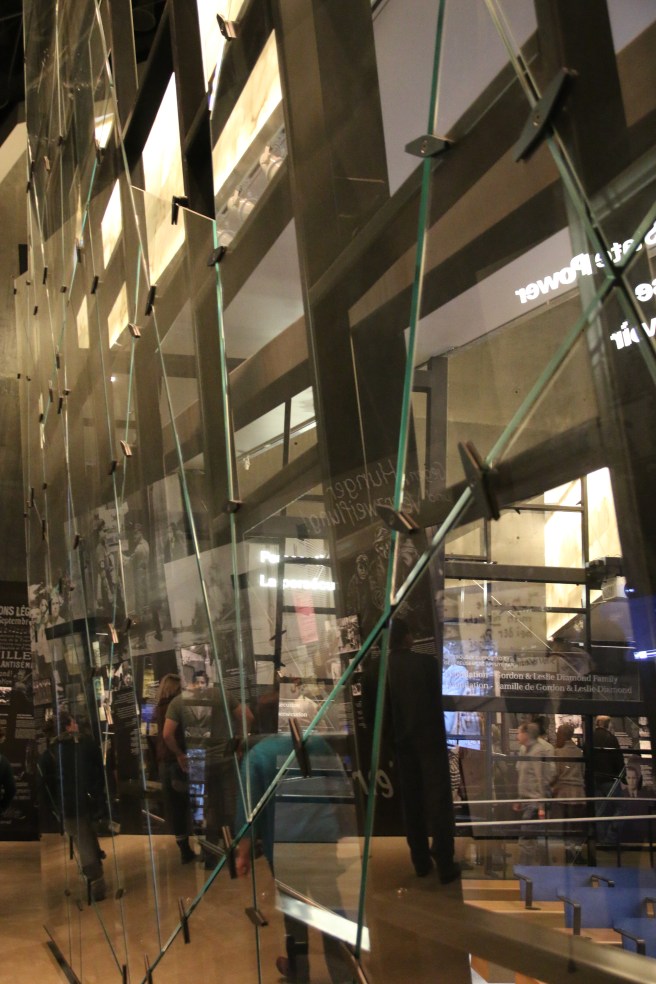
The photo of glass panels represents a wall of broken glass, which is based on Kristallnacht, or “the Night of Broken Glass” on the nights of 9-10 November 1938 when paramilitary forces and German civilians launched a pogrom against Jews by ransacking Jewish homes, hospitals and schools, which included the deaths of 91+ Jews and tens of thousands of males being incarcerated.

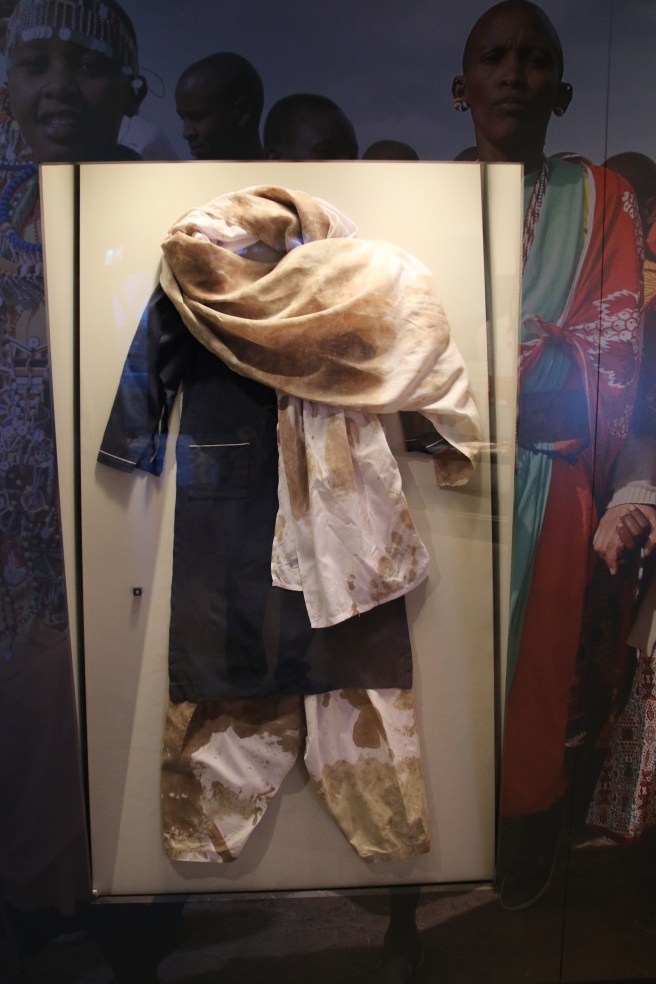
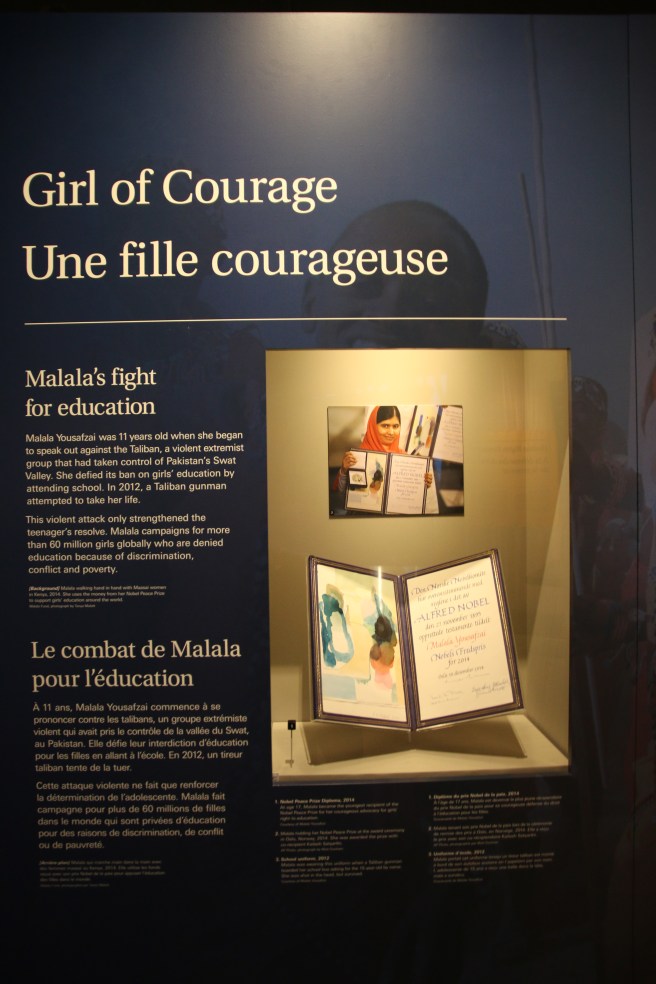
The level 5 gallery covers “Rights Today” and again uses multiple audio-visual as well as models and samples of different materials etc. to look into current issues in human rights internationally. One of the displays was of Malala Yousafzia, the girl from Pakistan who pushes for education for girls around the world. The display shows her Nobel Peace Prize as well as the dress she was wearing as a schoolgirl when she was shot by the Taliban.

2jani

2janj

The level 6 gallery, the second of the temporary exhibition spaces, had an exhibition entitled “Empowering Women”. This provides some of the work and connections from a range of women across Asia, Africa, and the Americas including creating grassroots cooperatives and how these have been transforming their communities. There are video as well as Virtual Reality headsets that display different women’s groups achievements. The VR headsets had to be booked as they were quite popular. I unfortunately didn’t have the time to wait for them but I did watch the video with headphones. The stories showed how strong the women of these communities were to continue on and develop these cooperatives, including at times when their husbands and sons had been murdered by guerrillas and other killers.

The visit was fascinating, and after 3 hours I had still only scratched the surface of what was available. However they were closing so I got kicked out. I then headed back to the hotel for dinner, a shower, and some 24 hour news and a current affair channel hopping. That was exciting.

January 1, 2017 (Sunday)

HAPPY NEW YEAR!!

Today was totally on the train. I’m really enjoying this single compartment. It is relatively small. It has a lounge chair on one side and a sink and toilet, with as wooden and vinyl seat that goes over the toilet when not in use, on the other side. And behind the lounge chair is the pull-down bed. The room also has shelves and a locker style safe up high for storage and access at night.

I had breakfast, then had a shower and converted the bed back into the lounge chair.  Then read a little and then had lunch in the dining car, and spent a little time sitting in the dome car as well, talking with some of the other travellers as well as taking some photos.

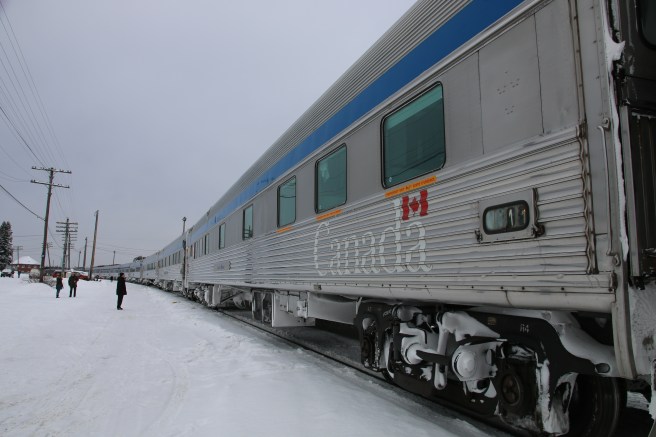
We also got to stop at a town called Hornepayne for a half hour. The drivers had to change over and waste remove and new supplied brought on board. One of the passengers brought out his Phantom drone and got some good footage. I took some photos of the engines as they are out of bounds at all of the stations.

1jana

1janb

I then read a magazine (Newsweek) in my compartment and set the bed back up and lay on it and listened to an audiobook of a Tom Clancy novel (Executive Orders). I was still relatively full by the time dinner came along so I didn’t go to that. So at about 9pm it was normal bedtime so I shut down the book and got to sleep by around 11pm.

December 31, 2016 (Saturday)

Today after breakfast I packed my bags as I was heading off.

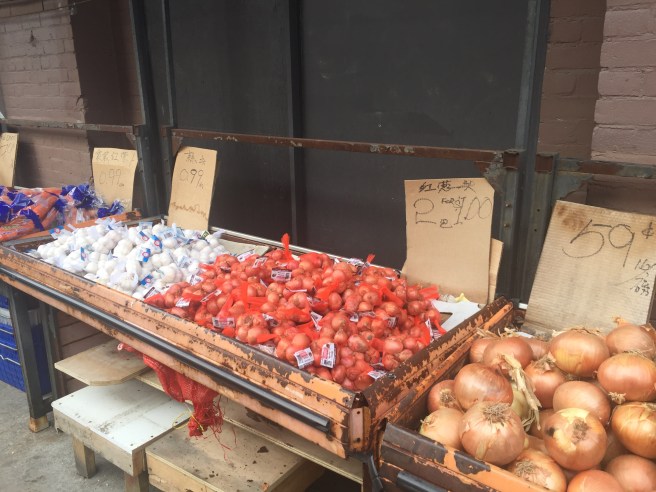
I then went for a walk around Toronto city. First I went to the biggest of the 6 Chinatowns in Toronto.

31deca

The fruit and vegetables look very reasonably priced, at least compared to Karratha ($1 Canadian is worth $1.03 Australian).

31decb

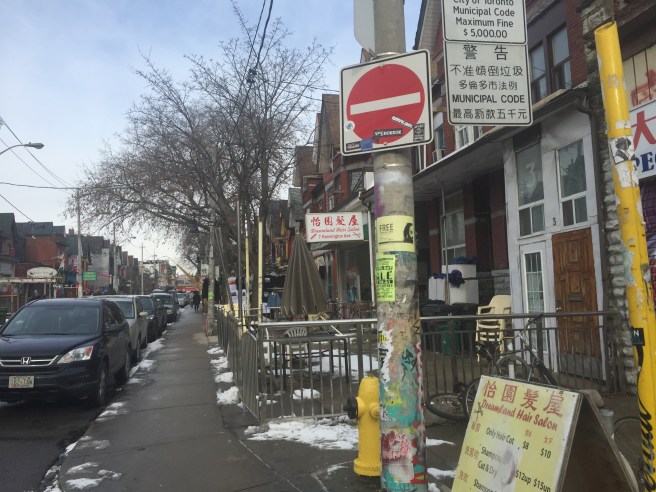
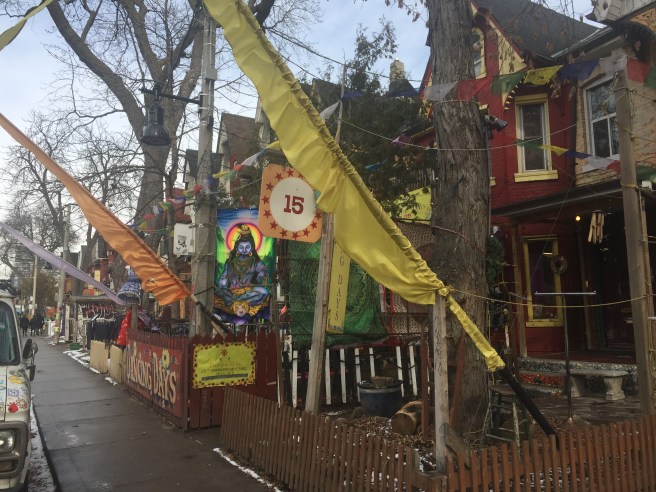
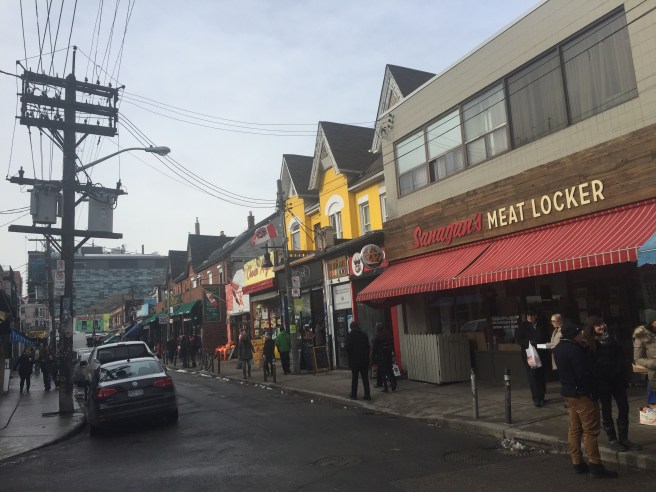
I then headed over to Kensington Marketplace. It was interesting to see the architecture and the variety of front gardens of housing properties that have been turned into “shops” for selling all range of goods.

31decc

31decd

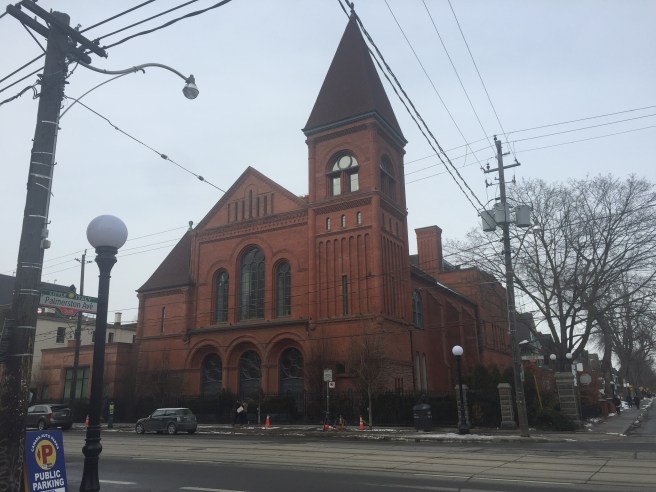
I then walked over to Little Italy, and like I had read, there is no longer a real Italian vibe to the area. There are, however, a large number of cafes and other similar shops. Also a range of different churches in that area.

31dece

31decf

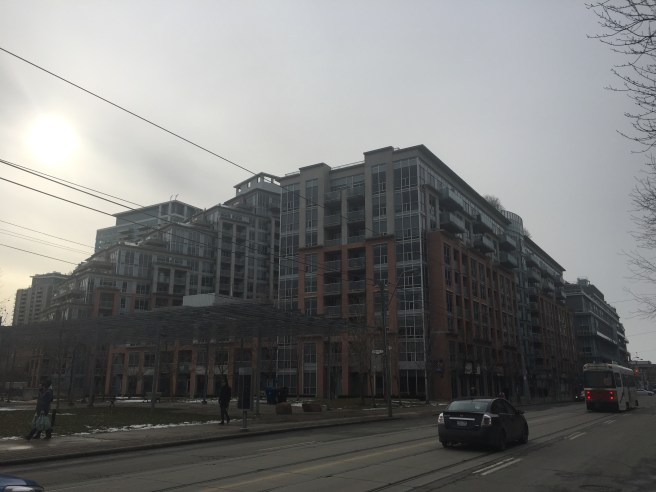
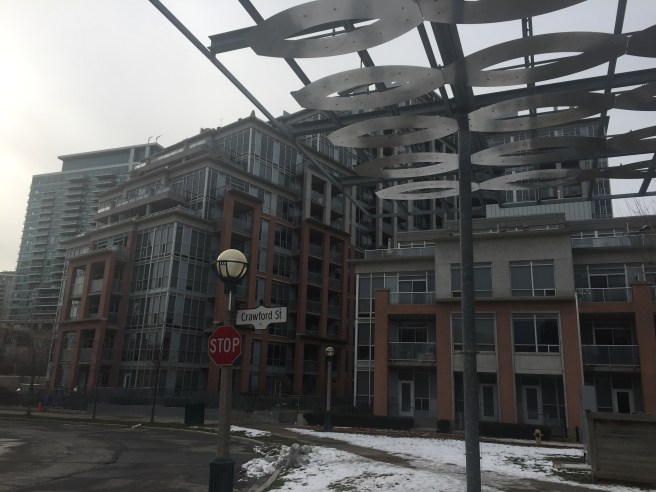
After this, I headed down to Liberty Village. This is an area that is located in one of Toronto’s oldest areas, having been developed in the late 1700s. However it has a large number of new condominium blocks through it, built in the last decade or so.

31decg

31dech

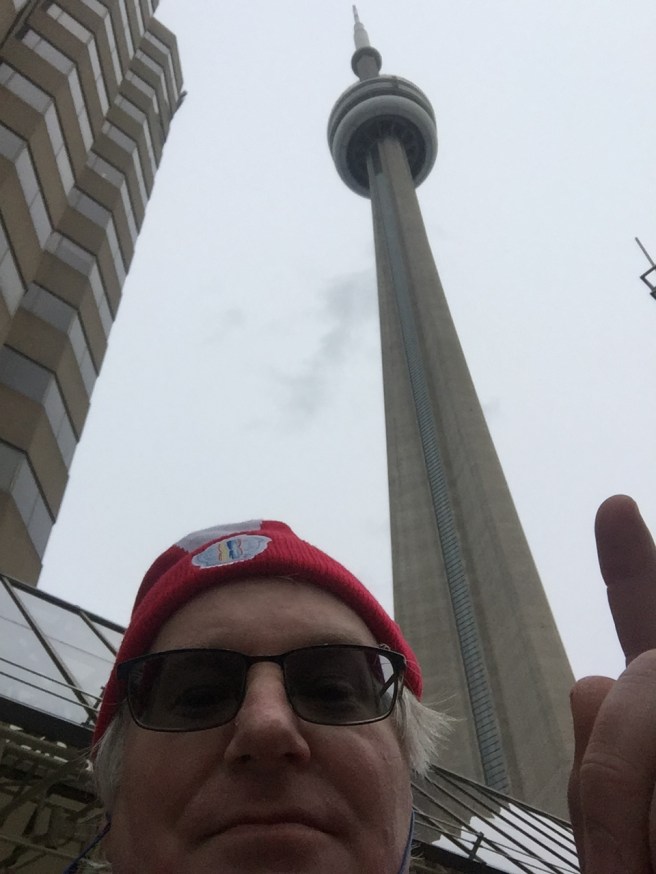
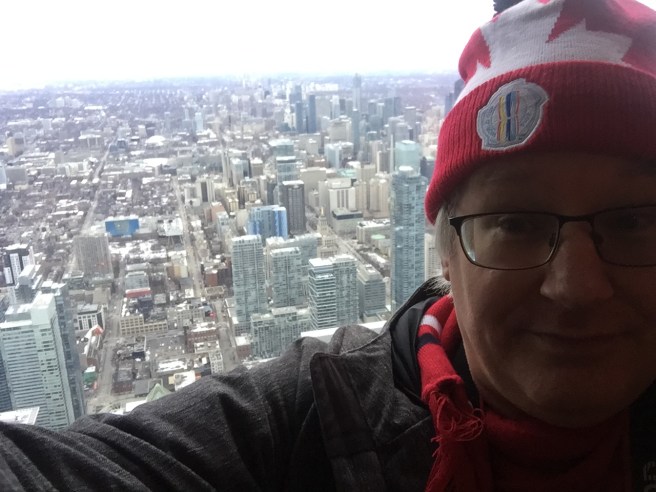
I then decided on my walk back to the hotel from the other side of town, to head into the CN Tower and take a ride in its lift up to the viewing station near the top. I took a selfie before going in.

31deci

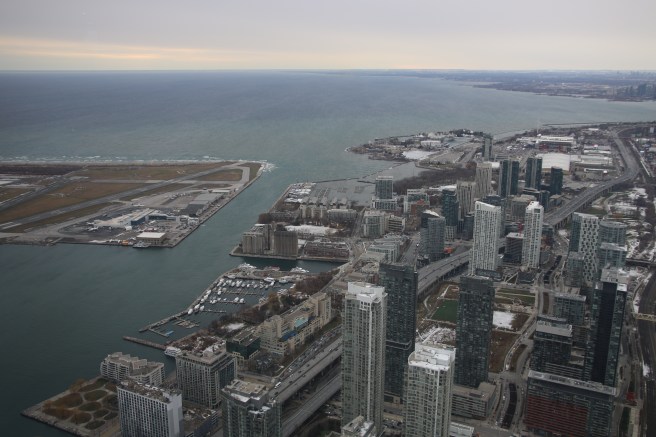
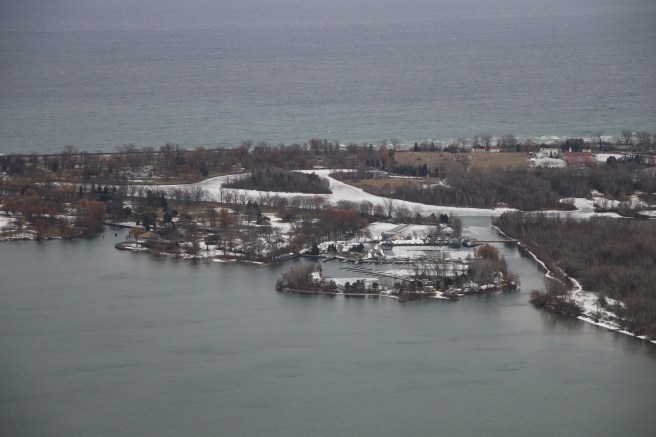
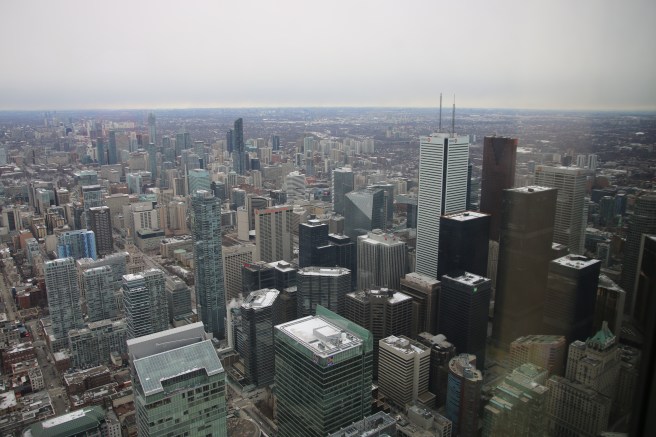
Once inside, the lift took 57 seconds to get from the ground floor to the viewing station. Here are a few photos, including one of the islands across the water (where I had taken the ferry previously for photos of the city). The CN Tower was initially only being built to be an aerial to solve the telecommunications issues with the rapidly growing city. However as development started, it was thought beneficial to build in a restaurant and other options to attract tourists. In 1995, it was made one of the 7 Wonders of the Modern World.

31decj

31deck

31decl

31decm

After exiting the CN Tower, I walked back to the hotel, picked up my bags at 4pm and headed to Union Station Toronto. As I had booked a single sleeper compartment, I was allowed to sit in the Via Rail Business Lounge whilst awaiting my train to leave at 10pm. I got to read a couple of business magazines with free coffee, soft drink and most importantly, hot chocolate. I also watched some of the New Year’s Eve fireworks displays from around the world, including from Sydney. The train left at just over 10pm. The train was to take 33 hours, to arrive in Winnipeg at 8am on 2nd January 2017.

December 29, 2016 (Thursday)

Today is Niagara Falls Day. I was picked up by the small bus at 9.15am and dropped off to get onto the full size coach. Which was full, so my camera gear went in the luggage compartment under the coach.

Then we headed off on the two hour drive to the Falls. The driver, Alex, advised that we would be visiting a wine school (the only one in Canada) for some wine tasting, then head off to Niagara Falls, and then visit a village called Niagara on the Lake on the return trip.

On the way, Alex talked about some of the history of Toronto as well as the falls.

Some of the information about Toronto he gave:

  • Toronto is pronounced Toronno
  • 13% of the population is chnese
  • 55% of the population is not from Canada
  • The current birthing rate to Toronto residents is 1.3, only half of that in New York, and so they need to accept immigrants just to keep things running
  • Since 2004, housing prices have gone up by over 10% per year
  • There is a section of apartments (called condominiums in Canada) just south of the city that was fields in 2004; it now has a significant number of condo apartment towers
  • But as is happening in Australia, these are not full of people, 11,000 of them are owned by foreigners, many not resided in so the government is looking at options for them as they have increased prices of properties but are not adding to the economy (sounds like Australia and other countries where the middle class Chinese are investing)
  • The average cost of a house in Toronto is just under $1m
  • 280,000 immigrants entered Canada last year
  • Toronto has 6 chinatowns, 3 little Indians and these areas continue to expand
  • Toronto has minimal public transport outside the city centre
  • It is very expensive to live in Toronto or Montreal, although Quebec City is cheaper
  • Millions of Canadians spend Christmas and the New Year with their family, and then head off to Florida for winter

Relating to Niagara Falls and waterways

  • The 5 great lakes in USA / Canada hold 22% of the world’s fresh water
  • Canada has 3 million fresh water lakes, mainly in the north where there are few people but plenty of land
  • The escarpment from which the water flows to Niagara is 2000 kilometres long and is 400 million years old
  • The falls at full strength can flow at the rate of 6100 cubic metres per second
  • It flows at an average of 2400 cubic metres per second because of the number of pipes taking the water out above the Falls to generate electricity (75% of the water is piped off). Ontario gets 65% of its power from nuclear, and 25% from hydro stations.
  • The power station is 11 kilometres downstream from the Falls with the water travelling downwards for the first 10 km and uphill for the last 1km, using the pressure from the downflow to push the water up the last 1km
  • 80% of the tourists visit in the period of May to September, 20% in the remainder of the 7 months

We reached the wine school and went into their shop to sample 3 types of wines. The first I had was an unoaked chardonnay, the second a rose, and the third was an ice wine. They were all very tasty. The wine school was opened around 6 years ago by Prince Charles. It is the only wine school in Canada. The wines are reasonably priced compared to normal wineries and shop wine due to them using unpaid students to do much of the work. They have two courses, a 2 year course on the winemaking side, which can then be followed up by a course on the business side of winemaking. They accepted 20 students in 2016, out of 2000 who applied.

Co-located on the same (very large) site is also a microbrewery school (which took 40 students in 2016 out of 6000 applications, and a horticulture school.

After our sampling, we headed back to the coach and got into the bus for the 20 minute ride to the Niagara Falls. It turns out that there were two Falls, and American side and a Canadian side. The well known horseshoe Falls are the Canadian Falls. There is also a less popular “straight” waterfall that are the “American Falls”. These being held by the Canadians versus the Americans are an outcome of the war of 1812 (which lasted between 1812 and 1815) between the Americans and the British and its North American colonies.

The basis of the war was pretty complex, with the outcome at the end being that when the land got divided up at the end, Canada as a British colony got the horseshoe falls and the Americans got the other. 95% of tourists come to the Canadian side (where you can see both sets of Falls – the American one is less than a kilometre from the other) rather than the American side where you can only see part of the horseshoe falls.

So we reached the famed Niagara Falls and were given 2 hours and 20 minutes to do what we wanted before being collected by Alex in the coach.

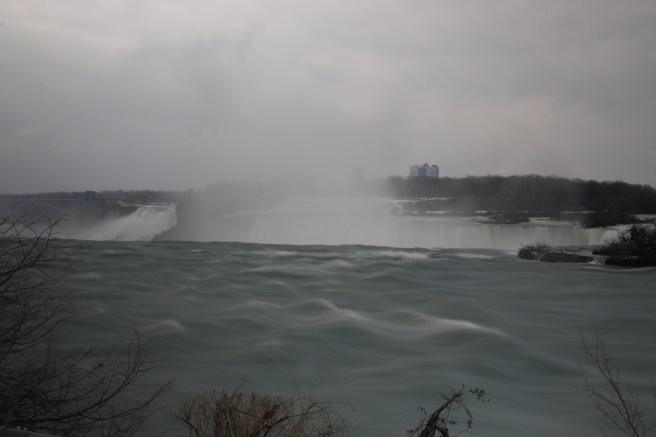
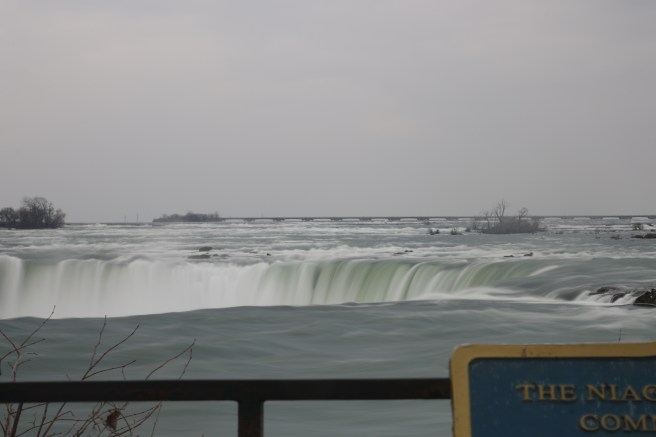
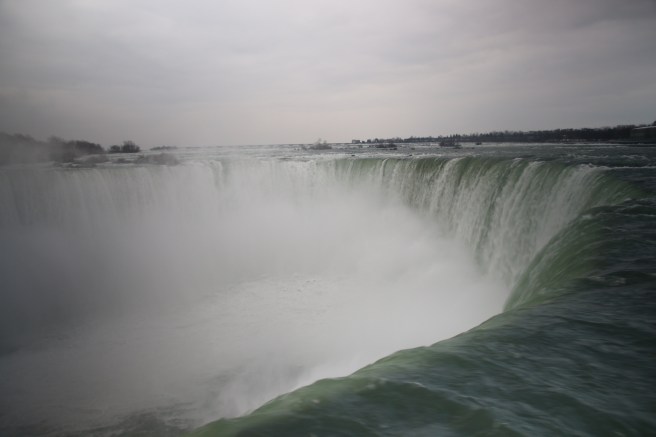
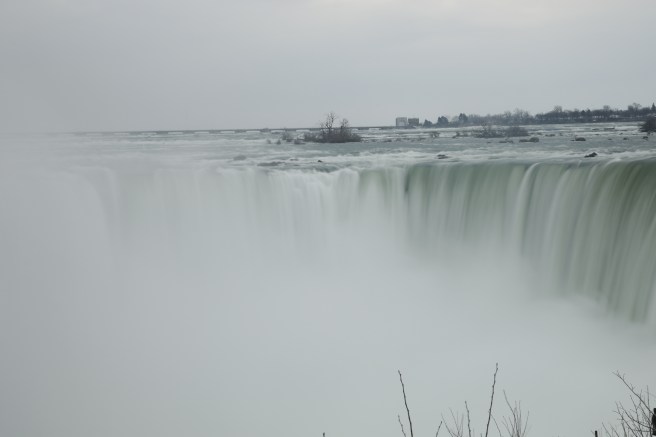
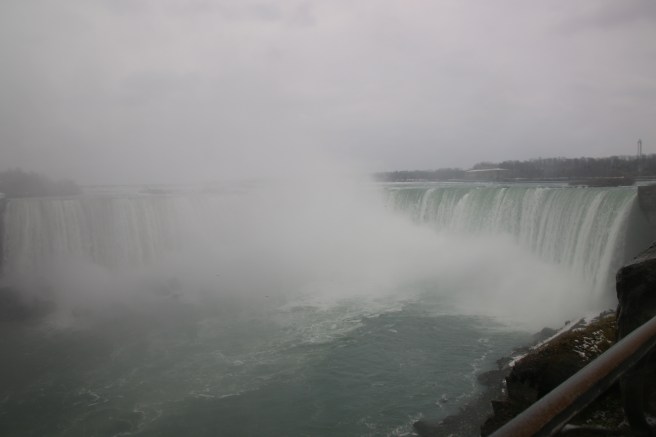
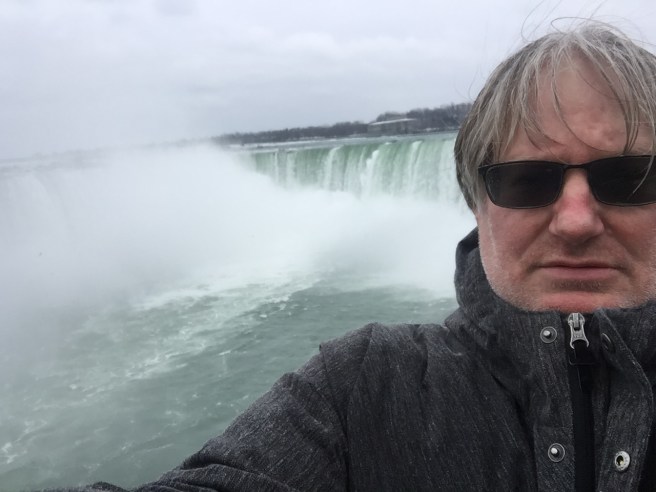
I took off and managed a series of photos over the next two hours, at different speeds and aperture settings. The first few were from the river at the back of the Horseshoe Falls, then from the side, and finally from the front. I also took a few of the American Falls and the bridge next to it. The mist covering the centre of the Niagara Falls themselves was marginally disappointing as it would have been nice to see the whole waterfall without it, but that’s what waterfalls do. It was great to visit the Falls after seeing so much about them as a kid. I even took a half dozen selfies (mostly in the rain). Also, what looks like a long narrow bridge right to the back of the river above the Falls, is not a bridge. It is actually the “control tower” which moves up and down, pushing water into the 13 tunnels.

29deca

29decb

29decc

29decd

29dece

29decf

29decg

On the way from the Niagara Falls, we stopped off at a corner of the river below the Falls, and looked across at Lewiston, New York State. Alex gave us the story of when, during the 1812 war, the Americans over on the New York State side (they had 4500 troops) launched an attack on the Canadians (they had 200 troops). The Americans were confident that they would overpower the Canadians due to their significant mismatch in numbers. However, they only had 13 rowboats. And someone forgot to check the water speed. So when they put their rowboats into the water, the boats and troops sped quickly down to the water given the water pressure. So the Canadians won because the Americans had lost their boats and couldn’t get across the water. We then hopped back into the coach and headed to Niagara on the Lake.

We then reached Niagara on the Lake. This is a quaint little village on Lake Ontario that tourists visit for icecream, chocolate and festivals (I bought the first two). The properties in Niagara itself are worth around $200K, those in Niagara on the Lake are worth around $850K. The houses aren’t very old, they are built in the style to look like they were built decades ago with gables etc., rather than the straight-line generic style of houses presently built in other places.

29decj

29deck

29decl

We had 40 minutes to wander through the village, I also headed down to the waterfront for 10 minutes to see Lake Ontario.

29dech

29deci

I then traipsed back to the coach, hopped on and we took the drive back to Toronto. I was dropped off a couple of streets from my hotel, and then got back there, unpacked and left all my wet gear out to dry overnight. I then jumped into bed.

December 28, 2016 (Wednesday)

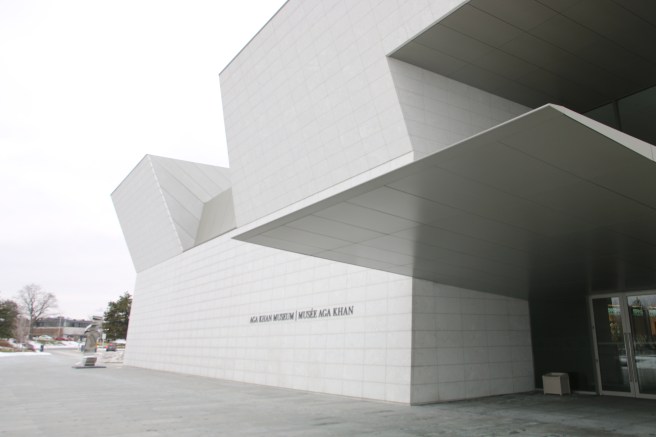
This morning I headed off to the Aga Khan Museum. It took one tram followed by a bus, and one hour, to get there.

28deca

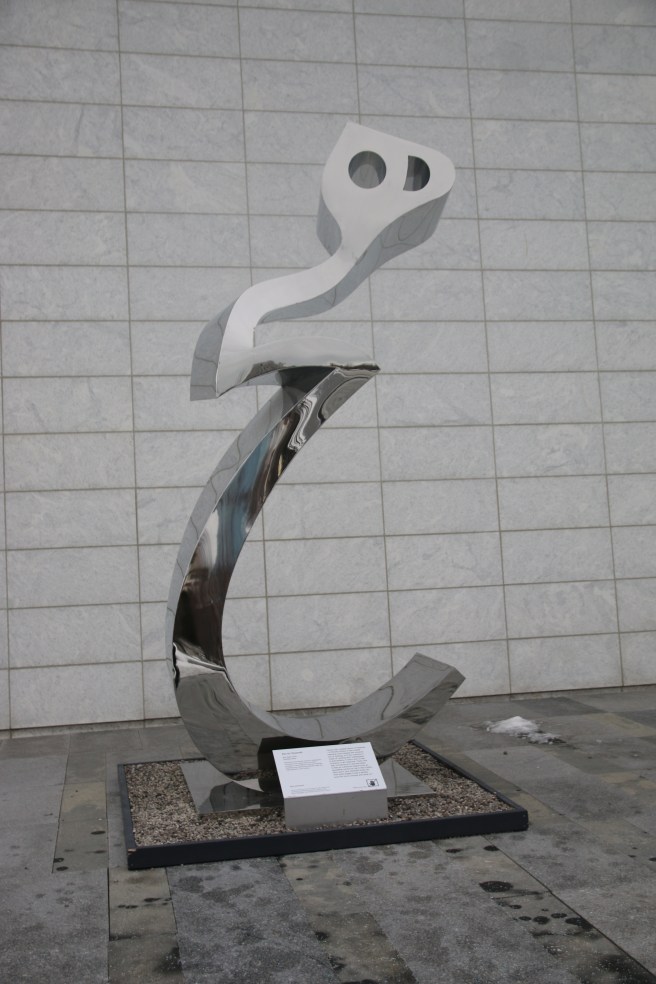
The sculpture outside is called “Big Heech” and was created in 2014 by Parviz Tanavoli. The artist states: “Heech has multiple layers of meaning – in Persian Sufism it has a great meaning: God created the universe out of nothing, so if the universe is made of nothing then nothingness is everywhere, in every part of the universe, in all creatures. That’s one way of looking at it, and the other is that as a physical shape it has an appealing volume to me; it has a head, eyes and a very beautiful body. So from both angles it was a perfect word for me to choose and work on”.

28decb

The museum is made up of three main exhibit spaces, as well as a shop, café, education centre, restaurant, patrons lounge, and auditorium. The exhibits at the museum display various artworks and artifacts from various periods based mainly around the middle east, and how they have changed over time.

The one on the first (ground) floor is the permanent exhibit. The two on the second floor are temporary exhibitions.

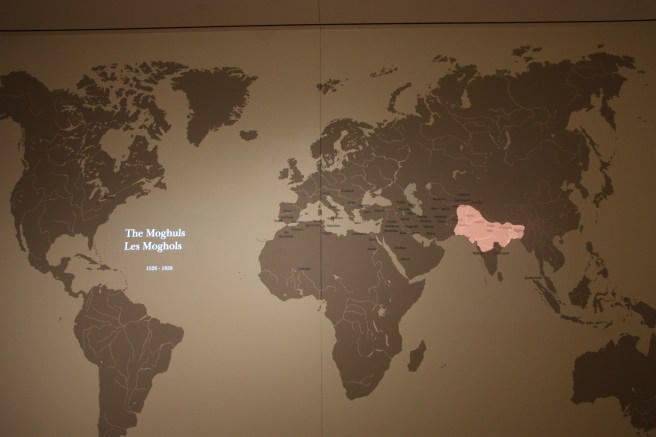
On one wall, the permanent exhibit shows a map of the world, with timed overlays of different periods over the centuries.

28decc

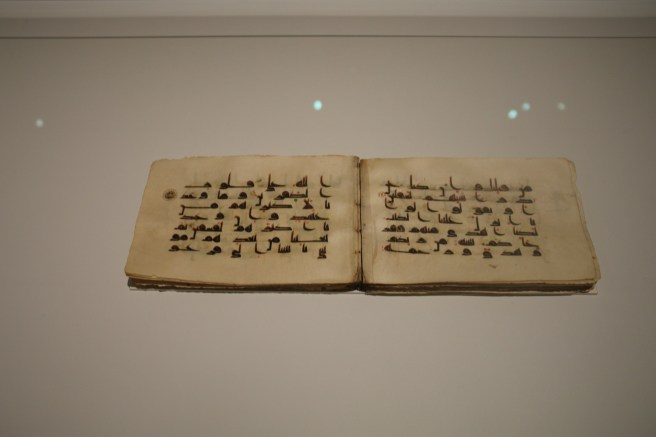
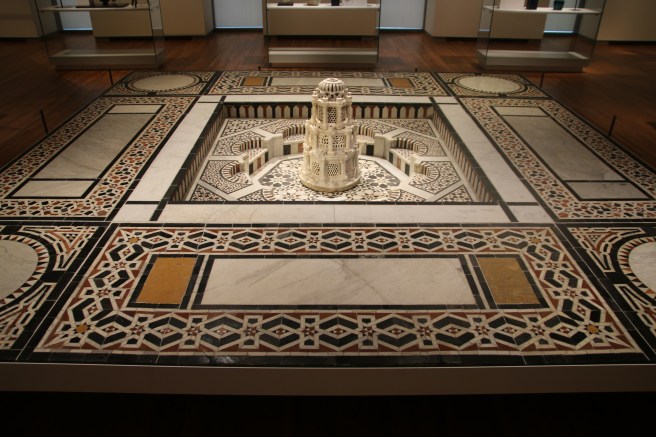
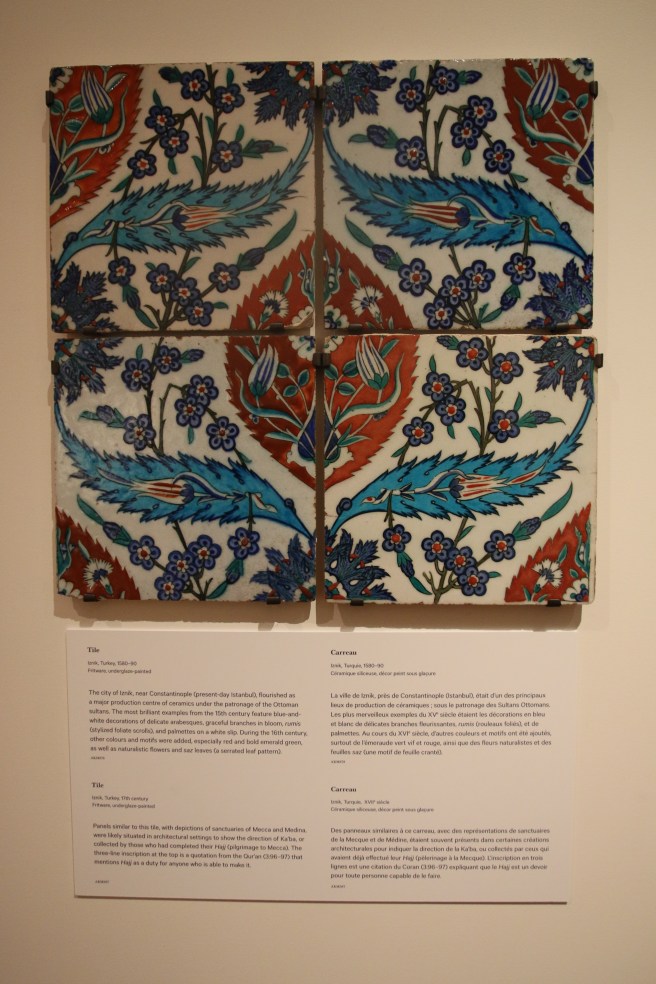
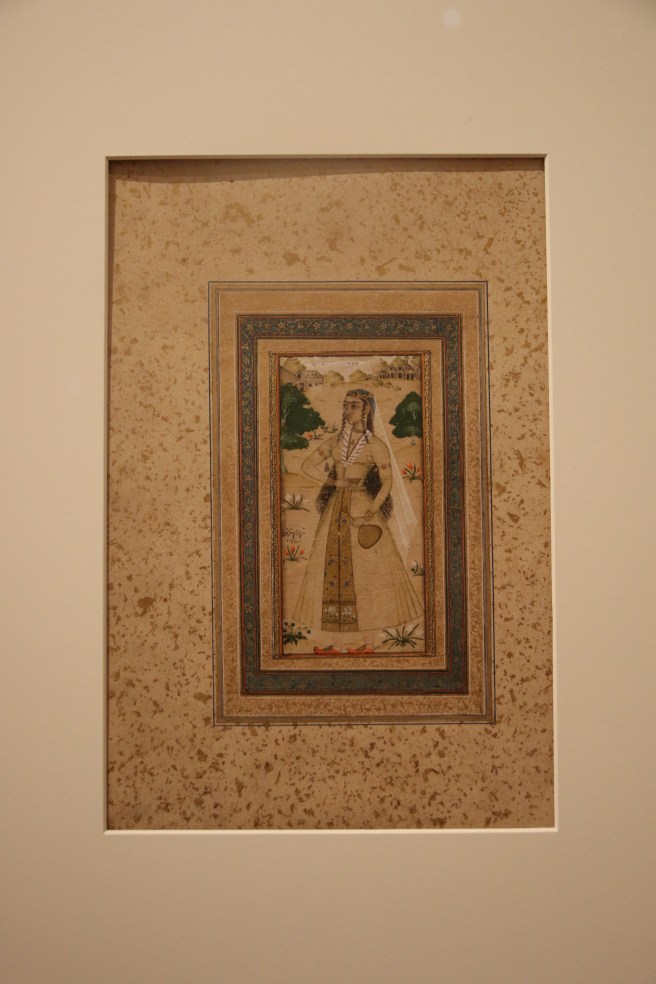
As I walked through there were various exhibits in glass cases or on the floor. The below photos show (a) a copy of the Qu’ran from 9th to 11th century, (b) a Fountain – marble and sandstone mosaic from Syria – 16th century and later (the fountain is original), (c) Tiles – from Iznik, Turkey 17th Century design, and (d) a painted drawing for a book – “Young woman in Indian dress” signed “Shaykh Abbasi” from Isfahan, Iran dated 1683.

28decd

28dece

28decf

28decg

There were also small storyboards for different countries and eras, discussing the various artistics / architecture, books, textiles, and so on occurring in those different ages, including the cross-pollination of different art styles etc. and how they travelled through different countries and cultures.

After finishing in that area, I put my camera away and headed to the two upstairs exhibits (no photography was allowed).

The first exhibit I went into was entitled “Syria – A Living History”. The display held 5000 years of artifacts. It talked about the Tale of the Deluge from 5000 years ago, told in the first Epic of Gilgamesh. It was this flood that Noah was added to later in the Qu’ran and the Bible.

The history of Syria talked about it first being Aram, the land of Aramaeans. And how it developed over time, being on the major trade routes (Incense Road, Persian Royal Road, and the Silk Road), which then led to the development of different cultures, as well as the different battles that occurred over time.

The displays included various buildings shown as they would have looked over time, as well as a tablet display (which was picked up and walked around in a set space, viewing what the room in Aleppo looked like with different rugs and paintings of stories from the Old and New Testaments. There were many different artefacts on display. The main lessons from the displays were around the intercultural impact of art, bringing different styles through trading and the changing peoples and multiple religions in different countries over different time periods.

The second display related to the Alhambra (The Red Castle) palace and fortress in Granada, Spain. The initial portion was originally constructed in the 9th Century as a small fortress, and was then renovated and expanded in the 13th Century in the Moorish architecture style. It then has a long history of being utilised by different rulers, who added to the site over time, until today when it is a major tourist attraction. There is a scale model of the site and the buildings, and would be one of the most popular tourist attractions in Spain.

In 2010, Alvaro Siza and Juan Domingo Santos were successful in an international competition to design a “New Gate of Alhambra”. Siza had visited Alhambra in 2009 and created various journal entries around his imagining of the design. The first part of the display gave the history from 300AD to the present, with the second half being around Siza’s ideas, musings and designs, with design maps, sketches, 3D models etc. It was quite fascinating to see design take shape from the very first ideas, through to scale models of the finished product, and a few books Siza has written.

After this, I headed back to the bus stop to take my reverse journey back to the hotel. The Aga Khan Museum is really worth the time to visit for anybody interested in history and art or archaeology.

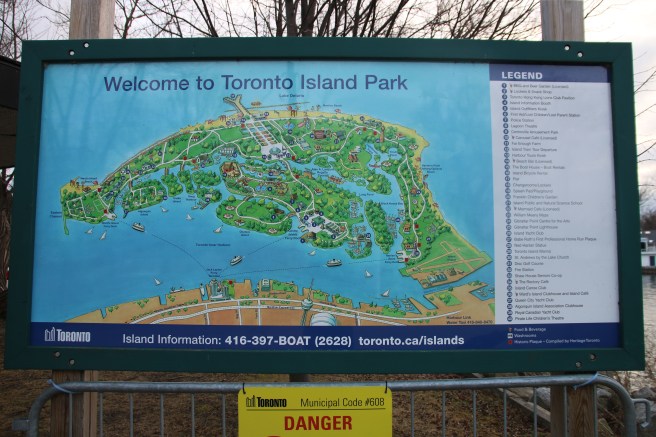
After a short rest I rugged up, grabbed my camera kit and headed off to the ferry terminal. After waiting a while, I caught a ferry across the river to Wards’ Island. Toronto has a few islands which together are called the Toronto Island Park, with ferries going to three of them. Only one, the one to Wards’ Island, is open in winter. It’s part of their National Park but people live on it.

28dech

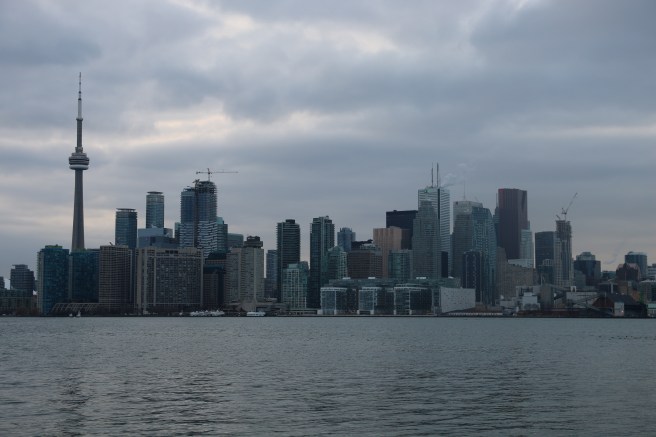
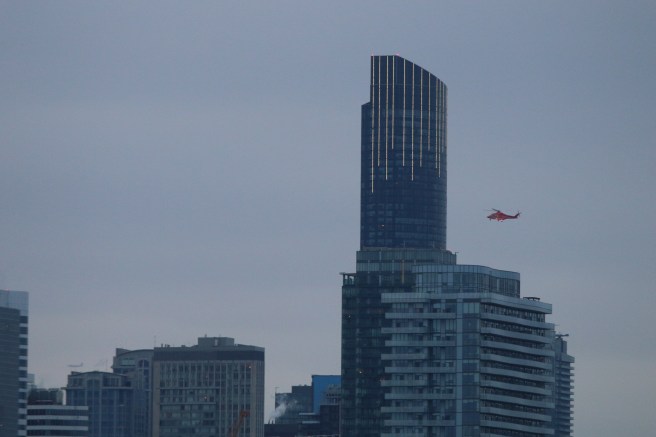
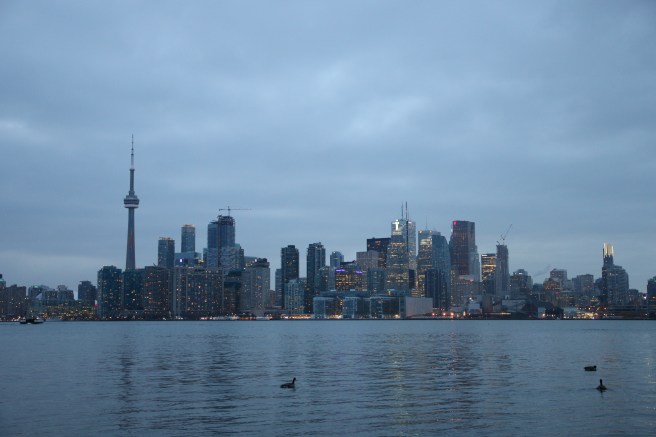
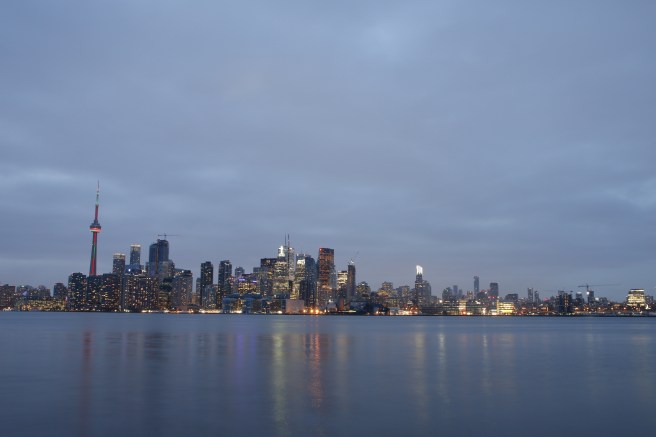
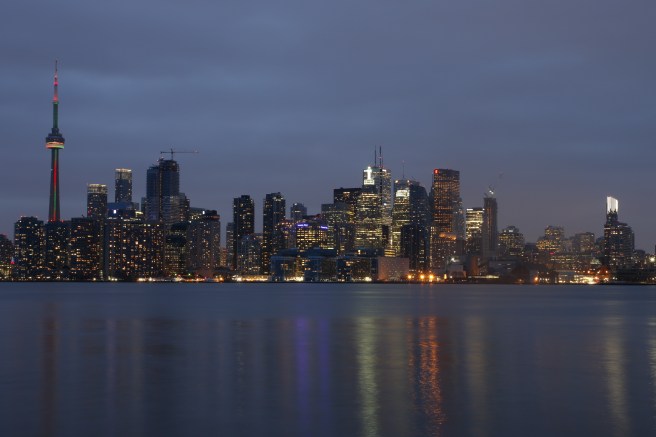
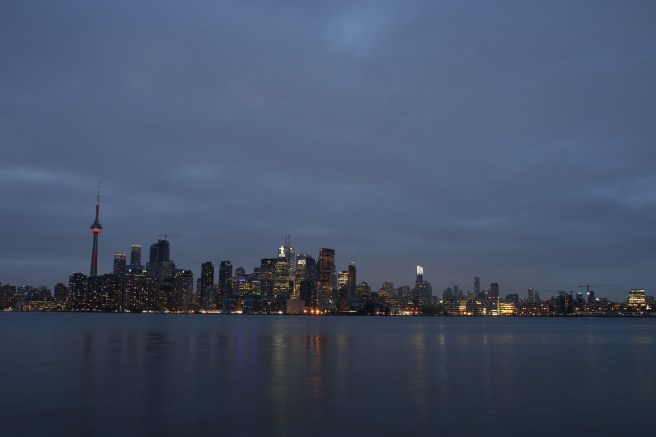
The islands have beaches, a massive fun park (closed in winter along with most forms of tourism entertainment) and bridges interlinking the various islands. The reason I took the ferry across was to take some photos of Toronto City as the sun went down. I gathered a range of shots with different times and apertures as well as some to stitch together later (hopefully). I really enjoyed watching the sun go down and the lights as they came on. There were also a few planes getting into some of the shots due to the Toronto airport being on the Eastern side of the Islands, to my left as I looked back – as well as a helicopter coming into land in the city. Herewith a few of my efforts.

28deci

28decj

28deck

28decl

28decm

28decn

28deco

By 5.40pm I had all the shots I wanted so I wandered back and caught the 6pm return ferry. On the walk back to my hotel, I wandered past the ice rink and tried to take some photos, but there were so many people on the ice that there was less movement in the shots than just large blobs of dark colours.

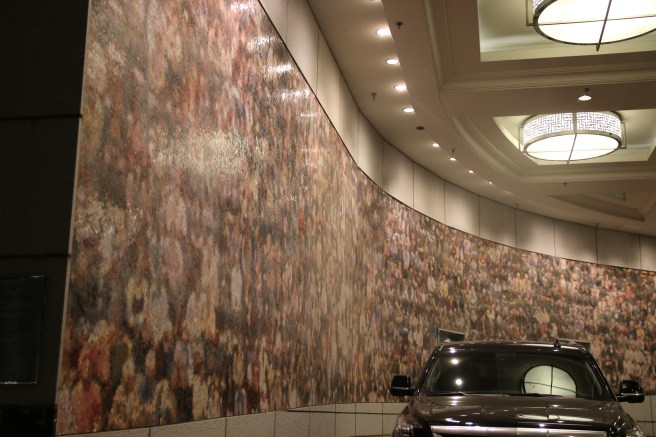
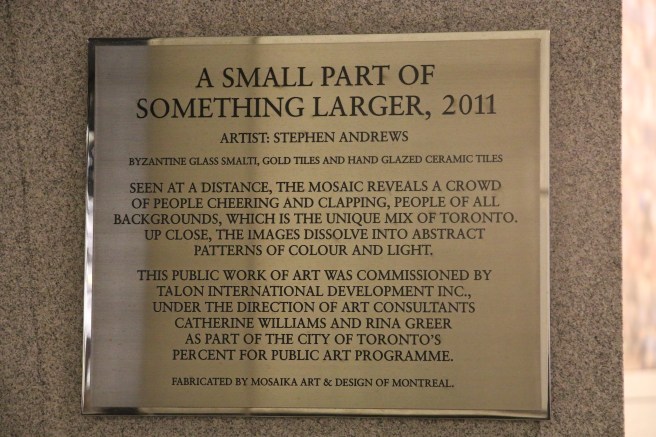
So I headed back to Trump International Hotel and took a photo of the mosaic I mentioned a few days ago, as well as the plaque from the artist. It’s a really well put together mosaic.

28decp

28decq

After that, I headed back to my hotel.

December 27, 2016 (Tuesday)

Today was a pretty busy day.

I headed to the Dundas East mall to obtain my hop on hop off city sightseeing bus ticket and then hopped onto the bus. Today I planned to visit an old castle / mansion, museum and an art gallery, and with the distances, the hop on hop off bus seemed the best way to get around.

The first stop was Casa Loma. There was quite a queue to get inside. As I waited outside in the cold and wind, I thought that this was surprising for an old castle. However when I got inside I saw they had lots of Christmas events and displays for children, so I could see why parents would take their kids.
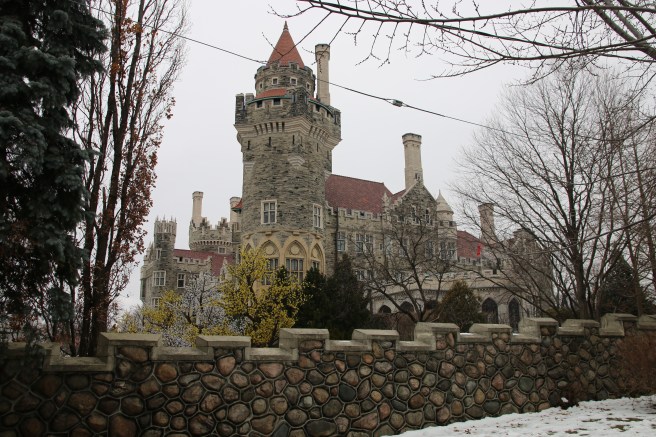
27deca

Casa Loma (meaning Hill House – and known in Toronto as “the Castle on the Hill”) was built in the period 1911-14 in what it calls a “Gothic Revival” style. It sits around 150 metres above sea level. The main and second floor serve as a museum to the property itself, and its uses over time; with the third (top) floor now the museum of The Queen’s Own Rifles of Canada. Note: In Canada, the ground floor is called the first or main floor, and the one above it is the second floor, unlike back home where the first floor is the one above the ground floor. The builder of the property, financier Sir Henry Pellatt (he was knighted in 1905), had been a rifleman in the Queens Own Rifles, joining in 1876 at the age of 17 and rising to the Commanding Officer role. During the owners time in the property, it was used for many grand occasions for the city.

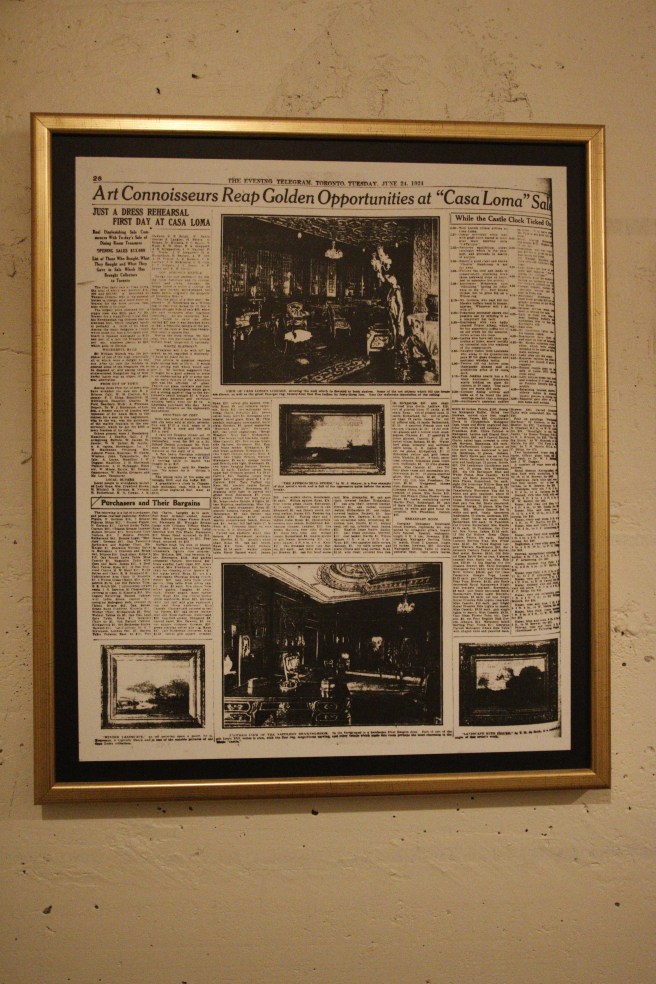
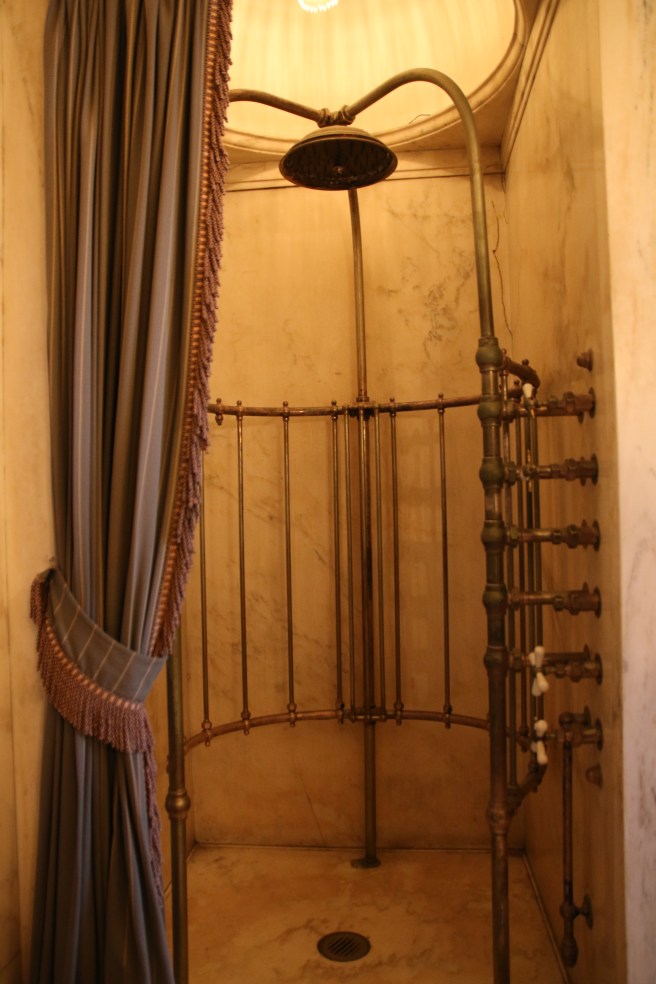
The owner had a huge sale of property after the First World War due to the increased rates and taxes being charged, and the rest of the cost of living at that time. This allowed him to remain in the property for a little under 10 years before he had to move out. It then went through various hands and for various roles, including for research during World War 2. It underwent a significant decade and a half renovation until 2012 and, as had occurred on and off since the late 1920s, became the tourist destination that it now remains. I’ve included some photos below, including of the newspaper article regarding the sale, and a picture of the male owner’s shower (he and his wife had separate bedrooms, bathrooms and offices). The shower cubicle had six separate taps for the different faucets.
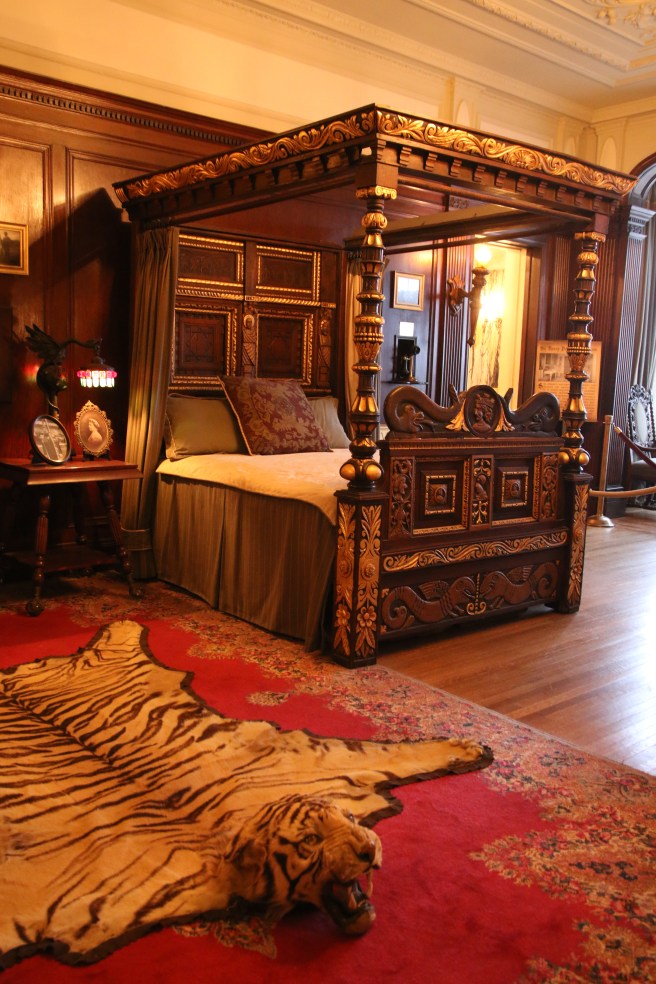
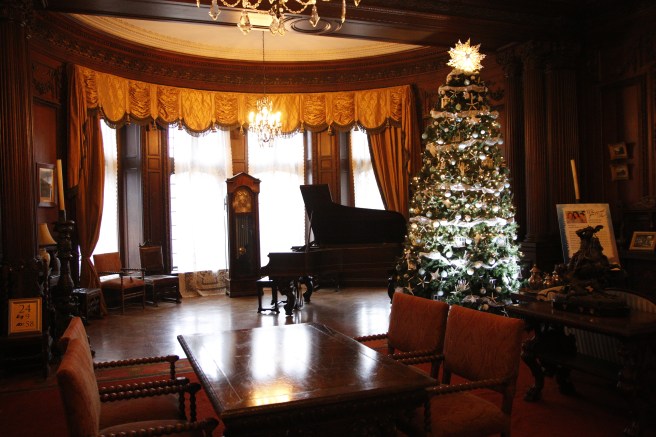
27decb

27decc

27decd

27dece

After viewing the property throughout and heading up the narrow stairs to the spires, I headed back to the bus stop to await the next hop on hop off bus. I alighted at the Royal Ontario Museum (known as ROM). It was obvious that I had chosen a day when most of Toronto wanted to head out and see the sights, because the queue here was quite long. It took about 25 minutes to get my ticket. Herewith the entrance to the ROM.
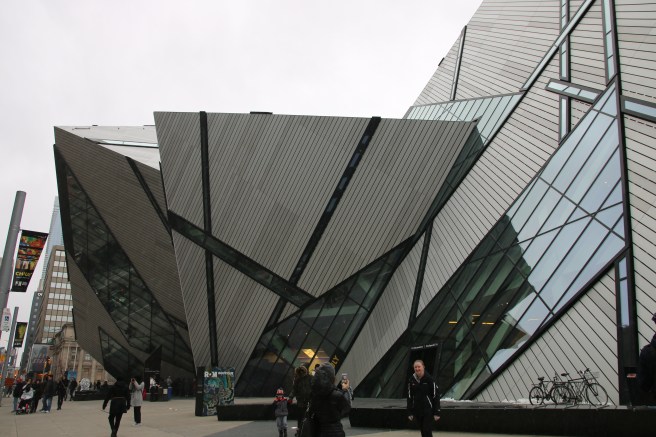
27decf

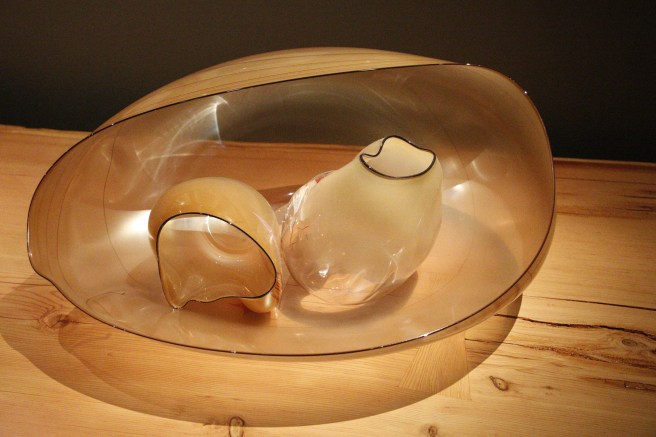
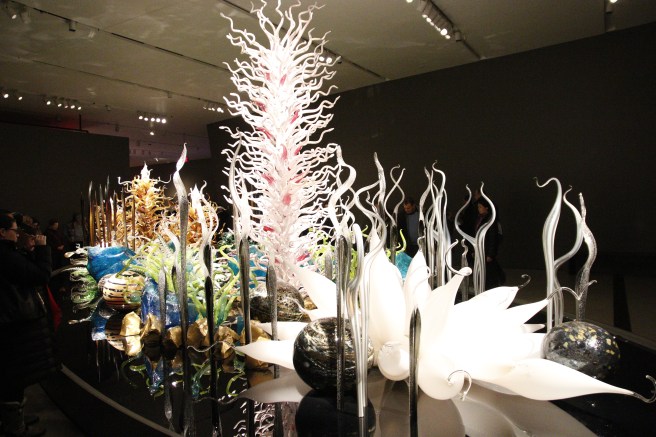
The number one exhibition at the museum was the Chihuly display. Dale Chihuly is an American glassblower and sculptor. The exhibition explores the life, work and global impact of Mr Chihuly. In the late 1970s he experienced first a car accident which left him blind in one eye, and then later a bodysurfing accident which left him unable to hold a glass blowing pipe. So he then became more of a producer / entrepreneur who was able to step back and design the sculptures and installations, whilst using others as glassblowers to make the various items. The colours and complexity of he and his team’s various works are particularly stunning to see first hand. Given half the population of Toronto was in the same room as me, and the other half was outside trying to get in, I sadly had no chance to use my tripod to take really good timed shots of the works. They were so much more full of life than I have been able to capture.

The first sculpture below is called Laguna Torcello, dated 2012. Mr Chihuly wrote that whilst his works look like they come from nature, he doesn’t see specific images and set out to make them.
27decg

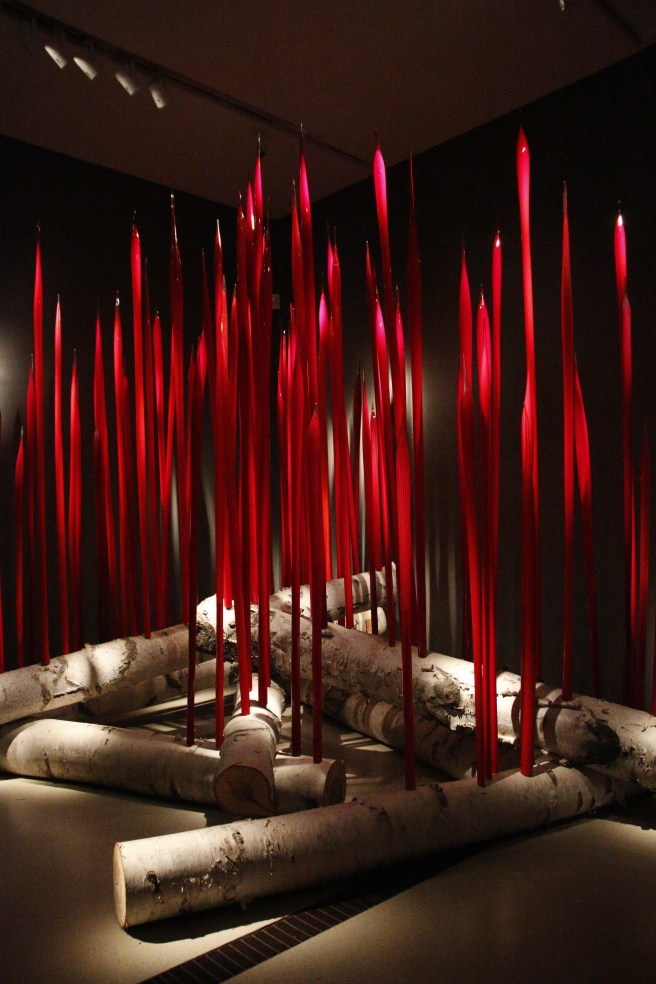
I’ve tried different camera settings to get close to the best shots without people in front and trying to reflect close to the colour of the glass items, which means the surrounds may be darker or lighter than it really was. For example, of the first of these next series (Sapphire Neon Tumbleweeds, 2016), if the surrounds were any lighter, then the light tubes would turn out white. However I think these settle reasonably well.

Mr Chihuly’s Seattle Boathouse studio holds a range of baskets and blankets made by Northwest Native Americans. The baskets inspired a display of glass baskets made as part of his Northwest Room, 2012 installation. The last photo is one of those baskets.

27dech

27deci

27decj

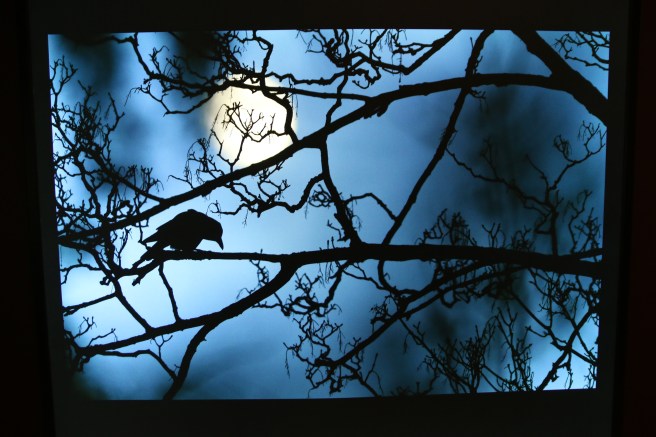
I left that exhibition to head into the “Wildlife Photographer of the Year” exhibit. The competition consists of a number of categories, and different age groups. There is also an overall winner of the Adult and Junior categories. There are some magnificent photographs, especially from the juniors. Some were inspired by birds, some by bears, or lambs etc. The stories that went with the photos seem to as much inspire the choice of winner as the photographs themselves. Many spent quite some time at different sites, waiting for the right one to come along, and it did.

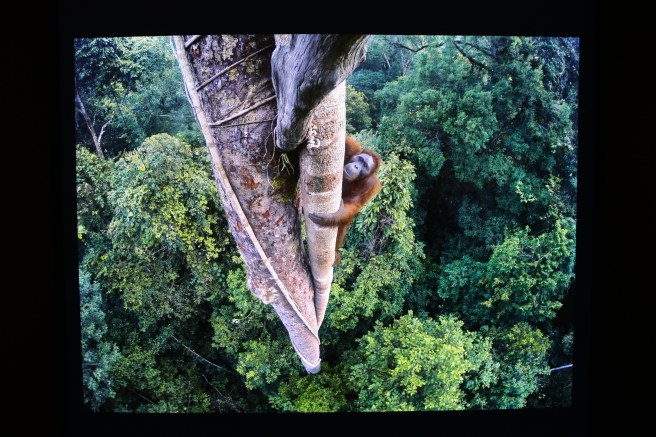
Below are two of my favourites. The first was taken by leaving a camera (in one spot in a national park where rangers dump carcasses) for just under six months, and setting the camera to take a photo around once every minute. The second was taken by a junior who was walking through the Swiss Alps. I like the playfulness. The final two are the overall winners, the first by a junior (16 year old Gideon Knight in the UK) taken at a park near his home, and the second by a biologist and photojournalist (Tim Laman in Borneo) working with his wife on the Gunung Palung Orang-utan Project.

img_7198

img_7200

img_7215

img_7217

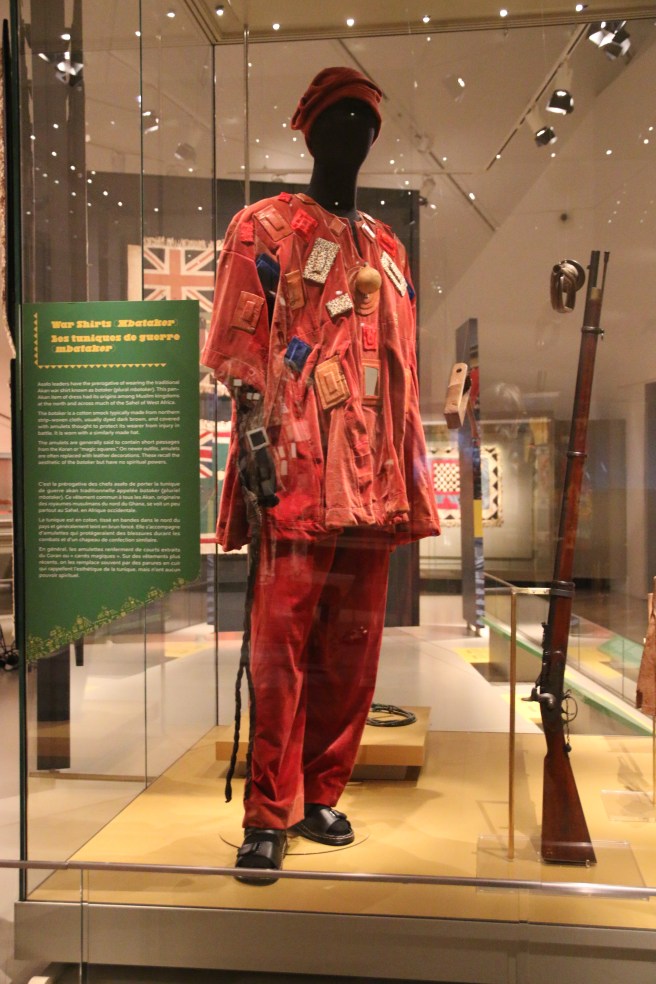
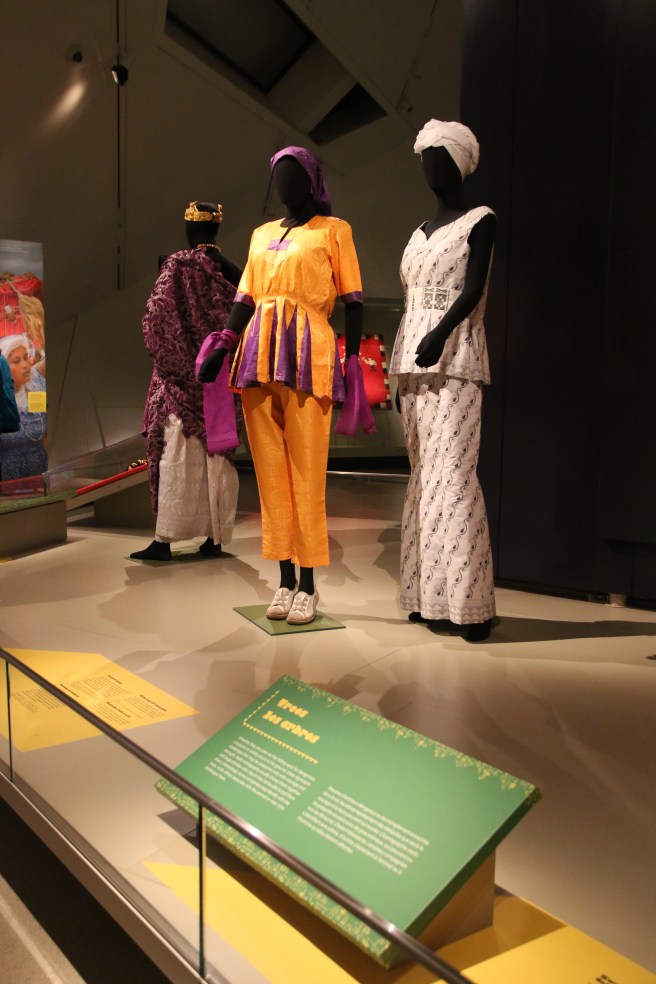
After that, I went for a browse in the “Art, Honour and Ridicule” display of the ASAFO Flags of Southern Ghana. ASAFO flags are visual representations of military organisations used in Fante communities known as “Asafo”. The Fante are one of the many culturally and linguistically related groups known as Akan. The Fante live along the coast in Central and Western Ghana. Each Asafo – company – has their own flag. The primary roles of the Asafo were to exert power, exercise political influence and maintain conduct within their community.

The flags were interesting, however I was more interested in their dress, and how they display the various parts of their Asafo in what they wear. According to the display, Asafo members manifest their sense of pride and company spirit through their dress. Each member’s choice of dress reflects and interesting mixture of uniformity and individuality. Whilst companies and subgroups wear specific colours and sometimes ensembles made of identical textile patterns, a great deal of variation is accepted in what people wear. This reflects the sense of multiplicity and self-fashioned belonging as well as keeping with the grassroots character of Asafo associations.

27deck

27decl

27decm

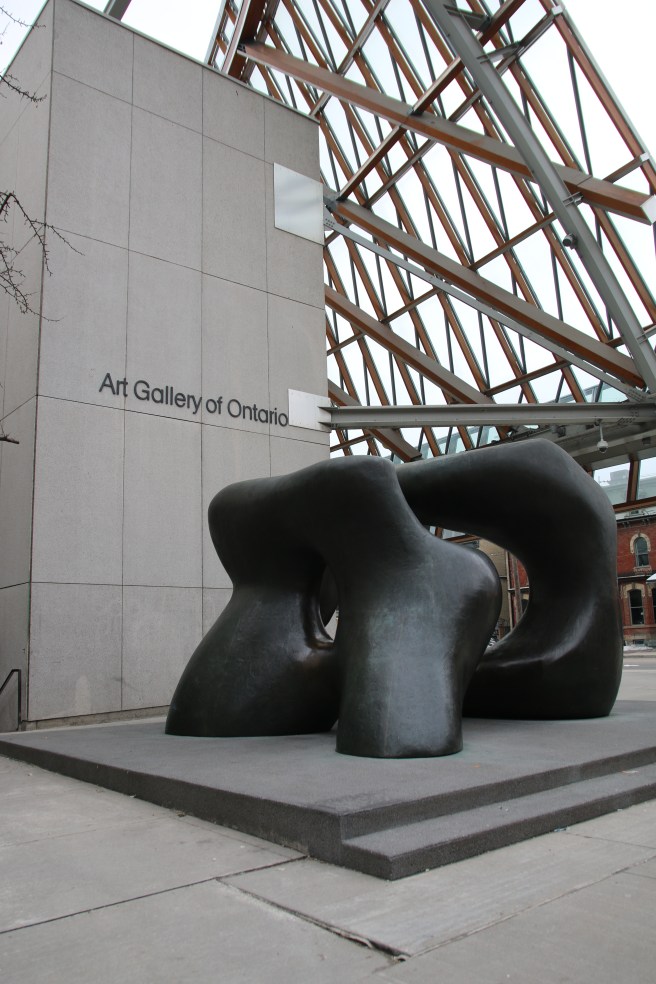
After this display, I left the ROM and headed back to the bus stop for the next bus. I hopped on and then back off again a couple of kilometres further down, at the Art Gallery of Ontario (the AGO).
27decn

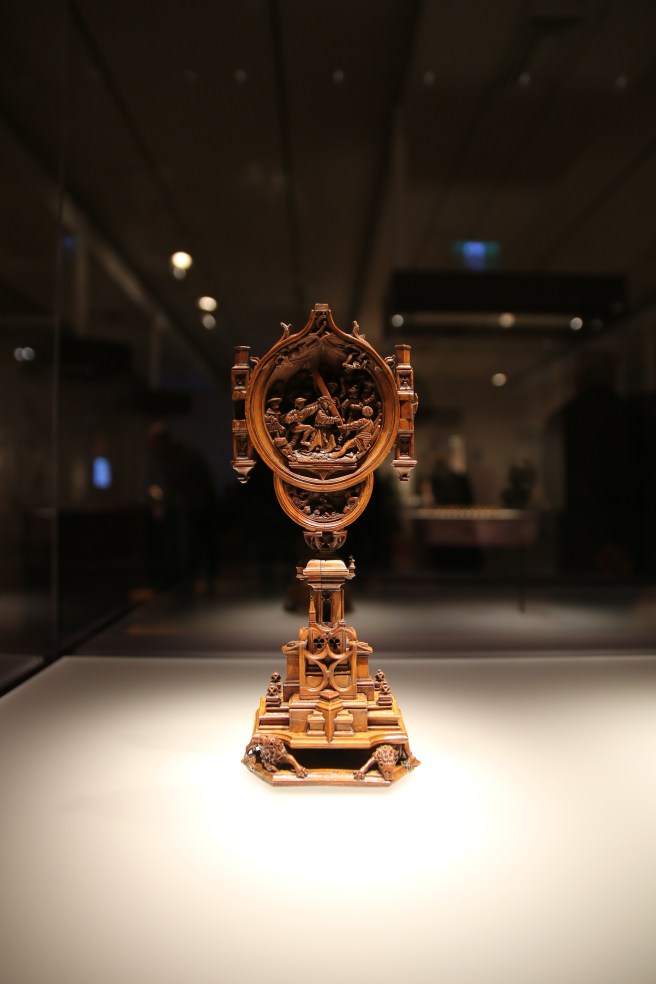
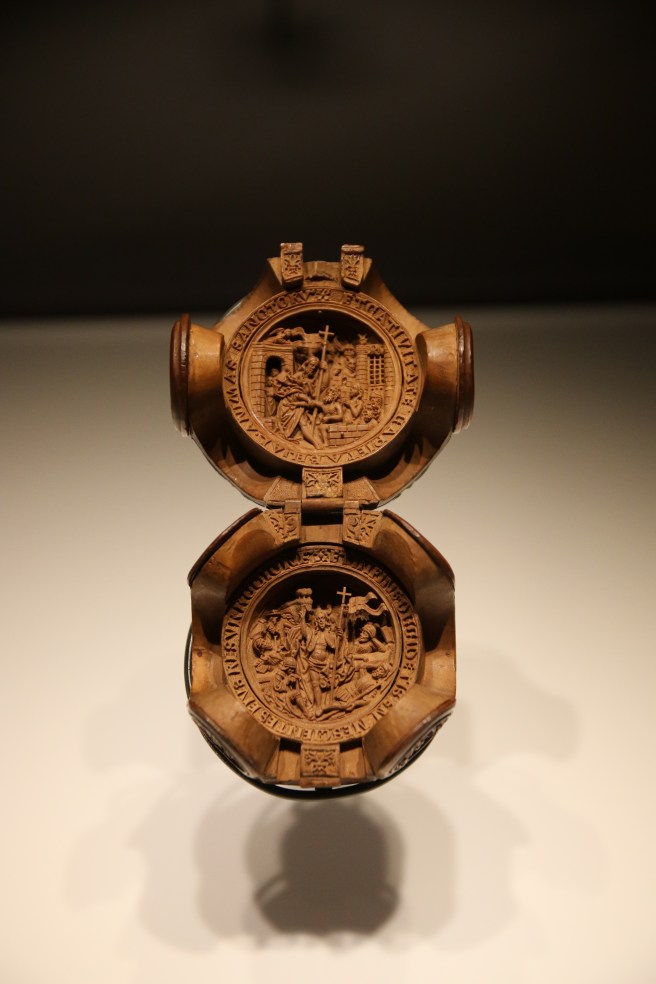
I first went into the Small Wonders exhibit. This was a display of Gothics Boxwood Miniatures. It was fascinating to see the small six of these miniatures carved from blocks of wood with such fantastic small details. One of the videos of a current woodcarver talking about the work that goes into this indicates that it would take him upward of two years to make one of these. Getting the wooden box from two blanks to be carved into the circular shape is reasonably easy with a lathe, but to do the fine work would be time consuming, if he could work out even how to do it. These items were made in the 1500s and 1600s. Here are a couple of examples, followed by a photograph of a set of workman’s tools from the 1600s. I can only imagine trying to use those tools to come out with these miniatures.

The first miniature below is about 10 centimetres tall, whilst the second is of two round halves, each around 3 centimetres in diameter.
27deco

27decp

27decq

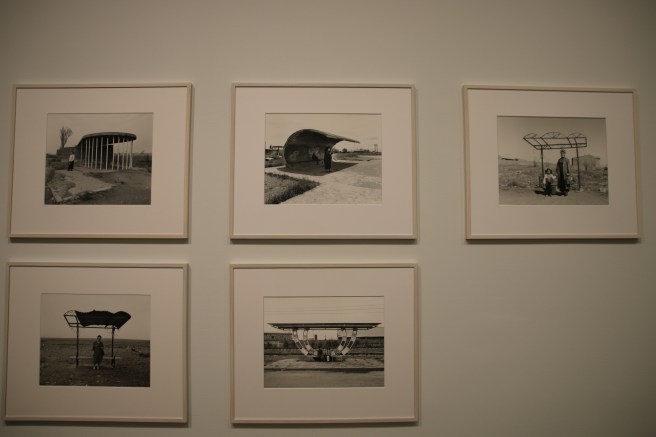
After that, I headed into the AIMIA-AGO Photography Prize exhibit. The set up is four spaces, each with photos and backstories of the four finalists, with the public to vote on the winner. Herewith a few photos (black and white) from the winner, Ursula Schulz-Dornburg, with a theme of the built environment and its place in society.
27decr

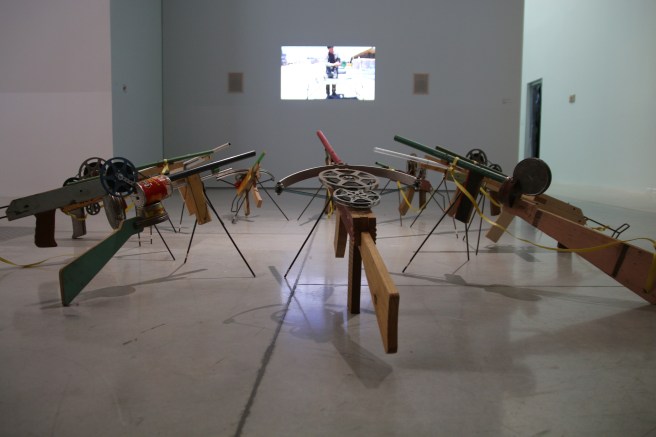
From that exhibit I headed into one called “Francis Alys: A Story of Negotiation”. Mr Alys is a Belgian artist who has lived in Mexico for the past 30 years. According to the display “His poetic work engages with urgent social issues through painting, drawing, sculpture, performance, video and photography. A Story of Negotiation presents three of Aly’s large-scale projects”.

The first photo below is from the display Reel-Unreel, where in 2013 he was embedded as a war artist in Afghanistan. The second is a screen shot of a video called “The Bridge” which he filmed in 2006 that explores border politics between Havana, Cuba and Key West, Florida. In this video, he has arranged for a “bridge” to be built from Havana going North and Key West going South to bridge the gap. He did not tell each side what he was doing at the other side, and on the day of the “installation” he had around 30 boats from Key West and around 100 boats from Cuba. They all lined up tied by rope to each other, and then departed after a period of time. You could certainly tell which were Cuba’s boats (mainly small wooden row boats with a few inboards) and the USA boats (medium size fiberglass mainly.
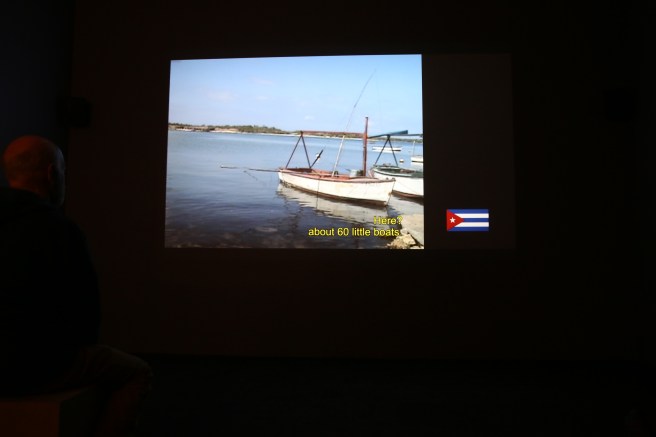
img_7263

27dect

After viewing that exhibit, I had to wait around for 1 hour to access the final exhibit “Mystical Landscapes”. Due to the popularity, I had been given a 5pm timeslot, with the rest of the museum closing at that time. So I headed to the AGO bar for a beer and some bar snacks, and then headed back at 5pm. There was no photography allowed in this exhibition.

There was a very large number of paintings with landscapes at night and during the day. Some of the paintings were by Vincent Van Gogh, Paul Gaugin, Claude Monet, Edvard Munch, and some of the others I have not heard much of but liked were by Paul Nash, Felix Vallotton, and Emily Carr. There were over 100 paintings and paper works, and they gave a fascinating display of the different feelings and mystique of different landscapes at varying times of the day and night, and the impact that these had on artist and art professionals. We had the option of an audio player to listen into, and around a quarter of the people had them (as did I), however with the number of viewers I generally didn’t get the time to listen to the audio before being pushed between paintings. I did however take the time to look at some of the paintings in depth.

My favourites on display were Van Gogh’s “Starry Night over the Rhone at Arles”, Edvard Munch’s “The Sun”, Emily Carr’s “Sea and Sky”. They showed a different range of colours and brushstrokes but were to me quite peaceful.
After leaving the AGO, I headed back to my hotel.