December 6, 2016

Well today was a busy day.

Today was the 99th anniversary of the Halifax Harbour Explosion. On 6 December 1917, Halifax was in the middle of war efforts as part of World War I. It had a deep harbour and was used as a staging post and meeting point for the various Allied navies. Two of the ships in the harbour that day were the SS Mont Blanc, a French cargo ship loaded with munitions (around 2600 tons worth) that was coming into the harbour (the pilot had boarded the night before), and the SS Imo, a Norwegian ship being used to bring supplies to Europe that was leaving the harbour.

At around 8.30am, the SS Mont Blanc noticed that the SS Imo was heading for it, through the Narrows, being the narrowest part of the harbour, and sent signals confirming it had right of way, to be returned by the SS Imo that it would not yield. The captain cut his own engines and depending on who you believe either angled slightly to starboard earlier or did so late in the piece (not really much time in between) to try to protect his dangerous cargo. By this time there was no way out of a collision although both ships had cut their engines. Sailors on other ships stopped to watch. At 8.45am, the SS IMO ran into the SS Mont Blanc, causing ammunition barrels to fall over and leak, and a fire broke out on the munitions ship. The locals in and around the harbour stopped to watch. The crew of the SS Mont Blanc jumped into life rafts, apparently trying to indicate to others that the ship would explode. Apparently this didn’t work so they rowed hard to shore and ran into the trees. As no other parties were aware of the danger, some rowed out to tie a line to the ship and tow it out.

At 9.05am, the ship exploded. The explosion was the largest man made explosion of its time, until Hiroshima. Over 2000 people died, 9000 were injured, with many of those who didn’t die being blinded by the explosion, blocks of buildings were blown down including mostly all of the northern side of Halifax, and windows shattered as far as 100 miles away. Many other ships were totalled, and their crew deceased from the explosion. Only one crew member of SS Mont Blanc died. The explosion also caused a significant tsunami that transferred a significant amount of water from the harbour to the streets, drowning many members of the public.

There was a significant amount of loss from this tragedy. But the war effort continued, including sending a convoy from Halifax only a few days later. And many medically trained people came from miles away to help out, set up a hospital (the hospital ship in the harbour was damaged and the usual building used was also damaged beyond repair) and a morgue.

XOX

My first action for the day was to head over to the Atlantic superstore for some provisions. On the way, I walked through Cornwallis Park. In pride of place in the centre of the park, it has a statue of Edward Cornwallis, “Founder of Halifax” in 1749, and its first Governor. Founder being listed on the statue which was unveiled in 1931, and in inverted commas (by me) because as with many historical events, there are disputes as to the facts and there was a native people already residing there.

img_4890


An interesting thing that I noticed on my walk is that none of the cars in Halifax have front number plates. A few have adverts, but most are clear. I’ll have to look into that.

Another thing of note in the area of Halifax that I am staying is that it has a large university, the Dalhousie University, and so caters a lot to the student crowd. Not that there is anything wrong with that, it means there are a number of pubs and cafes with cheap food and beer.

After finishing at the Superstore (basically a very large grocery store with a pharmacy, fresh fish and butcher, as well as a small amount of other things like books), I headed over to the Southern end of the Halifax Waterfront Boardwalk, via the Via Rail offices (the company that runs the train lines across Canada). There was no information like timetables and fares available (you get it off the internet), and for what I wanted in terms of tickets, it was recommended I just buy them off the internet too.

So off to the Boardwalk. At the southern end, it starts with the Halifax Seaport. So that’s where I started to investigate. I wandered through the Halifax Farmer’s Market (which opened at 10am, just before I got there so was only just setting up), followed by a closed Annexe used for various events integrating the water with the area close to it (closed), and the NSCAD University Port Campus (Nova Scotia College of Art and Design). Next door was the Mary E Black Gallery and Design Art Shop, which was open so I wandered in for a look. There were two small exhibits on, the first being various objects made from porcelain. This was quite colourful, with my favourite items being two boxes that very much looked like they were made from textile but were actually porcelain. The work was so intricate. The second exhibit, which is being advertised around town including on a brochure in my hotel room, was called Birth by Fire. It is an exhibit of forged steel with an interplay with wood and sometimes stone. It is interesting because whilst steel is forged in fire, wood in many cases dies by fire. I enjoyed some of the many uses of the materials. But I wasn’t allowed to take photos.

I then headed next door to the Canadian Museum of Immigration, which was also closed. But it is open for the next few days so will definitely go back. Canada has a long history of accepting immigrants, and I took some photos of items outside. But I’ll leave those until I am able to visit the Museum. Next door, there was another area for shops and displays that is used only when cruise liners are in town, which there wasn’t, so it also was closed. Then following that building is the operations of the Cunard Line. This line was started by Samuel Cunard, a Haligonian – someone from Halifax. There was a statue of him near the start of the actual Boardwalk.

img_4927

I then turned around and noticed a Brewery (Garrison Brewing Company) on the other side of the road. So I had to stop for a sample. They make a range of different beers, with their most ordered beer being Tall Ships Amber and Irish Red. I had a Nut Brown, a dark bitter beer. It was quite tasty, especially at $2.

I then headed off to the start of the Boardwalk. Along the way are a number of cafes, restaurants etc. and touristy items like bike and Segway hire (both closed until May). Whilst it was relatively cold, there were a number of joggers and cyclists using the Boardwalk. I took a photo of a large helicopter taking a circle around the harbour, which I think was something to do with today’s anniversary of the harbour explosion.

I passed George’s Island – in the middle of the harbour – on the way. It doesn’t look too exciting. But it was first fortified in 1749 by the British, then used as a detention centre. It became a naval base in the 1800s.

img_4944

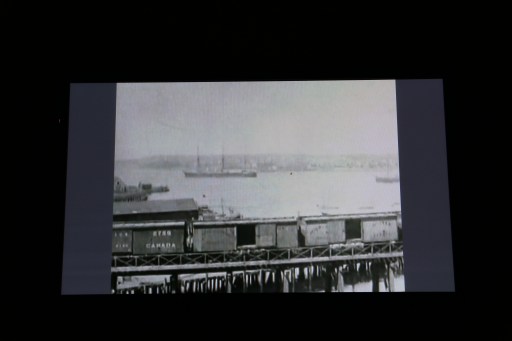
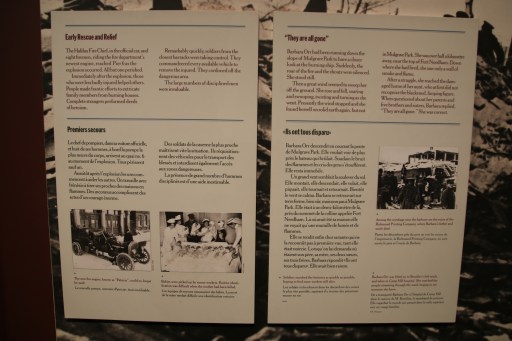
I then reached the Maritime Museum of the Atlantic. There were a number of exhibits. Downstairs was mainly around wartime navy ships and weaponry; a large exhibition and video display on the harbour explosion, as well as some fascinating storied from those who survived and those who came to Halifax to help out (some areas were set up for dignitaries to attend events later in the day).
img_4976

img_4962

img_5049

There are also another half dozen photos on this event that WordPress would not allow me to add. I will keep trying over the next week to update this entry, as the historical information is fascinating.

In the museum, there were also full and part size models of a number of yachts and other boats. Upstairs was taken up with two main subjects. One was a number of model steam ships (around 20 of different sizes between about 30 centimetres and 2 metres long) and various articles like quadrants, spliced shipping cables and various bits of wood from sunken ships. Given Halifax’s historical use of the water, and position as a major port and navy “half-way house” for the Americas and Europe, there are believed to be around 10,000 sunken ships around the Nova Scotia shoreline.

The final exhibit (and it’s a large one) is the RMS Titanic. The Titanic was sunk not much more than 400 miles from Halifax, and this was the nearest major port so was used to deliver bodies recovered from the event (the survivors travelled to New York). I’ll try to get out to the Fairview Lawn Cemetery, where the unclaimed bodies were buried, in the next couple of days and so will add some photos from the museum exhibit together then.

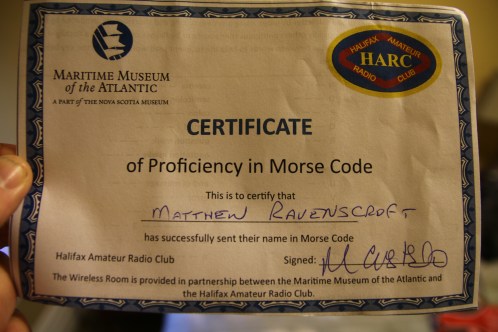
Two more noteable items from the Maritime. One is that Merlin, the talking parrot, has his own live webcam at www.novascotiawebcams.com. The other is that I received a Certificate of Proficiency in Morse Code from the Halifax Radio Club for being able to send my first name in a morse code message. Nowhere near up to your standards of course, Dad, but I did it.

img_4949

img_5085

After the Maritime Museum I went for a walk up to the Citadel. On the way, I stopped at a Rum Distillery (Halifax Distilling Company) and went in for a sample. It was quite smooth. I had a Mojito, but it was nowhere near the standard I got at Hotel Nacionale de Cuba in Havana, or even the Havana Café in Cairns. But it was okay (although missing mint leaves!).

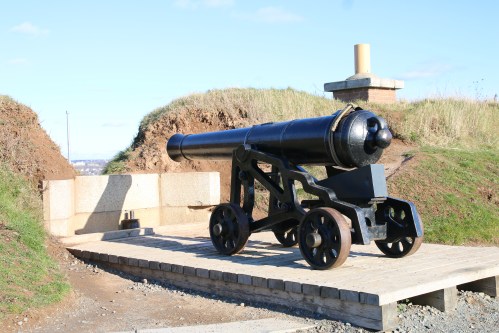
I got up to the Halifax Citadel (a National Historic Site). This was chosen (again in 1749 – that was a busy year for Halifax) as the right place to place a fort to protect the city, given its views across the harbour. It was well set up with cannons and its armoury. It is currently undergoing a major renovation (as are a number of historic parts of Halifax).

img_5060

img_5064

img_4231

After leaving the Citadel I wandered 2 blocks to the Halifax Public Gardens. They have a large fence around them. And were closed for winter. So I walked back to the hotel. On the way, I stopped in at a chocolate shop and asked for some chocolate covered honeycomb. The lady didn’t know what I was talking about. After a couple of minutes, we worked out that in Canada they call it “sponge toffee”. The shop sells it as Rocky Seafoam, as another company has trademarked the name “sponge toffee”. But that’s what everyone calls it. So I bought a packet to test. And after a couple of samples, I can highly recommend it. The honeycomb does not have as strong a bite as our Crunchie bars, but are half way between that and Violet Crumble.

I then headed back to the hotel (got there around 4pm) and sat down to read today’s Globe and Mail (they are free at the hotel), so I read the local paper (The Chronicle Herald) with breakfast. On the front page was an article on a political and environmental storm about an oil pipeline, one on Liberal Party fundraisers being unethical and potentially illegal. Sounds like more than one country has these issues.

There was also an article inside about concerns around an online survey on electoral reform in Canada, to decide a new way of voting (they currently use first past the post). There are concerns that the questions are not valid, and there may be nothing to stop people completing the survey more than once. The current Prime Minister promised that the 2015 election would be the last based on first past the post, but at this point the pollies cannot decide on what should replace it. The newspaper even listed the web address for the survey “mydemocracy.ca” and said that the consultants had posted out 15 million postcards to electors to get them to complete the survey. So I logged in myself and completed it too. Apparently, I’m a Challenger, and my politics is both responsive and transparent.

Now I’m finally catching up on my blog (more photos than word tomorrow), so now it’s time for bed.
 

December 4-5, 2016

These two days are combined into one entry as they consist of checking out of my Fairbanks, Alaska, USA hotel; waited around at airports in between taking 4 flights; and checking into my Halifax, Nova Scotia, Canada hotel. Whilst losing 4 hours in the process due to flying east.


4 December:

Got up for breakfast at 7am, packed my bags and checked that they met the check-in and carry-on for usual carrier requirements, and then sat and read a book until 10.50am, with 11am being my hotel check out time. Said goodbye to the Westmark Fairbanks Hotel and caught a taxi to the Fairbanks airport. I checked my bags through to Vancouver (was taking two Alaska Air flights, the first from Fairbanks to Seattle, the second from Seattle to Vancouver), the bought a newspaper and a bottle of water and cosied up for a few hours of reading. During this period I also had some “pretzels” – they were long fluffy sticks rather than the round harder ones I’m used to – and a couple of JD and Drys.

The first plane took off on time and it was a clear flight through to Seattle. Caught the internal train to Terminal C, and had enough time to stretch before getting on the next flight. That second flight also took off on time. I waved goodbye for the last time this trip to the USA.

I will say that, whilst I never thought Americans (from the USA) were all like the stereotypical ones you see on TV in Australia, either on comedy shows, documentaries or the news; I found mostly everyone I dealt with or spoke to, to be polite, intelligent, friendly and they made me feel very welcome in their country. Whilst some of their service presence may be due to the need to garner tips based on the way they get paid, I found the American hotel and restaurant employees to be attentive and polite, and on average superior to the average of similar employees in Australia. In terms of their attitude and demonstrated professionalism. This is obviously a relative thing, but I was impressed.


5 December:

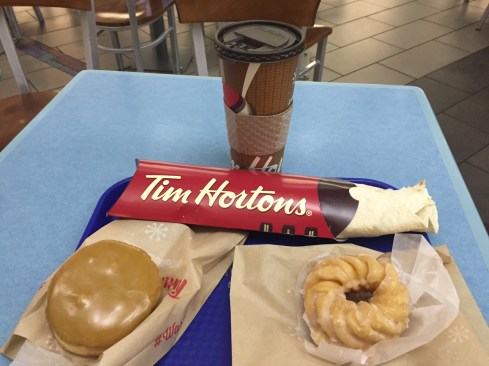
I arrived in Vancouver around midnight. After fetching my 2 suitcases I found most shops at the airport were closed, and there were no money changers still open so I could not get change for the vending machines. It was 1am, Air Canada was not opening their counters for at least another 5 hours, and the 7 or 8 people also waiting were laying on all the seats near the check-in desk. So I went in search for something to eat. There was one shop open, Tim Hortons, which I found out is the Canadian version of Starbucks. Now I was in Canada, I had to try their cuisine. So this is what I bought.

img_4110

It’s a Chipotle wrap, grande French vanilla coffee, Canadian maple donut, and a French honey crueller (the last word can be spelt a number of ways). Damn it was all so tasty. And laden with sugar.

After that sugar hit, I bought a bottle of coke from a vending machine with the change I got from Tim Hortons, and headed back for the 4 hour wait. Luckily I had a good Kathy Reichs book (4 novellas) to read.

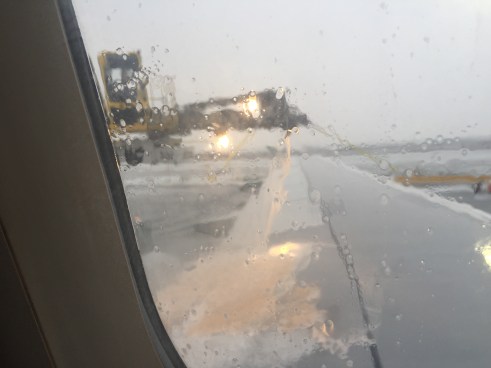
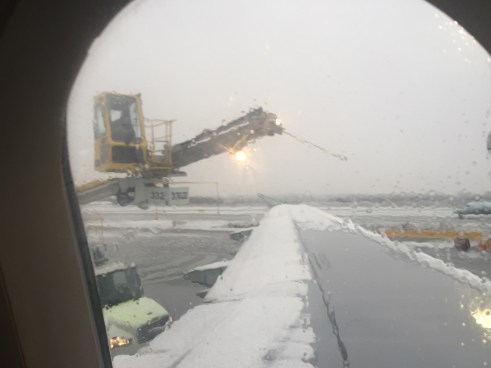
At 6am I was able to check my suitcases through to Halifax, and headed out to get a newspaper (The Globe and Mail) and a coffee, and waited until 7.20am to board. This flight was to be from Vancouver to Toronto – 4 hours and 25 minutes. Given it was a large plane, they boarded in zones, and I was zone 4. So I boarded about 7.35am and settled into my left window seat (like 50% of the window seats, over the wing). I looked out and saw lots of ice on the wing. I recalled an episode of Air Crash Investigation around icy wings and thought “damn, I hope they are going to be de-icing them”. By now it was around 7.50am and so 10 minutes before takeoff. I was wondering whether I should hop off the plane as it didn’t look like we’d have time to de-ice the wings. Luckily we were late. We left the bay 15 minutes after we were meant to leave, and it was announced we were heading over to have the wings and engines de-iced. I was very happy. That took around 45-50 minutes of waiting and then having the machines (a bloke sitting in a cherry-picker with a mechanical arm that held a pipe which sprayed the foam that turned the ice and snow yellow, and then it fell off) de-ice the plane. I am always happy to allow the airport workers to take as long as they need to do what they have to, and be as late as needed rather than be on time and miss something.

img_4133

img_4143

So we took off an hour and fifteen minutes late. And as we taxied across to the final runway, it started snowing! Once we were in the air, I calculated with the time change (I put my watch 3 hours ahead to Toronto time) that I would have a half hour from touchdown before my final flight left from Toronto to Halifax – 2 hours and 5 minutes. Luckily the pilots made up a little time. I have always assumed they do this by flying a bit faster which would use up a little more fuel, much like driving a car 10km / hour faster. Which I assume they cannot afford to do very often. The Air Canada team on the ground had also spent time rebooking about a quarter of the passengers on later flights than they had already booked. And they advised the rest of us which gates we would be going through on our latter flights, so we’d get there before they had taken off. Plus after we landed, two special people got to deplane first so they’d catch their next flight. All in all we got in about a half hour late. So all was fine for me.

I got onto the final leg (Toronto to Halifax), changed my watch forward again by another hour, and settled into the final leg of my 2 day travels. The flight was fine. I got to finish another story (3 down, 1 to go), happily at the end of the flight my 2 suitcases came through, so I caught a taxi to my hotel. The Halliburton Inn in Downtown Halifax. It’s a 3 storey boutique hotel, very comfortable. So I headed off to the 24 hour pharmacy a few streets away to get a couple of supplies (it was minus 2 degrees Celsius so I didn’t take my scarf or gloves given Alaska was so much colder), then came back, had a shower and shave and went to bed.

December 3, 2016

Today (Saturday) was quite a relaxed day. In fact, I didn’t get out of bed until 11am. Mind you I was watching TV until midnight. The various channels and their take on their President-elect is quite fascinating. There are more right wing media forums than just Fox, although Hannity is certainly promoting himself as Trump’s Number 1 media supporter. Still trying to see what Bill O’Reilly’s view is. Anyway, I’ll leave that up to them.

When I got outside, it was clear that Fairbanks had received some snow whilst I was away. I went for a walk to the Cooperative / Grocers a few streets away. It was very much into organics, and the prices were no different from ours. I bought a few goodies to try. I got a packet of rice cakes topped with 68% cocoa chocolate. Who’d have thought you’d melt chocolate onto a health food? Well, apart from strawberrys etc. I also bought some cashew brittle (lighter in colour than our peanut brittle but still as tasty), and some pork rinds (like our pork crackling) in a chip sized packet. Now that is something I’d love to import into Australia, instead of only being able to buy really small bags at the local bar.

I then went for a wander around a few streets just to snap a few photos and see how the snow had impacted the houses. I realised my gloves (not the mittens I have used most as they are great) were really not of much use in the cold. I’m pretty sure I bought them in London so I’d have thought they’d keep out the cold. Anyway, I then walked to the local bus terminal to catch a bus to the museum. Sadly I had missed it by 5 minutes and the next one wasn’t for an hour and a half, so on my way back to the hotel I hailed a taxi to take me there. The trip cost US$22, around AuD$33 which was pretty reasonable for the distance, and only about two thirds of what it cost to drive from Port Hedland airport to my home when I worked there.

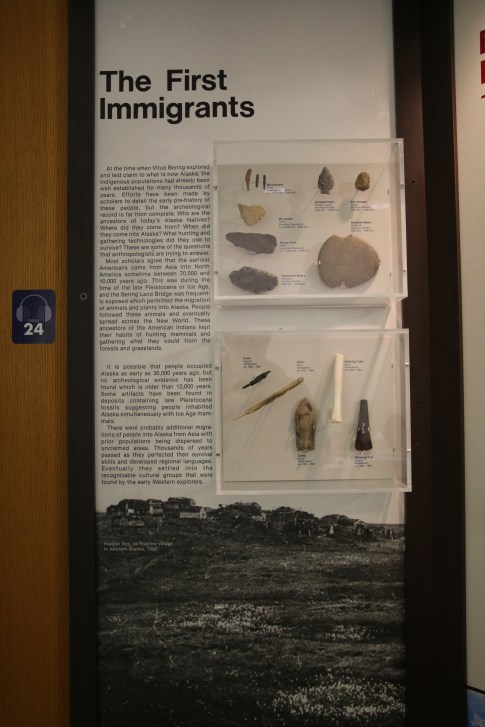
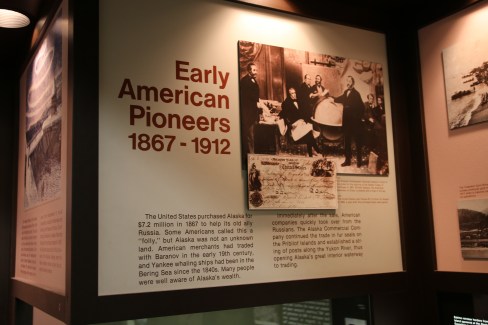
The Museum of the North is based at the University of Alaska. It has three main areas; an art gallery; a “Place Where You Go To Listen” (which was unfortunately closed); and an area like a usual museum, with the history of Alaska, from the time before it was “discovered” when it was occupied for many thousands of years by various indigenous peoples, and how they lived, through to European arrivals, to its sale from Russia to the USA in 1867 for $7.2m, through the goldrush and the oil pipeline, etc through to relatively near the present (there is a new wing being built to update the history and bring things through to various changes that have occurred over time).

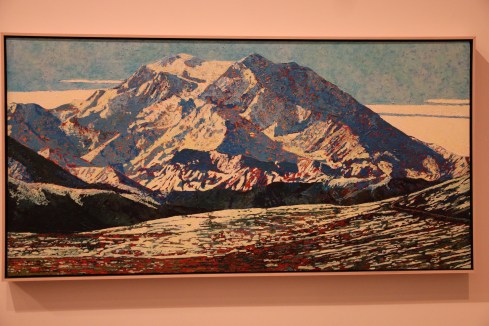
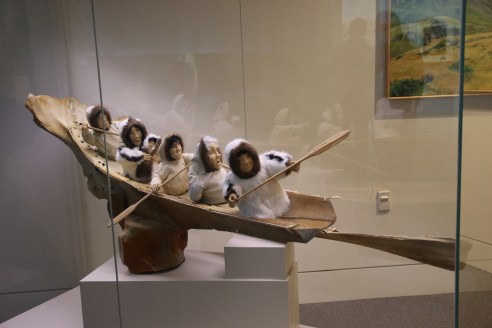
Here are a few photos of the artworks in the upper gallery.

img_4839

img_4827

img_4838

img_4849

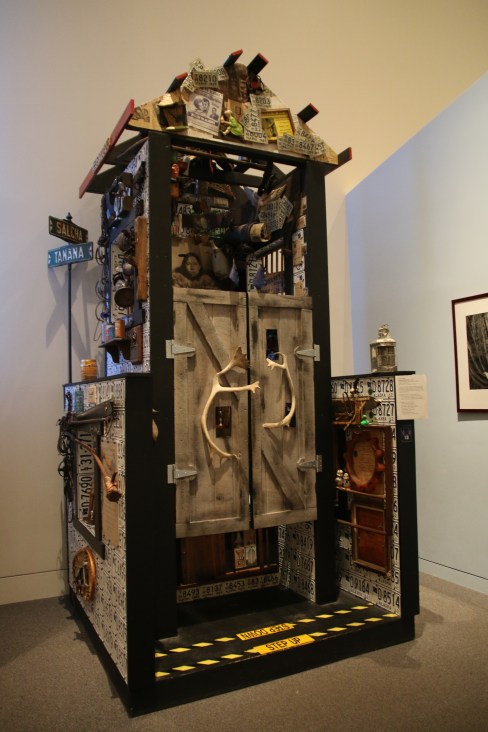
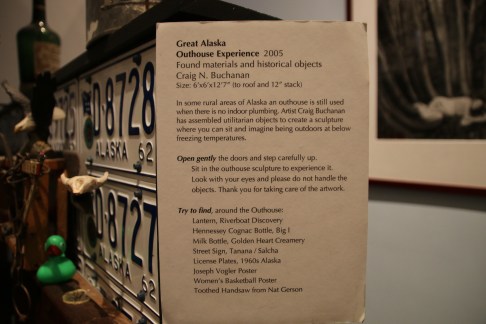
This last photo was an “Outhouse Experience” you could open the front swinging door (with the antlers) and go into and sit down on a bench. The whole article is made up of found pieces inside and outside. Below is the explanatory sheet attached to the right hand side. I remember we had an outhouse when we lived in Kenny Street Bassendean (until I was 7 or 8 years old). That was too long ago for me to remember much, but I recall that it was sometimes scary to head out at night!

img_4850

Here are a small number of photos from the downstairs museum section.

img_4864

img_4867

img_4876

I was particularly interested in the display on the Permafrost, given what I’d heard about its effects during the trip up to the north.

There were also three display tables out in the corridor to the entrance of the museum, each with what looked to be University Students at them. There was one table that had a whole lot of instruments and items made out of wood. It was something I would have liked to spend more time on except I knew it was unlikely that anything they sold at the shop would have been been treated to the level acceptable to Australia’s customs officials.  So I spent some time talking to the young lasses at the table that displayed the deforestation of trees in Fairbanks over the previous 100 years. We got to talking about it around the world and then onto climate change. One of the ladies asked me where I was from and so I said Western Australia. So she asked me about the two things that everyone has asked me about when wanting to know about Australia – are there really lots of snakes and spiders! And how scary are they? Personally I’m more worried about spiders than snakes, certainly the ones I have seen. I explained how sometime we catch a spider on a piece of paper and take it outside to shake it off, rather than killing it. She said she go straight at it with a shoe. It’s always interesting to hear overseas people and their view on our killer insects and reptiles. Then I had to get to the shop to buy a couple of gifts before the bus came.

I really did enjoy visiting the museum, and although I have been reading up on the history over the past 12 months, getting details from a personal level rather than just at a country level, is enjoyable and educational.

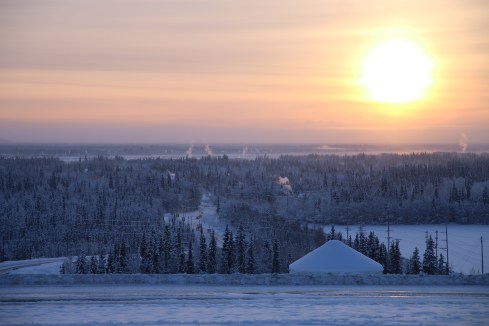
I then went to catch the bus back to the hotel. I took one photo of the “sunset” behind the clouds across the road from the museum (the sun did rise a little above the horizon in Fairbanks).

img_4816

Unfortunately, the bus came about 5 minutes early so I didn’t get a photo of the museum building itself. It was quite architectural. I caught the bus back to my hotel and fired up my Surrface Pro to transfer across all my photos from the Coldfoot trip and update my blog. For dinner I was thirsty but not hungry, so I headed off to the Red Lantern Steak and Spirits restaurant for a half sandwich / half soup meal (Cuban sandwich / clam chowder soup) and a glass of Chateau Ste Michelle Reisling (Columbia Valley). A sweet wine, thinner than but with the same lemon honey taste of a Botrytis Semillon dessert wine. I liked it so much I had 3 glasses. Then off to bed.
December 2, 2016

It’s now Friday, the final day of my trip north of the Arctic Circle.

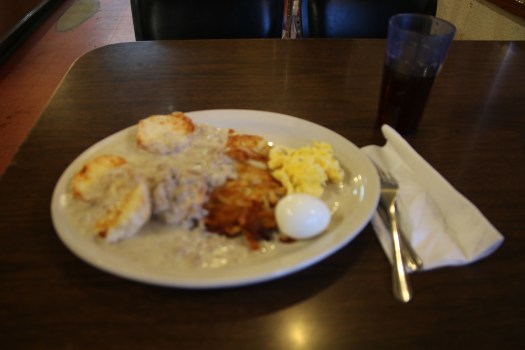
So I slept in, relatively speaking, getting up at 11.10am. I don’t know what has got me staying in bed so long as I’ve never done it elsewhere. Anyway, off to the Cafe for breakfast I go. It’s my last breakfast here in Coldfoot, so I challenged myself to the Truckers Breakfast. 2 eggs, 2 hash browns, 4 biscuits and gravy, along with two cups of the cold tea that I have come to enjoy.

img_4725

Yummy, doesn’t that look tasty!

I also took a photo of an genuine Ice Road Trucker!

img_4723

I then headed back to the Inn. I wanted to make a snowman on my last day, but I was told that the ice and snow here is too dry and so would not make a snowman. Very sad to hear that. I guess I’ll have to wait until Canada then. So I sdat down to watch Forensic Files on the TV (having already packed).

The plan for the day was we were to be picked up at 1.30pm for the trip to the airstrip and 1+ hour flight back to Fairbanks. The time then became 3pm, then 3.30pm. I didn’t have a problem with the delays, except for the darkness taking away from the photo opportunities. The reason is, I’d rather whoever is doing so spends as much time as they need making sure the plane is airworthy, rather than rushing to meet a deadline.

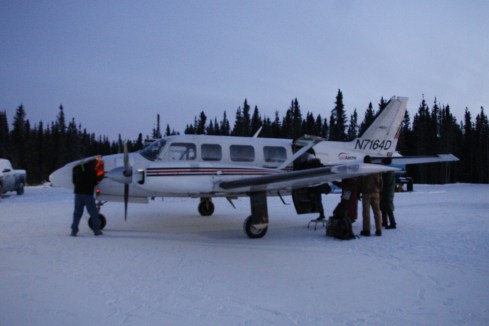
Anyway, we left around 3.45pm. It was getting dark as we drove up next to a 9 seater plane. And there were 8 of us plus the pilot. Hmmm, would some of my 24 pounds of gear not be let on the plane? But no, all was fine. We got on and prepared for takeoff. Herewith a photo of the plane as we board.

_mg_4758

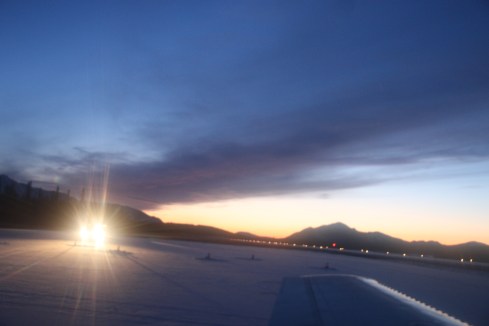
And one of the airstrip as we taxi on.

img_4762

And one as we climb into the air.

img_4776

The plane did shake a little as we headed further up into the air, so I decided to close my eyes and meditate for 10 minutes. When I re-opened my eyes, we were still up in the air, which comforted me greatly. Until the pilot decided to call up another passenger, obviously a colleague, to help him close his window – whilst we were flying! Now I am normally a bit perturbed with small planes because I am all in favour of having 2 pilots, just in case one has a heart attack or something like that. But when the pilot’s window isn’t closed?? Argghhhh.

Anyway, I have been updating my posts, so I obviously survived the trip. Most of the rest of the flight was relatively calm, and we could not see anything out the windows. It was all like a grey / green fog had enveloped the plane for the rest of the trip until we reduced height to land. Anyway, I was very happy for the skills of the pilot. But I was glad when we landed.
So we headed off to the Northern Alaska Tour Company’s offices (co-located at the airport), said our goodbyes and then I headed back to my hotel. Then into the shower (which surprisingly was not as hot as the showers at Coldfoot Camp – which were actually the hottest I’ve had in Alaska, and off to bed.
The whole four day trip is something that I really enjoyed, and that I will remember for a very long time.


December 1, 2016

Today was a quite day to relax, with no tours planned.

I got up at 10.30am and ambled across for a late breakfast. This along with a relatively early dinner means I can save on buying lunch. So today I had a short stack of pancakes (2 buttermilk pancakes, fluffy and perfectly cooked – I wish mine were as good), topped with maple / honey and matched to a couple of cups of sugar-free iced tea. yummy.

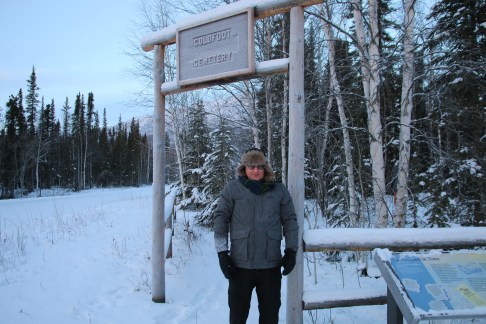
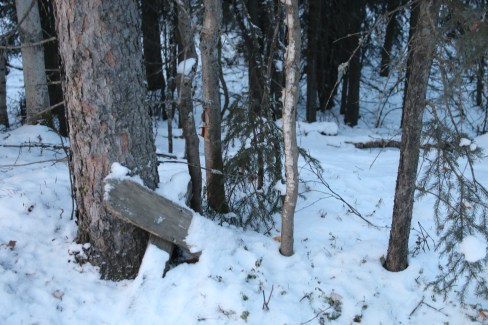
Today was pretty warm relatively speaking, with the temperature up at minus 16 degrees Celsius, virtually tshirt weather. So I went with Marian and Rodney for a walk to the cemetery. It was about 400 metres away. We couldn’t find any actual graves but there was a couple of information boards. Sadly they tell of a couple of time between 1899 and 1903 of people have left for Coldfoot and not arrived, plus one of a man who froze to death at 73 degrees Fahrenheit (minus 58 Celsius) in 1903 when trying to drag loads of moose meat.

img_4641

img_4642

img_4640

After we got back to the Inn, I sat down and watched TV. There were a few episodes of “Alaska Mega Machines” which demonstrated a number of very large pieces of equipment used to ship products to Juneau, clear the Dalton highway and prepare it for trucks after snow storms, dig a trench in the snow / ice to ensure the melting ice in spring does not cover the highway, and another large piece of equipment to dig up the ice. As well as a tug boat used up north that has its own ice-breaker fitted to break ice up to 3 feet thick. The Alaskans have thought of everything, and most of the equipment on these shows was specifically developed for Alaska.

There was also a show about an indoor shipbuilding facility in a place called Ketchikan, which has 13 feet of rainfall per year (hence the need to be inside). And some of the hull is built upside down so the welders, technicians etc. can get to it easier, then uses a double gantry which is one of the strongest in the USA, to flip over the hull to allow it to be welded to the rest of the frame.

Interestingly, Juneau is the capital city of Alaska, but is south of the main body of Alaska ands has no roads in or out – so you have to fly in or take a cargo / passenger / vehicle ship to get there. There are many light aircraft around Alaska to traverse the large areas where there is no roads.

An interesting thing I noticed as well was to do with commercials that sell medications. For every 30 second commercial, the first half of the commercial is selling the product, then the next, approx.,  10-12 seconds lists the various reasons you should not take the product as well as its possible side effects, followed up with the last 3-5 seconds being about speaking with your doctor before taking it. They do still have some small print at the bottom of the screen like in Australia, but it was fascinating listening to the possible side effects and warnings about taking the medications. It is nothing like we do in Australia.

At 5.30pm I headed back over to the Café for dinner. I had a very tasty Chicken Soup, followed up by an Oreo cheesecake with a scoop of chocolate icecream for dessert. I followed up by watching with Mark a game of basketball between the Houston Rockets and the Golden State Warriors (the team Andrew Bogut used to play for), with Houston winning 132 v 127 in double overtime. It’s as I remember when going to see the Perth Wildcats with my brother Chris some years ago, lots of stoppages and advert breaks. In between the adverts, the game was pretty good though, especially as it was pretty tight the whole time.

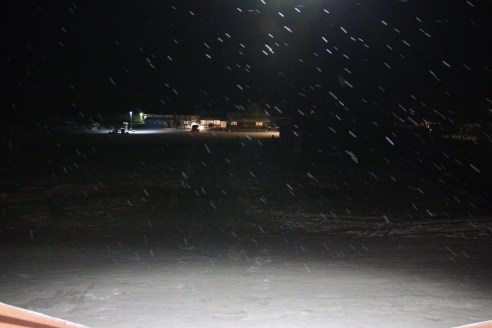
At 9pm it was still cloudy, there were no stars obviously, so I decided not to stay up to see if the clouds went away thus revealing the Aurora Borealis. There was however some very nice snowflakes that started to fall. I took a couple of photos from the front of the Inn over to the Café with some of the snowflakes, with different aperture and time settings. I hope to improve on this in Canada to get some good shots, when the temperature is warmer and I can actually get my hand out of my mittens to touch the camera!

_mg_4682

_mg_4689

Then I headed off to bed. It turns out that the clouds lifted and the Aurora Borealis did come out, as Rodney and Connie went to the cabin in Wiseman to watch and get photos. I was glad to hear in the morning that they had gotten some good photos of the AB. Everyone should aspire to get up to see the northern lights, or in fact travel down to the bottom of Tasmania or New Zealand to see the Southern Lights, AKA Aurora Australis, as I will hopefully get to do in a couple of years time!


November 30, 2016

Well, today was day 2 of my 4 day, 3 night tour up north of the Arctic Circle in Alaska.

I got out of bed at 9.30am and prepared myself for the day. Shower, put on my thermals, then my mid layer, then my outer layer – including scarf, mittens, woollen hat. Then I was ready to walk the 50 metres to breakfast! Being in the USA, I decided to have a traditional American breakfast – Biscuits and Gravy. I have wondered for some time what sort of biscuits you’d put in gravy, and why you’d have gravy for breakfast. Anyway, the biscuits are Australian scones, cut in half, and the gravy is a mix of what tastes like mayonnaise, white sauce and bits of sausage in it. Surprisingly, it was actually quite tasty. But still something I’d more likely have for lunch than breakfast.

Before I speak of the next event, I’ll introduce you to the four other people on my tour – Marian and Rodney from Queensland, and Connie and Mark from Oregon (if I remember properly).They were delightful company across the trip. A better group I could not have asked for. I had met Rodney previously on a photo tour in Anchorage.

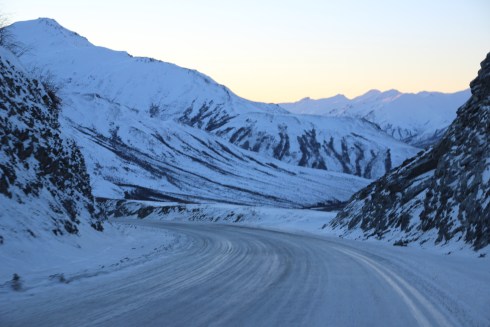
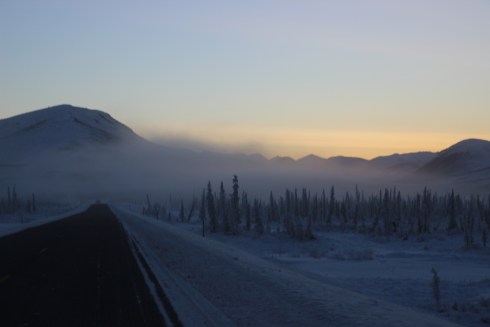
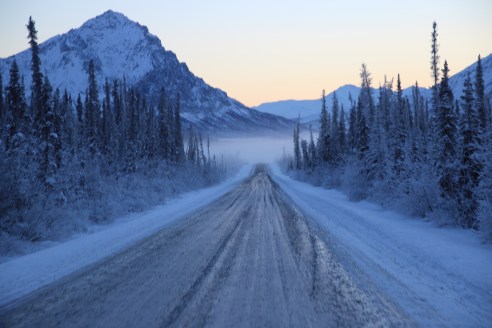
At 11am I went along with Marian and Rodney (also a keen photographer) on a Mountain Safari, which consisted of a trip up the Dalton Highway to a DOT (Department of Transport) way station, the role of which is to keep the lifeline that is the Dalton Highway operational. Given this is the mode of transportation for almost everything up to Prudhoe Bay, a high level of monitoring is required to ensure no cessation of services and deliveries.

I got some really nice photos, again some will be helped along with Photoshop and Lightroom, however here are a few. I really like the texture in a couple of them. I also really like the way the fog lays over very thin parts of the landscape, and the effect it has on the light.

img_1672

img_1699

img_1740

img_1713

One of the things we learnt was that the moose population was fairly thin in the area due to there only being a couple of months of green shoots in the spruce trees in summer. There is twice as long (four months worth) in Fairbanks, so hence there are more moose closer to that city. Also we heard that the day with the lowest amount of sunlight will be December 21. The sun comes up but this north it does not go higher than the horizon. So there is light from around 10.30am to around 2.45pm, but no sun. December 21 will only have around 10 minutes of sunlight, after which it will increase by 9 minutes per day, until it gets to mid year, when there will be approximately 21-22 hours of sunlight. Not sure how comfortable that would be especially the type of curtains needed to get to sleep.

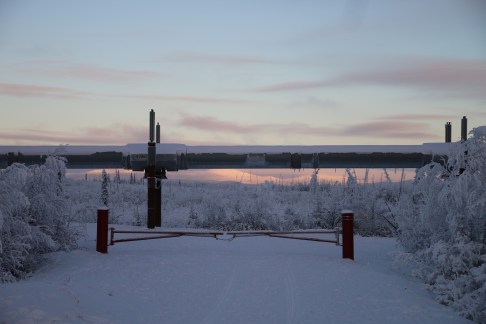
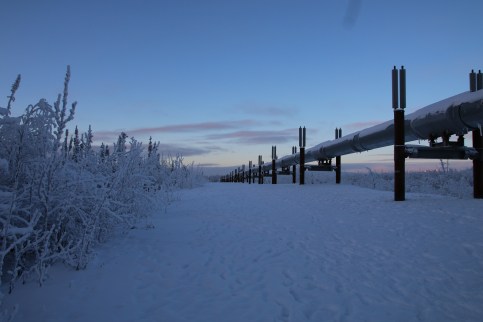
The TransAlaska Oil pipeline started being built in 1974, after the 1973 international oil crisis caused prices to skyrocket in the USA as it did elsewhere around the world. Special techniques were required during construction to offset the Permafrost problem. Without this, any heat from the pipes would cause a melting of the ice and therefore a pressure downwards due to gravity of the pipes. So some of the pipeline is built above ground on a frame / stilts (see photos yesterday), and some is underground.

The pipeline was developed for approximately 2.1 million barrels per day. The current flow is around 500,000 barrels per day. This is due to a number of factors including that the pipeline is now approximately 39 years old, and was built to last 25 years. So reducing the flow is extending the life of the pipe system.

Not all pumping stations (12 were built along the pipeline) are operational due to the reduced flow of oil. And one of the roles of the operational pumping stations is to keep the oil from gelling up due to the cold. So a certain amount is filtered out when it gets to the stations, is warmed up and then filtered back into the pipes.

With the ageing pipeline, there is now a decision to be made as to when to replace it, and where the finances are sourced to allow this to happen.

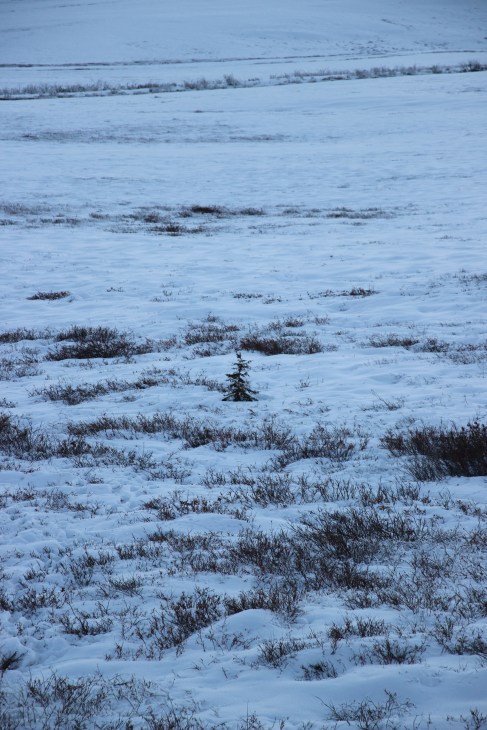
One of the things we did see on this trip was the northern-most tree. Here it is, all on its lonesome 😦

img_1668

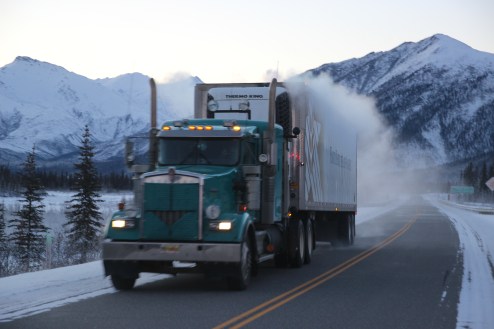
And here is an ice road trucker – without the ice at this point.

img_1756

Then after a while we headed back to the Inn for 3pm finish of the tour. A very enjoyable tour. It also got to the coldest temperature of my whole trip on one part of the tour. The temperature reached approximately minus 45 degrees Fahrenheit, which works out to approximately minus 43 Celsius. Brrr it was cold.

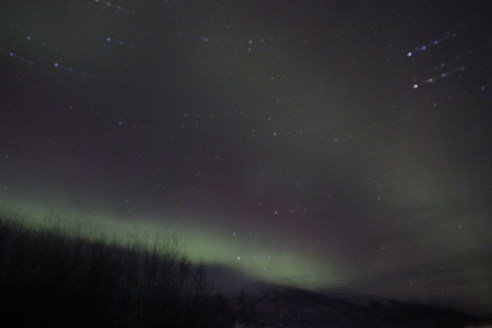
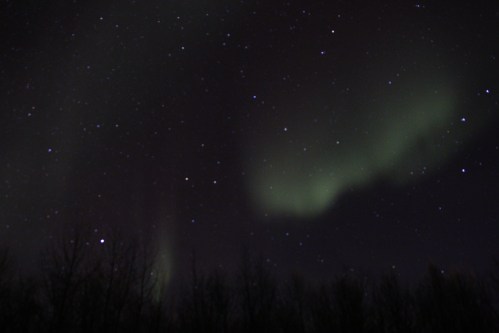
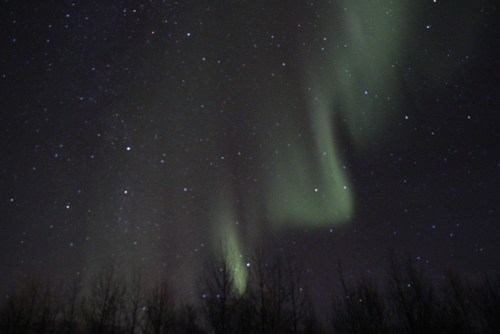
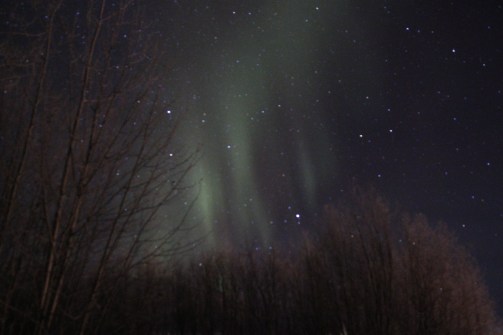
At 11pm, I got up to go over to the pond (it was frozen – about 50 metres from the Inn I was staying at, to take some photos of the Aurora Borealis if it decided to appear. I wandered over first in the dark without my gear to make sure I could get there and back without any problems. Then I got my gear and walked back across and set up. Nothing much happened for the first 20 minutes, and then it came out. Here are a few photos.

_mg_4510

_mg_4533

_mg_4563

_mg_4584

_mg_4595

After an hour it started to settle down. I was very cold at the time (about 10 minutes after midnight), so I packed up and headed back to the Inn to sleep.


November 29, 2016

Today was my trip up north of the Arctic Circle to see the Aurora Borealis, or Northern Lights.

I caught a taxi at 8.38am to the Northern Alaska Tour Company to book in. The maximum luggage we were approved for the trip was 20 pounds (approx. 9.1 kilograms). The tour includes a bus from Fairbanks to Coldfoot, and a light plane flight back. Which I assume is the reason for the luggage weight limit. However despite my best efforts, I could not get the weight below 24 pounds. Even leaving my 100-400mm L Series lens at the hotel L So I just hoped that the 24 pounds would not be a problem.

We were advised that there would be no shops between Fairbanks and Coldfoot, so would stop off at a shop in Fairbanks on the way through to pick up enough for our own meals etc for the day. We headed off at 9.45am in a mid sized coach which was pretty comfortable. At the time, the temperature was minus 30 degrees Celsius. It was minus 38 degrees Celsius in Coldfoot – where we are heading. Joe, the driver, gave us an overview of Permafrost, of which there is a fair amount across Fairbanks – and the problems it causes with building of roads, houses etc., and how many of the locals live up in the hills around Fairbanks, rather than in the city itself, due to the Inversion heat effect, which means it is warmer up in the hills.

Our second stop (after the shops) on the trip was a remote General Store (now closed) which the travel company leases off the owner to use as a stop off, toilet break facility. The toilets were like our camping style toilets with no flush long drops, like you’d use in most Australian National Parks. Although a lot colder so you need to be a lot quicker. According to Joe, our driver, the owner of the General Store was given 20 acres of remote land in the 1970s (this was an offer to Alaskans) on the basis he lived on t for 5 years and upgraded it. So he built the general store. Sadly, more recently the owner’s wife has become unwell so they have had to move to Fairbanks closer to the hospital for her needs. Herewith a very brightened up photo of the centre and a shot of the long drop.

img_1485

img_1486

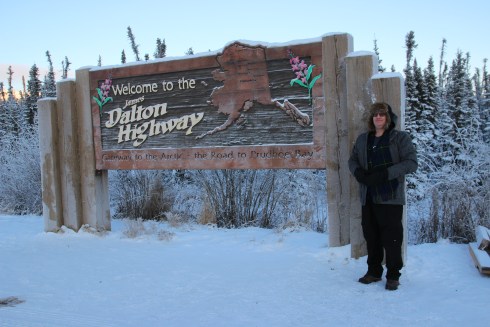
We then stopped at the commencement of Dalton Highway. This is the road used to transport all sorts of goods by truck from the very north – Deadhorse at Prudhoe Bay, down to Fairbanks. This road and the Coldfoot Camp has been seen on the TV show “Ice Road Truckers”. We learnt that DOT (Department of Transport) mixes gravel and sand with water and use it to spray down on the road to ensure stability.

img_1531

Our next stop was a photo opportunity at an area close to the 800 mile TransAlaskan oil pipeline. There is so much history around that pipeline, and it is a significant economic driver for the Alaskan people. But given some of the things I’ve learnt about it, I believe there are some potential economic problems ahead for Alaska. Anyway, will try to do a bit of an overview of the economy, the history of gold and the oil pipeline in a later blog entry.

img_4133

img_4142

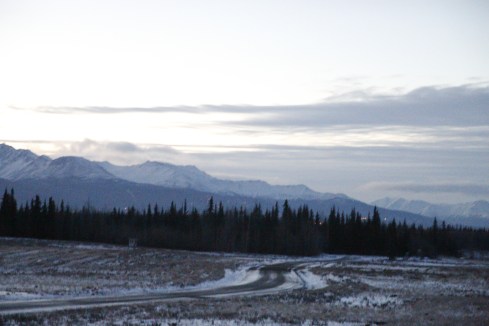
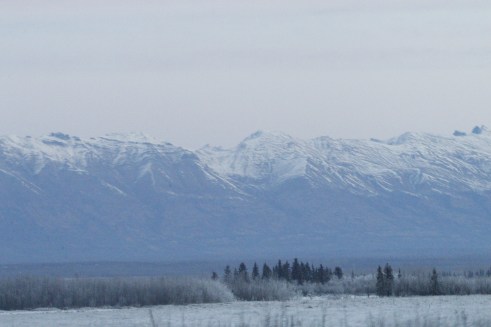
I got some good photos of the scenery from the bus, although with the usual problems because the bus is moving and the only way to get photos without reflection is the camera lens being directly flush with the window. Which reduces the angle I could get for what I wanted to take the photos of. Which in the scheme of life isn’t a big deal.

img_4156

img_1550

Our next stop was going to be at the mighty Yukon River (now frozen). The idea was that we would have our lunch first (at around 2.30pm) and then pop down to the river for photos. However it looked to me like the light would be starting to go down before we got there and so I decided to eat my lunch on the bus, and then go straight down to the Yukon River as soon as we got to the site. I had bought a container of macaroni salad for lunch but had forgotten to buy any cutlery. Luckily, I had bought a packet of small ginger biscuits. So I got out a few of them and used them to scoop up the macaroni salad. I could get three scoops out of each biscuit before it got soft and I had to eat it. In the end I got through the salad, it was pretty tasty.

So when we reached the site, I headed down to the river to take photos whilst most of the others on the tour went to have lunch. I think it would be a magnificent river when it is flowing. I also took some photos of the café / roadhouse and the little boats around it.

img_4232

img_4218

img_4216

After everyone had taken all of their photos, we jumped back onto the bus and headed off to cross the Arctic Circle. The temperature was going up on our trip, with it being at 25 degrees Celsius leaving Yukon River. It was then 56 miles to the Arctic Circle.

Given it was relatively dark, we got to watch a short video “The Alaska pipeline” It was quite educational.

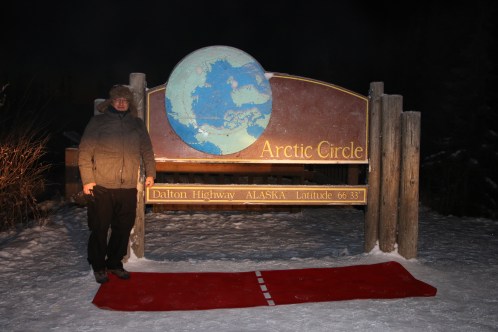
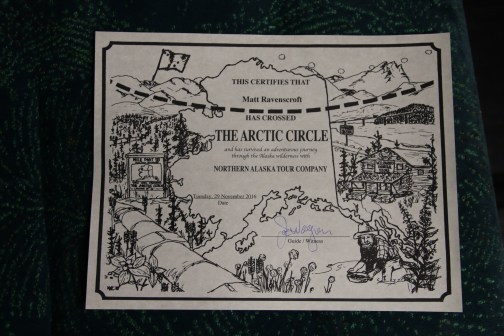
By the time we got there it was dark, but we got out and took some photos of each other in front of the Arctic Circle sign.

img_4267

img_4273

It was approximately minus 39 degrees Celsius. Then we waited for another tour group coming down from Coldfoot to swap over. There were 5 of us on the tour from Fairbanks who were doing a 4 day 3 night tour up to Coldfoot, and about 5 doing a one day tour. There were also some people on a multiday Coldfoot tour who had flown up by plane and were returning by bus. So our 5 were swapping buses with the tourists coming from Coldfoot, and they would all head back down to Fairbanks. So the bus arrived, we all swapped over (ours was now a smaller 10 seater bus) and we then headed off to Coldfoot. When we arrived we got our keys to the Inn and then I unpacked and then rested until our trip out to Wiseman to watch for the Aurora Borealis.

Coldfoot was a gold mining camp from around 1900, which in 1902 had multiple roadhouses, stores, saloons and a gambling house, as well as a post office. Currently there is one café, one inn and a post office, as well as a visitors centre open in summer (and a small one open a few hours three times per week in winter). Wiseman was developed later (around 1908) when gold was found there and Coldfoot people moved to Wiseman.

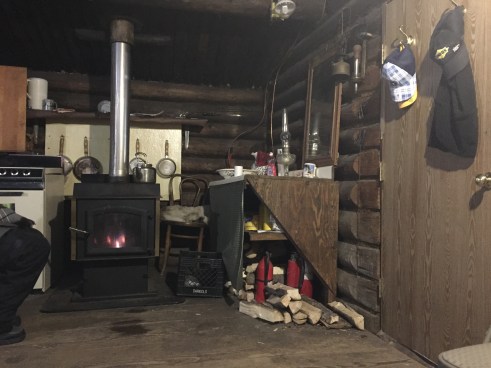
So we headed out at around 11pm to the cabin in Wiseman. It was VERY COLD. But our host lit up a fire outside and put the gas heater on inside. It was a great experience of a real cabin experience. It had a whole lot of old knick knacks, including an old Kodak camera (the same as my first ever camera when I was a kid).

img_4068

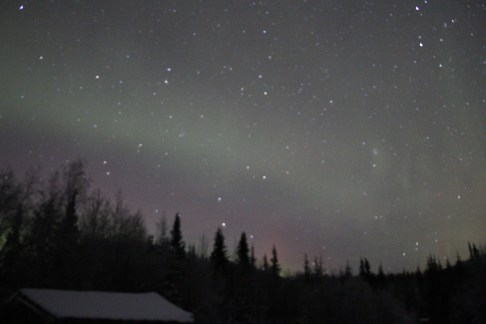
I went in and out of the cabin to take photos. It was really interesting that even though I could get some picture of the lights in the sky, I could not see it very well visually. It’s the camera that makes it look great.

_mg_4277

_mg_4281

Anyway, after a while, we didn’t get to see much more (it comes and goes) so we decided at 2am to head back to the Inn. We got back at 2.10am. It was apparently minus 42 degrees Celsius – and the coldest start to winter in a number of years according to those who live there. So I rugged up and went to bed!

November 28, 2016

Today I went back to the park near the local Visitors Centre to get photographs of the river and the environment. It was a very cold experience. But I did get some very nice photographs. I was surprised to see the ducks on the last bit of the Chena River that was not frozen.

161128a

161128b

161128c

The “Alaska Siberia WWII” memorial is a bronze statue of a USA and a Soviet pilot wearing cold weather gear. The monument commemorates the flights of American planes from the continental USA via Alaska to Siberia. These pilots flew around 8,000 warplanes to protect the war effort between 1942 and 1945. Alaska was the exchange location (USA pilots from the continental USA to Alaska, and handing them over to USSR pilots for the flights over Western Alaska to Siberia.

After an hour, my head had gotten pretty cold and my toes too, so I needed to warm up. So I had to pop into the Visitors Centre to warm up, before heading back out to take some more photos. One thing that I have realised is to not pay attention to the instructions for Toe Warmers. They are little pads around 3cm x 4cm that have a sticky side which you are meant to stick to the top of your toes (above socks, not directly against your skin) before you put your shoes on. So you walk around and they are meant to keep your toes warm. But the ice and snow is below your shoes, not on top of them. So the top of your toes stay a little warm whilst the bottom of your feet and toes freeze. So I started to put them under my toes and they worked a lot better after that. Anyway, here are a couple more photos.

161128d

161128e

It was a fantastic place to spend time in quiet contemplation. Just a spectacular place.

Then I popped back to the hotel and watched some One America Network News (more right wing than Fox News) – the biggest issues were Fidel Castro’s death and Trump’s team trying to paint him into a corner on his picks for leadership.

I went to Red Lantern restaurant and had an entrée of potato twists with mayo and other sauces; with a main meal of steak, mashed potato and vegetables (carrot, sweet potatoes, pumpkin) with a glass of Cranberry Juice. The meal was delicious. I was nearly falling asleep during the meal (not sure why!) so went off to bed.


November 27, 2016

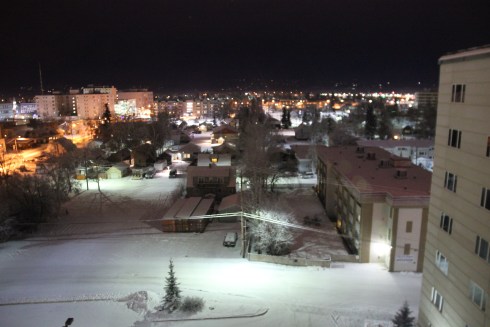
Today was my first day in Fairbanks. I took this photo late last night before going to bed.

161127c

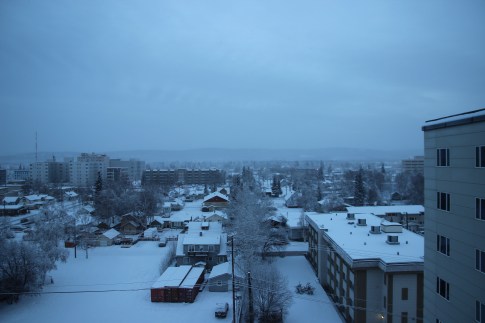
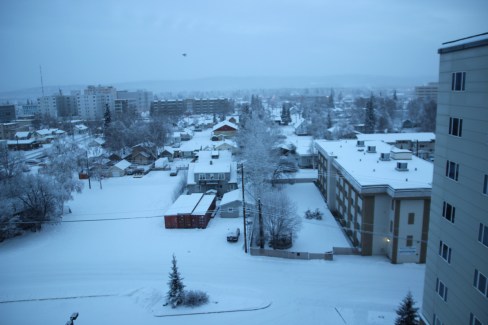
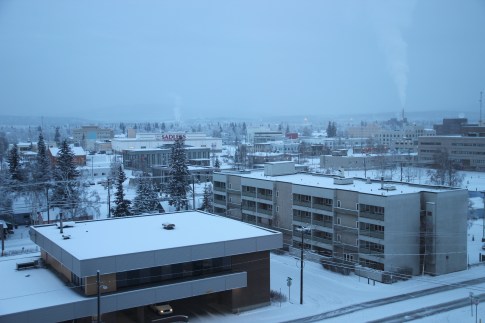
I awoke at around 8am and had breakfast. I then took the following photos from both my hotel room (the first two) and one from another window on my floor. They are a little dark as the sun had not yet risen. The black spot in the sky in the second photo is a bird flying through. I really like the steam coming from the chimney of the third photo.

161127g

161127f

161127h

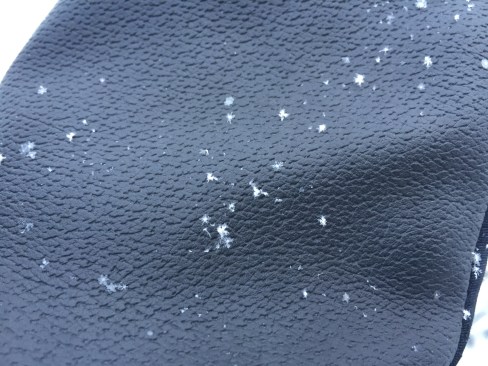
After doing my laundry I headed outside for a walk with one of my cameras, down to the local Visitors Centre. The temperature was a very crisp (-) minus 19 degrees Celsius when I was leaving the hotel. I had to keep taking my glasses off as they would steam up every time I took a breath. I also had to stop for a second at each street to recall which side the cars would come from, given everyone drives on the right hand side of the road. As I wandered down the street, there was a small snow shower. Here are some snowflakes on my waterproof mittens. They lasted about 20 seconds on the mitten, or about a half second on the iPhone case.

161127a

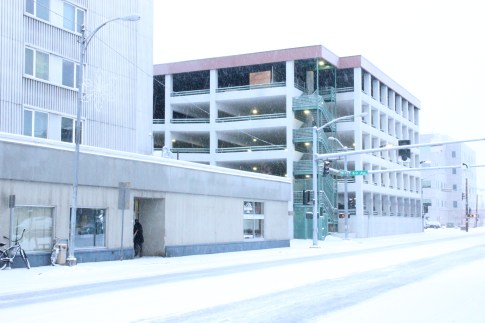
Herewith a photo of a building with snow coming down, which can be seen between the floors of the back building. I adjusted the shutter speed to 1/10 of a second to capture this. The camera set the aperture width which may have unduly lightened the buildings and the snow on the road. Although the scene on the street was very white.

161127l

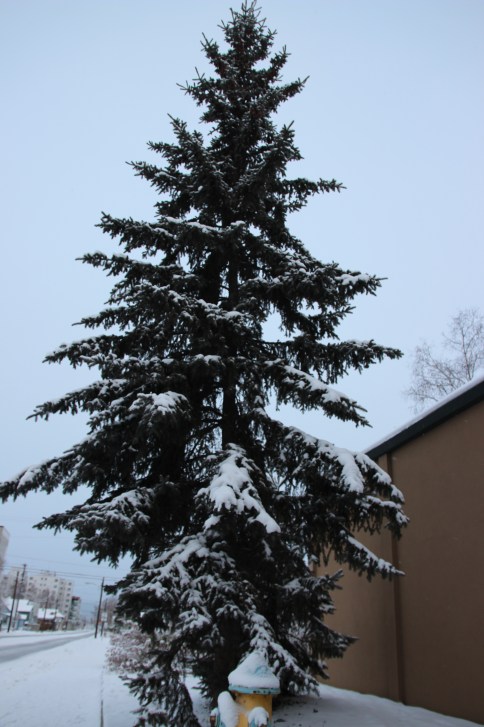
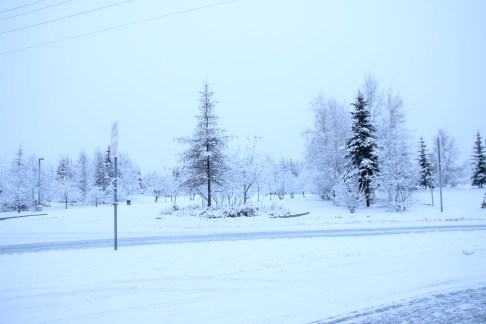
I also came across some Christmas Trees on my walk.

161127j

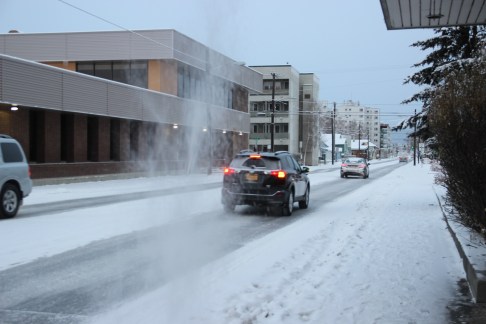
And a small amount of snow fell off a roof as I was walking under it.

161127i

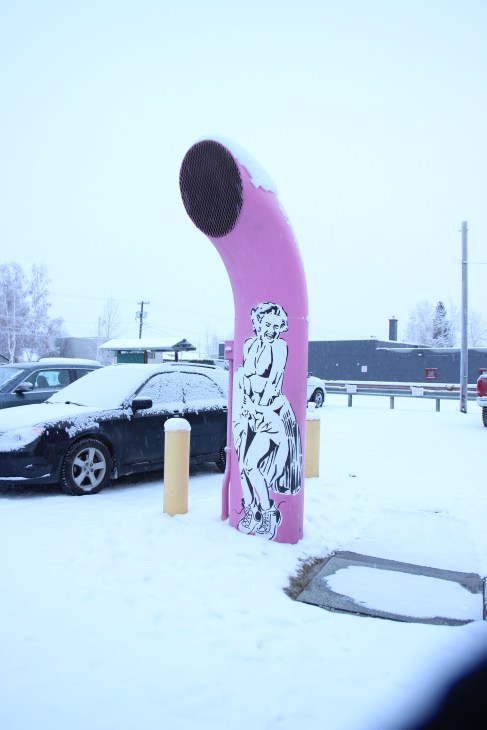
And I came across Marilyn Monroe in a car park.

161127m

At the end of the street (my hotel is on 10th Avenue and the Visitors Centre is on 1st Avenue) is a park that the Visitor’s Centre is located in.

161127n

161127o

By the time I got here, my camera battery (and the spare – I brought one along with me)had gone flat. The cold sends batteries flat very quickly so they have to be kept warm. I was however very surprised at how quickly they were gone.one

161127b

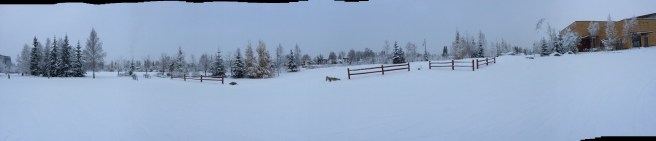
I was able to capture a couple of panoramas on my iPhone before that battery went flat as well. The different variations in brightness can be seen across these photos. I’m going to visit a couple of museums tomorrow but also want to play around with different camera settings in this park. I’ll also spent a bit of time getting into Lightroom and Photoshop to do some further work on some of my preferred photos, but I’d really like to take as many good photos directly through the camera if I can. Without completely ruining my cameras, so will have to wrap everything up in Thermal gear this week!

After the batteries went flat, I visited the Visitors Centre to get some ideas of museums and galleries that I could visit tomorrow or next weekend – after which I went shopping!

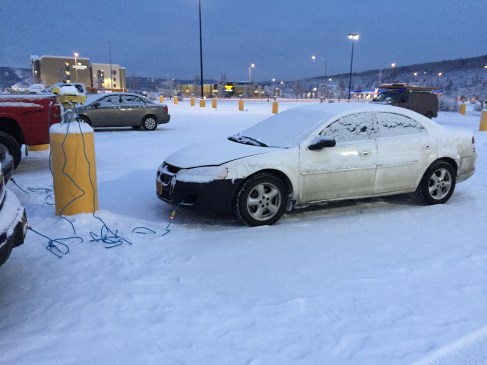
I had a fantastic walk through snow for about 3 kilometres to get to the shopping centres I wanted to stop at. I had to go over ridges of snow, along very slippery “pathways” (not that they could be seen), and through various carparks with snow stacked high. I bought a few bits of clothing that I had waited until I got here for, and some Ice Trekkers for my shoes (chains to wear so I don’t slip over) and a few other things. By the time I had finished in Fred Meyers and Walmart, and was on my way to the Sportsmans Warehouse it was around 4.30pm, the sun had started to go down, and one of the camera batteries had enough juice for another photo. Here is a power station being used by two cars in the Walmart Superstore car park. They have a number of these power stations for staff use during winter to keep their vehicles charged. They aren’t meant to be used by others but apparently sometimes people with large RVs who camp in the car parks overnight will hook up to them.

161127d

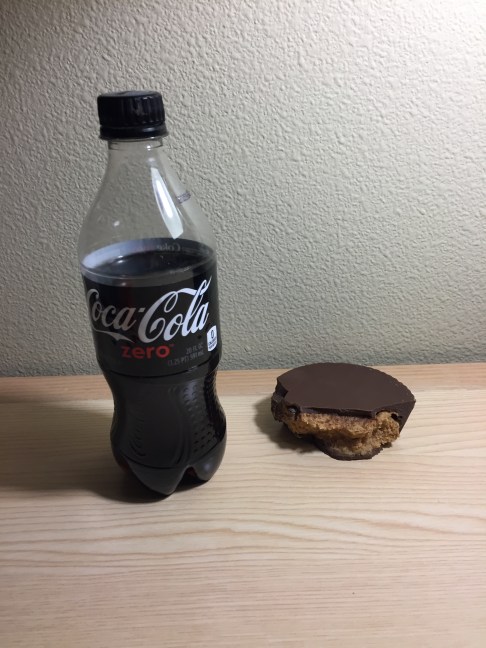
After all that walking (I walked around 15 kilometres today), I decided on a nice Coke Zero and a Reeses Milk Chocolate Peanut Butter Cake. The cake is around 226 gram chocolate coated cake of peanut butter. I took two bites and that was all I could eat. So the rest went in the bin. Then I had a proper liquid dinner.

161127e

Then off to the fitness centre for a workout.


November 26, 2016

Today was all about a train ride.

I walked to the station reasonably early (7.15am for 8.30am start) to find the station full of people. I was surprised so many people wanted to travel to Fairbanks. But when I got on the train (I was in Carriage A, Seat 8D which meant a window seat) it was only about a half full. The train was to take 11.5 hours to travel from Anchorage to Fairbanks, with ETA of 8.00pm).

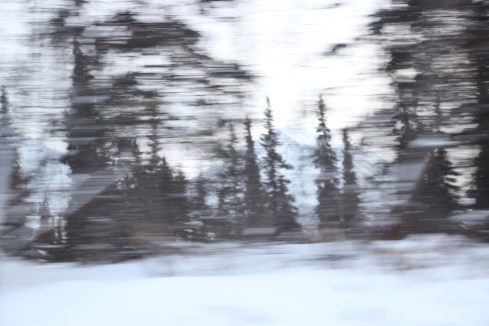
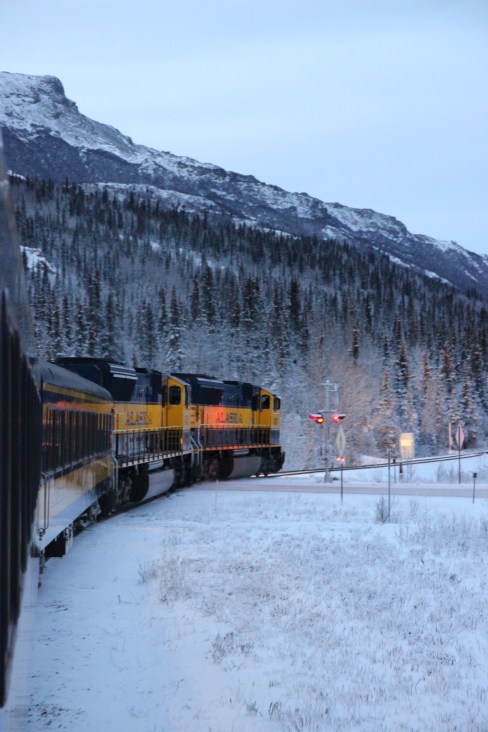
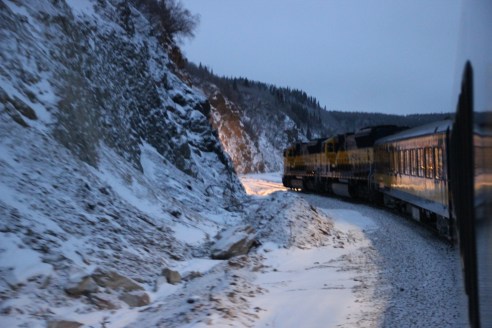
The train consisted of 2 engines, followed by a dining car, followed by two passenger cars, with the luggage car at the end. We took off on time, whilst it was still dark, which meant for some very nice photos early on. There was one vestibule on each of the two passenger cars, and these had the top half of the door removed to allow for photos to be taken. Each vestibule could fit about 3 people each side. And generally there was only photos worth taking on one side at a time. This wasn’t due to there being nothing picturesque on both sides, there was plenty to see. In fact the whole trip was nothing short of majestic. However both sides of the track from Anchorage to Fairbanks were covered by thin trees or Christmas trees. These trees stopped the camera from focusing on anything beyond them (mountains, off-grider shacks, etc.), and given the speed of the train, made the trees themselves blurry.

161126a

And with around 30 photographers on the train including around 10 hard core photographers (including myself), it was a battle to race to the vestibules first when something really great to photograph came along, or there was a break in the trees (although by the time I’d race to the vestibule, waiting my turn, focus the camera on the mountains or lakes, we’d be back to trees to block the view). It was too cold to stay in or around the vestibules for more than about 1 minute, so that was not a solution. In the seat beside me was a young lady from one of the “lower 48” (as Alaskans call the main body of USA states) who was working in Anchorage studying water use and reuse opportunities in remote communities, with her parents across the aisle. After I got up a couple of times to take photos (I had the window, she had the aisle seat), she decided to go to sit somewhere else. I offered to move to another seat myself but she was okay.

Here are a couple of my earlier photos.

161126b161126c

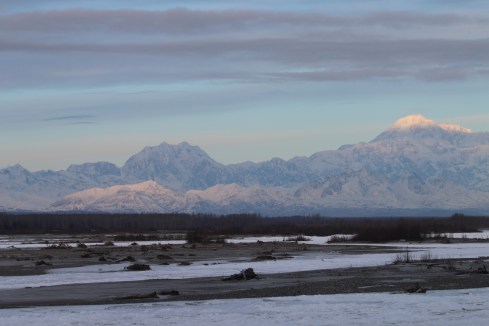
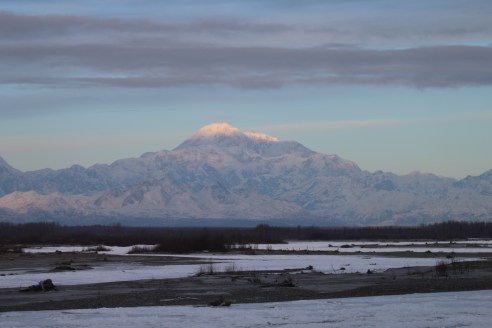
We got to Mount Denali and those around it, and so I got a couple of shots of that too.

161126d161126e

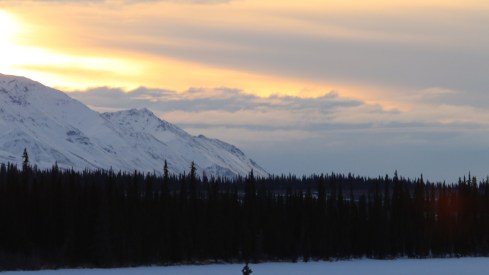
By around 3pm, the temperature was cooling and the sun was starting to go down. So I got a few shots around that too.

161126f161126g

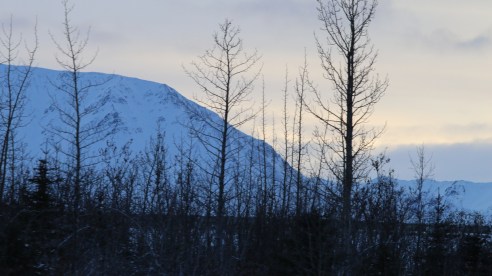
By around 4pm, it was so cold that the few remaining photographers were all rugged up when getting into the vestibule. I made the mistake a couple of time of putting my head out to get some photos of the train as it made a curve.

161126h161126i

After that my head hurt so much from the cold and wind that I couldn’t take any more photos out of the vestibule windows. For those who have had a cold forehead when eating something cold too fast (like ice cream or a frozen drink or dessert), where you have to hang your head for a few seconds to let your head get back to normal – imagine it 20 times as bad. Plus the cold seeped through my gloves, and even though I had a handwarmer, I didn’t think a few photos were worth losing my fingers over. I have never had them so cold. So after that I only took a few photos through the window next to my seat. Apart from that I put on an audiobook to listen to.

161126j

161126k

During the trip we were offered breakfast, lunch and dinner. I had already had a free breakfast at my hotel so gave that a miss, but I had a tasty lunch of corn and vegetable soup, followed by a Reindeer Sausage Hogie.

161126l

The reindeer was not as tough as emu, in fact more like kangaroo in texture but more like emu in taste. I am hoping that everyone gets Christmas presents this year, as I’d feel really terrible if it turns out that I have eaten Rudolph.

For dinner I had Chef Alexa’s Penne Special, which included a blend of red and green peppers, onions and mushroom in a coconut milk tomato sauce. It was quite tasty. I might try it myself with some home grown chillis to add some bite.

About 7pm, the engineer advised the train host that he could see a little of the aurora borealis. So they turned the lights off and about two thirds of the passengers crammed across to see it. I wasn’t one of them. Mainly because there wasn’t much room on that side and a number of the passengers had their phone torches on, meaning you couldn’t see anything anyway. I hope to see it on my trip to Coldfoot in a few days. Overall it was a very enjoyable train ride. We arrived at Fairbanks about 5 minutes early. It was a very crisp (-) minus 20 degrees Celsius. Then I caught a taxi to my hotel (Westmark Fairbanks Hotel) , unpacked, went down to check out the laundry, spent about 20 minutes on the crosstrainer and rowing machine in the fitness centre, and then went to bed.