Today I slowed down just a little bit because Winnipeg had a high wind chill level, taking the minus 27C up to something close to minus 40C. Therefore when I headed outside it did not take too long for my face and head to hurt – my face and head only being covered up by a scarf, a beanie and a hoodie from my jacket, as against the three layers on the rest of my body. Again like an instant ice cream headache. So I walked behind various buildings to keep away from the wind and then headed across to the closest skywalk to get to the Manitoba Art Gallery.
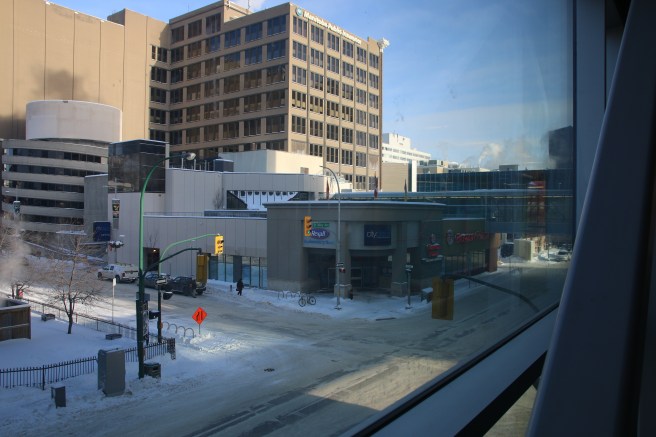
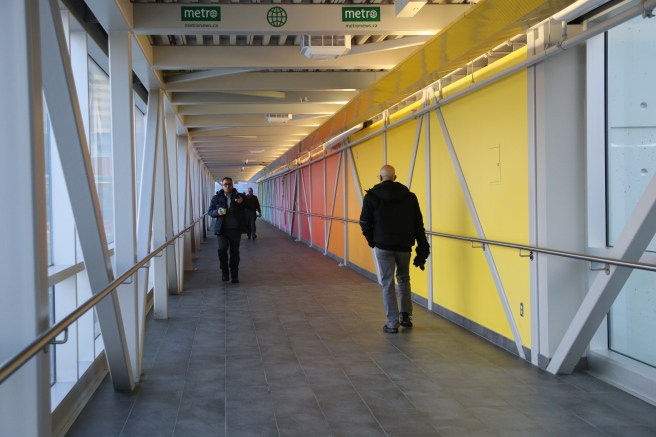
Where Montreal and Toronto have underground cities (tunnels linking various buildings with shops and train stations so you can walk through much of the downtown without getting out into the snow, rain and cold), Winnipeg has skywalks. These are walks that are linking buildings at second floor level, a level above the street, also with shops in some places, however Winnipeg’s is significantly smaller in scope than the other two mentioned above. The first photo below shows one of the skywalks (above and to the right of Boston Pizza) taken from another skywalk link, with the second photo being inside one of the links. Not as busy as the larger cities, but still as useful.
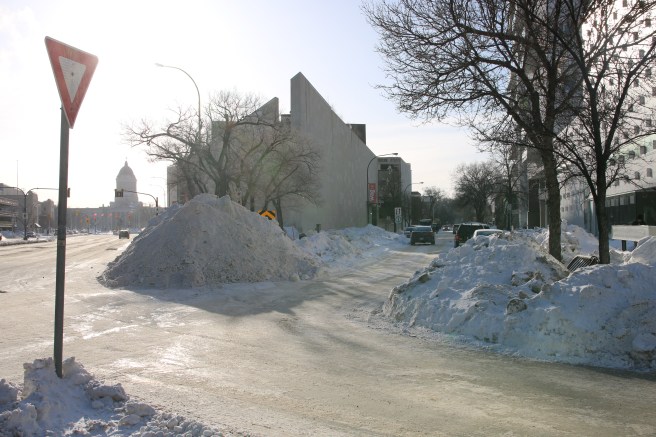
But it worked for me. I got to the art gallery in about 10 minutes. Below is a photo of the Art Gallery, the building in the middle. This photo is of interest to me because it shows (a) piles of snow on the sidewalks that usually get pushed away within 48 hours in the eastern cities like Quebec City, Montreal and Toronto but apparently not so much in Winnipeg from what I have read, and (b) the Union Station is the building to the left with the dome. Interestingly, Winnipeg and Toronto’s railway stations are both called Union Station.
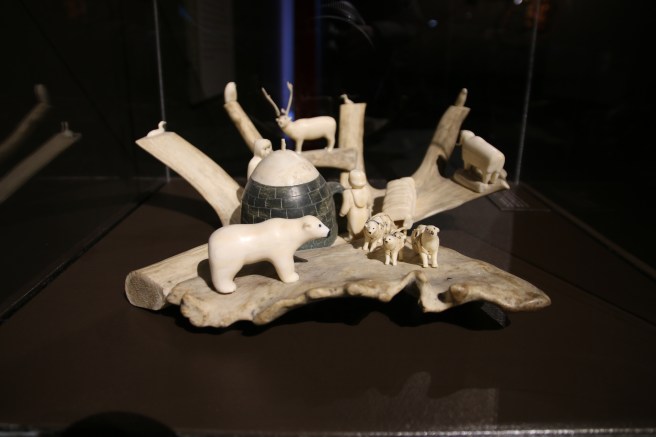
I went inside and bought my ticket and then headed into the first exhibit, on the first floor. This was of Inuit Sculptures. Inuit inhabitants of the Canadian Arctic initially carved functional items for themselves, however as trading occurred and extended over the 19th and 20th centuries, they started to carve articles for sale/ trading. The most common material they used to carve was stone, and the type depended upon what they could hand quarry. Because some had minimal access to useable stone, they carved with materials such as ivory, antler and whale bone. The Manitoba Art Gallery has one of the largest collections of Inuit carvings and has plans to commence a new gallery to display these and the rest of its collection more appropriately. More about that later. Some of this work is very intricate.

After that exhibit, I went back into the lobby to have a look at a couple of the large tapestries the gallery had on its walls. These 16th century tapestries are called the Bisham Abbey collection, as they once adorned the walls of the Bisham Abbey in Buckinghamshire, on the country estate of King Henry VIII. Herewith an example of one.

I then headed up to the second floor to see an exhibition of sculptures under the title “Starting with Rodin”, by Francois Auguste Rodin and those taught / inspired by him. There were around 30 sculptures in the exhibition. The first photo is of two marble items by Rodin, ”Tete de danseuse” and “Small Torso”, with a story of Rodin having sculpted these (and others) for a planned Museum of decorative Arts in Paris, which never went ahead. The next is a marble sculpture entitled “Crouching Venus” by Italian Pierre Barzanti. The most important item, in the exhibition in the bronze sculpture “Danaid” by Rodin. Danaid is a femme fatale who murders her husband using a hairpin, and is an apparent reference to ancient mythology via the Italian poet Dante Alighieri.

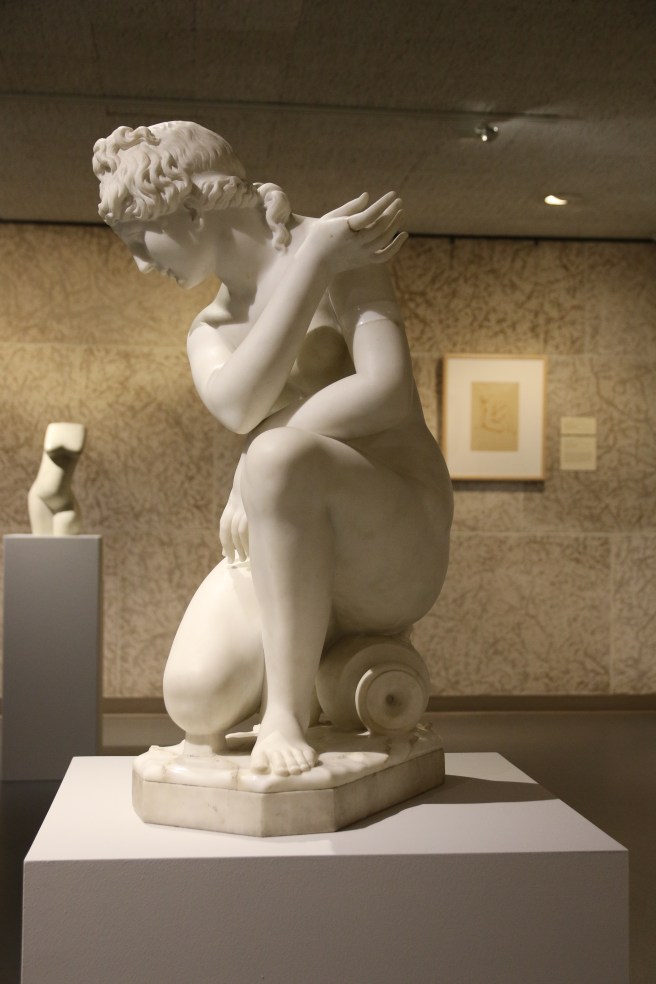
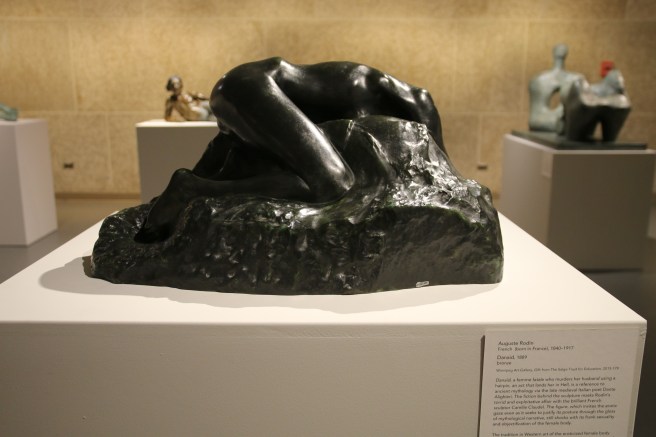
After this, I reviewed the plans and model for the new art gallery which is due to commence construction in the next 18 months. It has a number of really good features, the best for me being the Visual Vault. Knowing that galleries own significantly more artworks than are displayed at any one time, the gallery (apart from the usual exhibition spaces) will have a cylindrical galls-walled art storage facility which will display thousands of artworks, and where the public can visualise curatorial and conservation activities. An interesting way for the public to see more than the usual displays.
After that, I headed up to the third floor, where there are two exhibition spaces, one I would say has about one third of the floor, the other with two thirds, as well as the lobby space. The lobby space itself is taken up with a large size model of “The Thinker” by Rodin, this one believed to have been created by Rodin students or ancestors after his death from the original plaster cast moulds Rodin used from the original sculpture to make other casts.
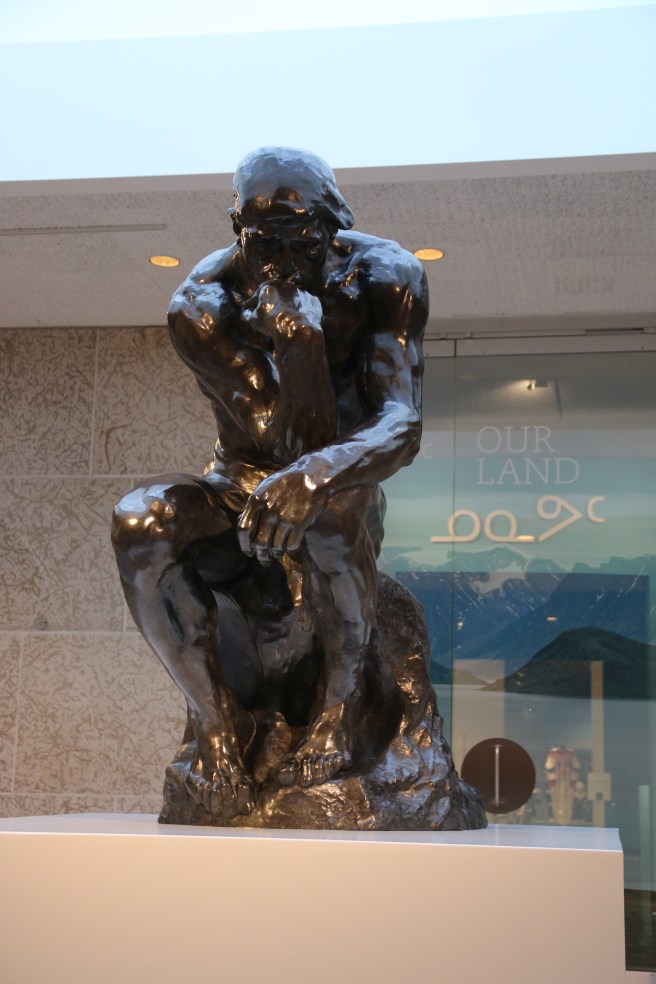
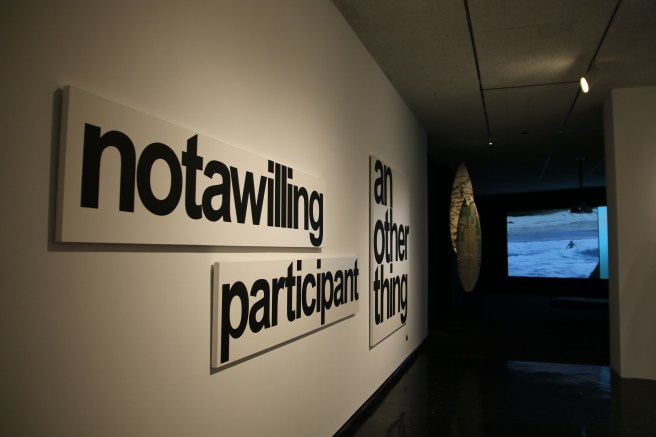
The smaller exhibition space starts with a smallish area that is set aside for an installation by Vernon Ah Kee called “cantchant”. It’s an Australian Aboriginal display, some surfboards painted in the colours of the Australian Aboriginal flag, plus some signs on the wall, going through to a room with a very large split screen showing film of Dale Richards, an Australian surfer, surfing.
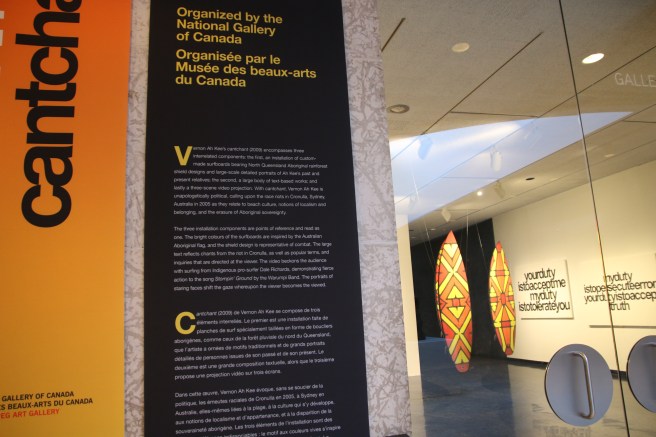
The remainder of that side of the exhibits is a storyline both visual and electronic of Inuit, Metis and First Nation artists and the sorts of art that they create. There was a fascinating range of modes and styles, and stories of artists and their communities, as well as the cooperatives that they use to promote their artworks. The artworks and the videos were quite fascinating.
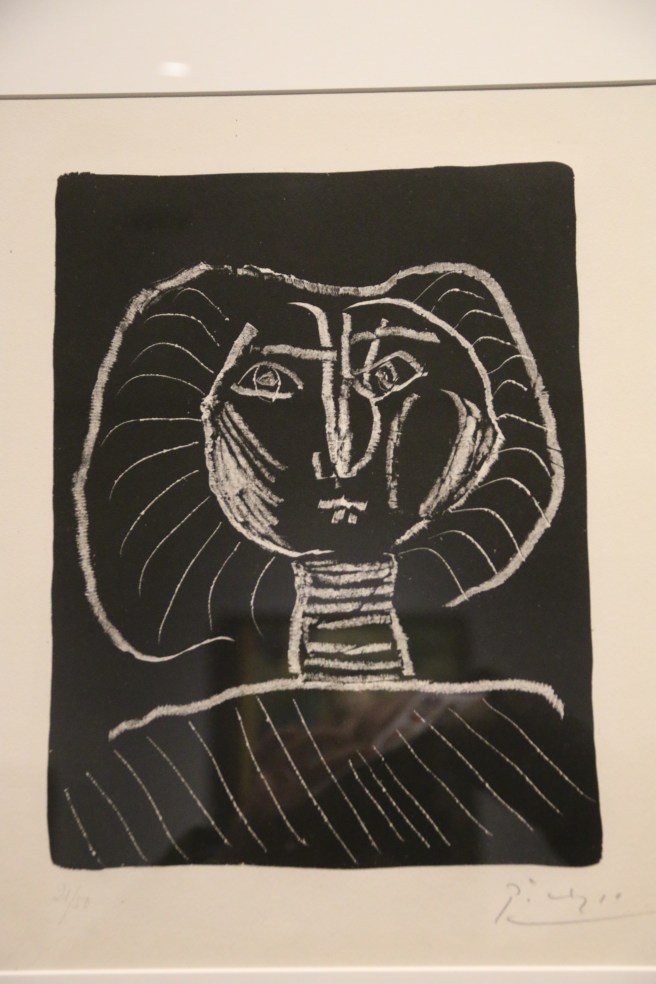
The larger of the two exhibition spaces on that floor consists of a large number of paintings as well as some sculptures, by Canadian artists. This took me a good hour to go through. The painting themes ranged from religious art through to portraits, old style landscapes, newer techniques, and to ones that look like they were done at day care by a 3 year old. There was even a Pablo Picasso lithograph on paper “Tete de femme fond noir” (below). Below is also a photo of a very small portion of this display.

By then I headed back to the hotel for a quick break before then heading off to my final visit in Winnipeg, The Forks.
The Forks is a small area on the river where the river splits into two. It is just behind and past Canadas Human Rights Museum. It is a little difficult to see given the river is frozen and covered in snow, however in the below photo, the Red River comes from the left and “forks” into two to the right of the photo. The Red River continues on the far side of the concrete bridge pylon (and then heads passed the buildings in the photos middle) and the Assinboine River comes off on the close side of the concrete bridge pylon.
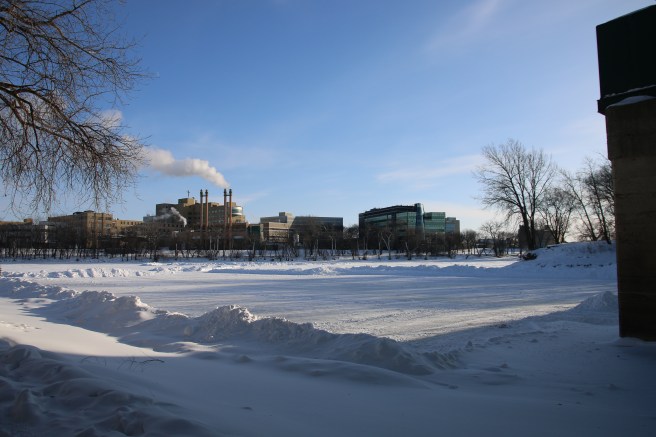
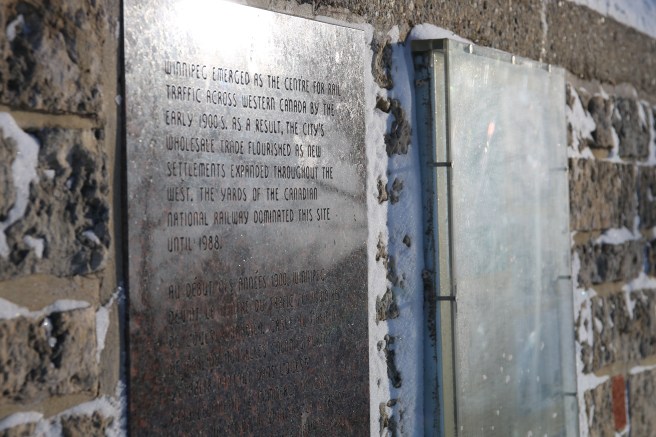
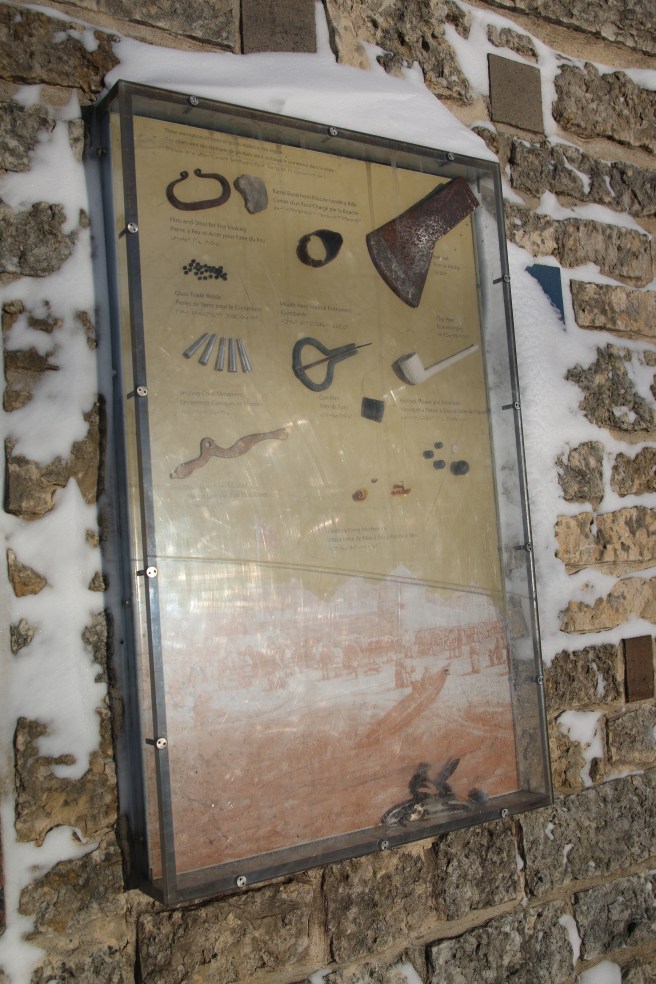
This is an area of historical significance, with artefacts showing that early aboriginal groups arrived in the area over 6000 years ago. Artefacts uncovered included hunting and fishing tools. The site was visited and transversed through by multiple peoples, and was used as a meeting place and a trading site. As it is now with its markets, restaurants, ice skating rinks and walking trails with stone plates of historical information, along with models of some of the artefacts located. Some parts even expose the sedimentary changes on the river walls over the 6000 years and earlier.
It started to cool down quickly, so I headed back to my hotel to pack in readiness to travel to Edmonton tomorrow morning.
 mattravoblog