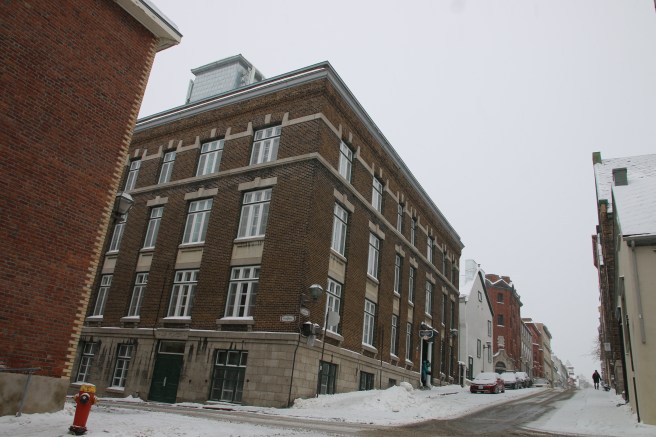
Herewith a photo of Auberge Internationale de Quebec, my hostel.
Today I went on two short tours.
The first tour was a walking food tour of the Saint-Roch District, an area a little north west of Old Quebec where I am staying. Getting there I had my first experience of the non-infallability of Google Maps. I left an hour early just in case the place was difficult to get to, plus as it was snowing I wanted to buy an umbrella. The seventh store I went to on my route had umbrellas for sale, although only one type, so I bought one. One of the umbrellas that are about 35 centimetres long and you push it to open up. Instead when I pushed it, it did not lock into place. I read the cover and found it was an automatic one with a button on the handle. You press the button and it opens. It uses a piece of string so does not lock into place. Then you press the button again and it closes. When carrying a camera bag, wearing gloves and trying to manage the umbrella, you’d be surprised how many times you accidentally press the button so the umbrella goes down and up and down and up – not exactly what you want when you are trying to shield yourself from the snow. So in the end I held it by the metal shaft instead of the handle.
On my way I saw a taxi but decided to keep walking.
Further to my journey to Saint-Roch, I found that the streets Google said were in place were not the same as what was on the side of the buildings. I ended up about 500 metres the wrong way until I closed the phone and decided to rely solely on the paper map I had. Which was okay, apart from now having a sheet of paper which is around A2 size with about 16 folds to juggle under the umbrella just added some complexity to my attempt to locate where I was going. In the end I made it just as the snow shower was increasing in strength.
The meeting place was Fromagerie des Grondines on Rue Sainte Joseph (rue translates to street; and the majority of the rues in Quebec City are names after saints). It was a nice little shop / delicatessen with a broad range of cheeses, prosciuttos and other meats, plus the olives, dried tomatoes etc. that one would use for a picnic or an antipasto plate. It also has a few tables to sit and eat / drink / talk. Hopefully the new Fiorita deli in Karratha will get to this standard.
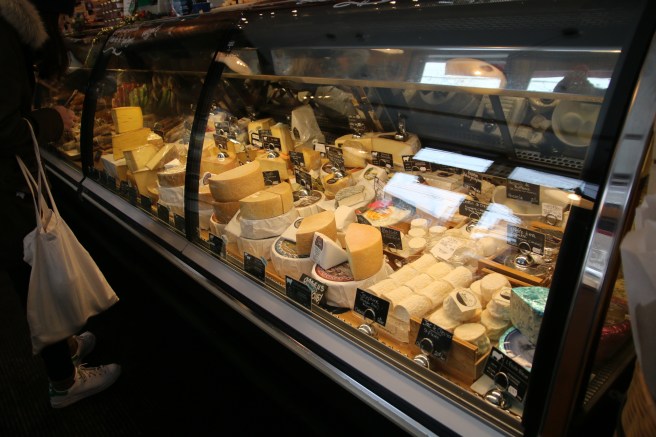
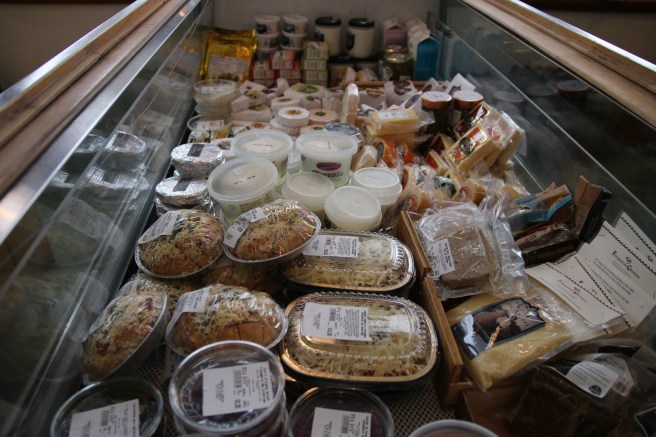
We had some of those tables reserved for the 9 of us plus our tour guide, Florence.
Florence introduced herself, then went around the group and we all introduced ourselves. She then talked about growing up in the area and how it had become a real foodies paradise with many different types of food and drinks being made here. We then started sampling. We started with a sample of cheese, then a drink made from a sea buckthorn berry which then has some water, oxygen for bubbles and some maple syrup for sweetness added to it. Delicious and something I may try when back home. We then finished with a toasted cheese sandwich. It had, as expected, cheese; but added was a thin slice of prosciutto, sun dried tomatoes, and pesto. This really added to the taste, and it was good to have on a cold morning. We then headed out into the snow shower for our next stop.
Stop 2 was Om Prana, a Vegan Bistro. The owners had visited as tourists, a year ago, liked the area so much that they decided to move their and buy a business. They purchased a vegan restaurant and changed it a bit by making it a bistro and adding some other items not eaten by vegans, but have kept the vegan foods as well. We got to sample a Raw Avocado – Lime Pie. Our walking tour booklet even has the recipe in it. For vegan food, it was quite tasty. I generally think vegan and vegetarian food goes really well with a 400 gram medium-rare T-Bone steak so am unlikely to try the recipe myself. But that’s okay, to each their own. And with the range of ingredients and final products at the bistro, I think the new owners will do well.
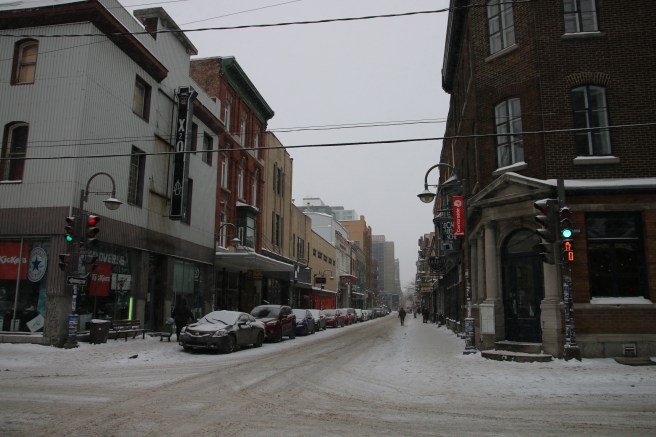
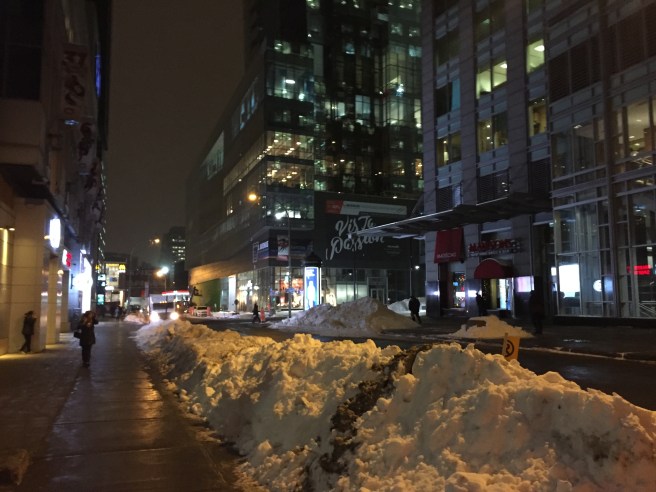
After we left the bistro, we walked through the streets in the snow and had some information provided about some of the buildings and history by Florence. There are some very interesting stories and history behind these areas and Saint Roch itself has obviously come a long way from its past. The area in this photo was a shopping mall 20 years ago but is now more boutique shops below and condos above, as the shopping malls in the suburbs mean that many urban dwellers no longer need to travel into the city.
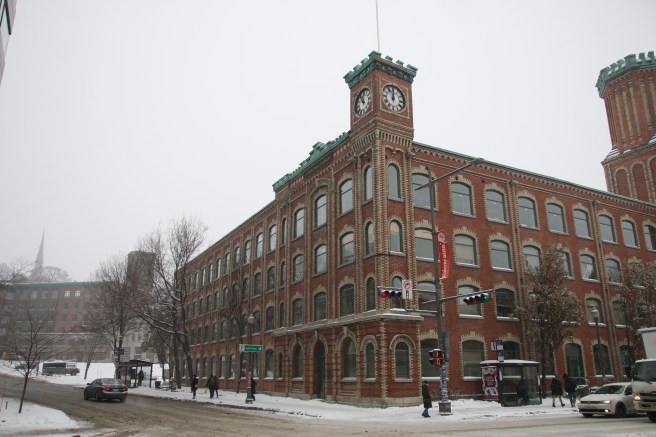
This building – originally built as a factory – used to be a place where ladies of the night plied for trade, drug dealers hung out and generally was a no go area. To clean the place up, an art school was developed nearby and artists were moved into it. As urban renewal it worked really well.
The next stop for us was Noctem Artisanal Brewers. It had a large dining area, with a bar to the side and the brewing room at the back behind glass. So we could see as one of the owners was in testing some of the brew (mainly by sight and smell) whilst we were there. It was a nice clean spot and we started by having a glass of their IPA. It was a mid straw colour with a low aroma (that I could smell) and a slight sourness but with a herbal and nut feel to it. Tasty. To go with it, we had a small plate of pickled salmon and cabbage (I think it was), and I had a pickled salad whilst the others had black eyed peas, which I cannot eat. We then followed up with a stout. Very strong, very bitter with a nice long aftertaste. Whilst we were dining, Florence discussed the microbrewery scene (there are 4 in this area) and how they work together to an extent as they see themselves taking customers from the commercial breweries rather than each other. And in a place like this, customers can tend to go on a pub crawl, so they will visit each of the microbreweries and may then get hooked onto some of their products.
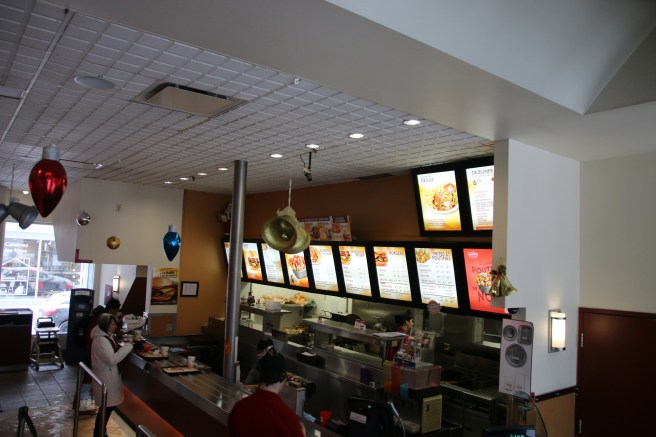
The next place we were heading to was dropped from our list, as it was a tea house and was very small, so with other customers in the store we would have gotten in the way. Or something like that. So then we headed down Rue Sainte Joseph to Chez Ashton. This started in 1969 as a little food van, and has grown into a fast food outlet. We went in and our food tasting here was Poutine, that great Canadian food, which it is said Mr Ashton brought to Quebec City. According to our host, it originated in Quebec and there are three small towns that claim to be where it originated from. It consists of French fries, cheese whey and gravy. Hearing the story of the three towns made me chuckle and think of pavlova. So this was my second time trying it. It is an interesting concoction, and is apparently similar to the kebab for those from Perth, that is: it’s drunk man’s food – you line up to buy it when the pub closes at 3am. And apparently here in Quebec there are very long queues for it at that time.

We then headed off to our last stop – the Champagne Chocolatier. Always a great ending to a tour. We got to sample both a chocolate, in this case a raspberry chocolate, and have a hot chocolate drink, in my case I had a dark chocolate drink. It’s usually stronger but has less sugar than the milk chocolate drinks. It was perfect for a morning wandering through snow showers. Then others then started buying gifts. Everyone else on the tour was from the USA and would be heading back within the next week. Any I buy I’d end up eating myself so I took the opportunity to thanks the tour guide and head back to the hostel. I didn’t hurry, I browsed around, looked in windows, at buildings and generally just taking my time. Even though it was lightly snowing, it was a pleasure to be outside in Quebec City at that time. It was a very enjoyable tour.
I got back to the hostel and browsed a bit through my photos and read up on some activities for Quebec City.
My next tour, the Ghost Tour of Quebec City, was to start at 2000 hours at 94 Rue du Petit-Champlain which was close to Saint Lawrence River, so I headed off around 1830 hours to scout the locations on the way for photos one night when I’d take my tripod etc. So I headed over to the top of the Quebec City wall near Le Chateau Frontenac – apparently one of the most recognisable and photographed hotels in the world – to see down the embankment to waterfront, and across the river over to the area of Levis.
With much of the wall around the old city mainly still standing, and the steep embankment around the waterfront, it can be seen that it was a very tactical position to establish the settlement. Quebec City was founded in 1608 by explorer Samuel de Champlain, although it had also previously been the site of a fort built by another French explorer, Jacques Cartier, in 1535. This initial settlement was abandoned not long after it was started for various reasons including unfriendly natives and harsh winter conditions. Tactical for a reason – there were many battles for it over the following 200 years. More of the history later.
So from the peak, I headed down L’escalier Casse-Cou (AKA the Breakneck Steps) very slowly so as to land at the bottom in one piece, still alive. The snow and ice on the steps make them somewhat dangerous in winter, so holding onto the rails for dear life seemed to be the way everyone dealt with them, and I followed suit.
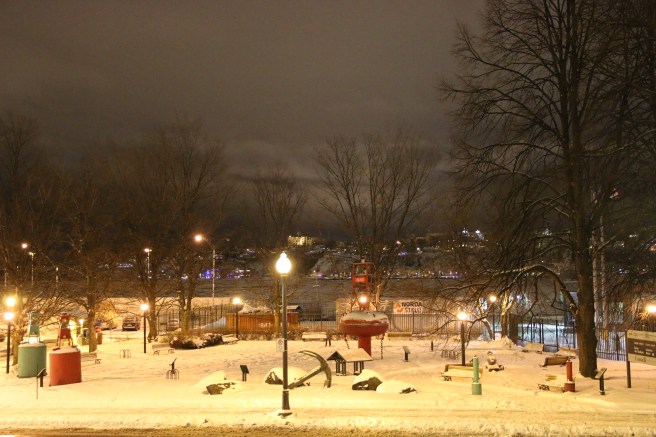
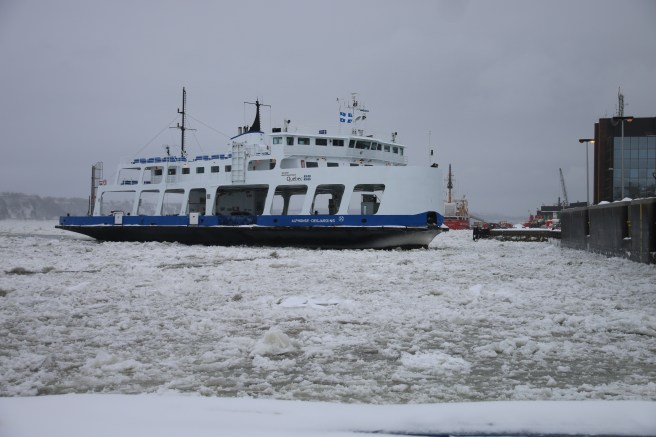
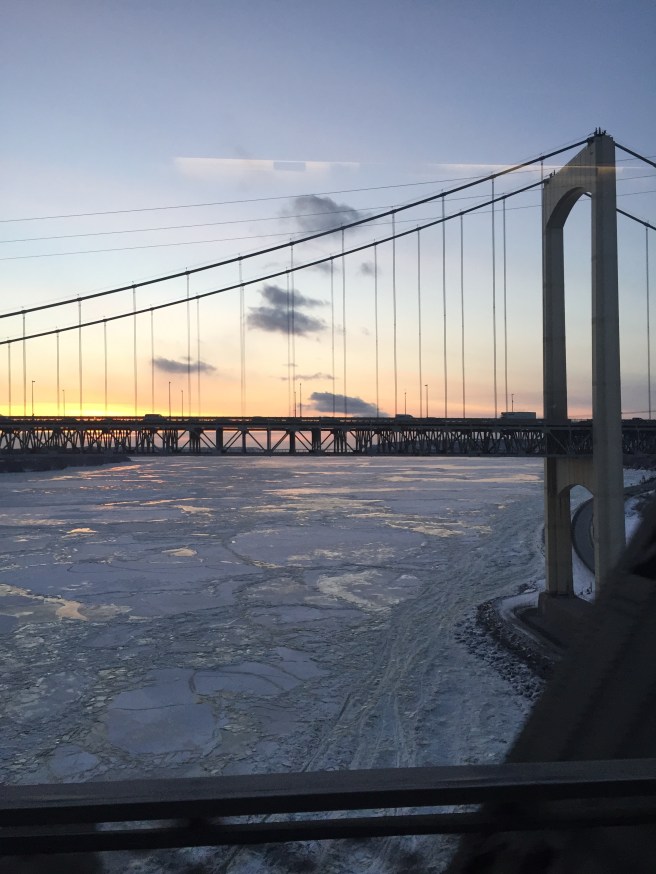
I wandered over to the riverfront – the ice in the waters was just something else – and then made my way to Rue du Petit-Champlain. I met up with Trevor, our tour guide, around 1930 hours, which gave me the opportunity to wander around and look in windows and take more photos.


So we started at 2000 hours sharp. The tour turned out to be more about death and spooky stories than ghosts, here were a couple of those thrown in. Because (a) Trevor didn’t want us electronically recording his stories (quite rightly since he had done all of the research and was the entertainer not wanting it to be uploaded to YouTube), and (b) my iPhone battery died pretty quickly – it always goes flat in the cold – and I didn’t have a notebook, I don’t have as much info on this tour as on the last. Plus they are his stories so I’ll just go into a small number of them, a couple of interesting ones and a couple that are publicly available.
Herewith Thomas, our tour host, at our commencement point.
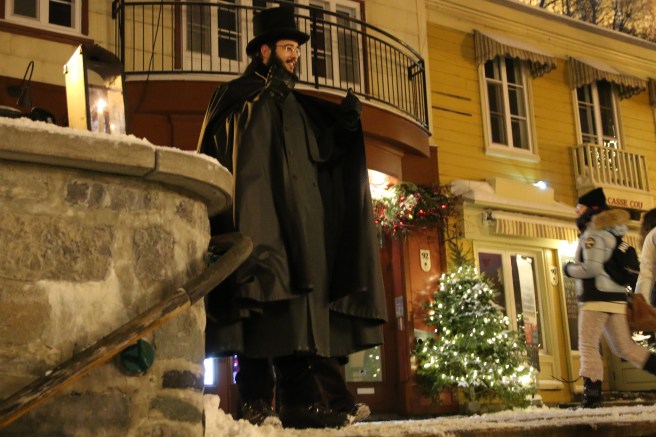
The first story he told was of a farmer who had been involved in an incident at a pub where a young girl was killed. This farmer had a wife and three children. The farmer was sentenced to death. The gallows was built in the town centre right near where we were, on the steps of the Cathedral of the Holy Trinity (more about this below). However, on the day of his hanging, the hangman dropped dead. Given the difficulty in finding hangmen due to the antipathy the community felt towards them – they were despised and ridiculed by everyone – the warden came up with an offer. The farmer could wait in prison until the hangman was replaced and he would be hung, or he could become the hangman himself and be set free. Naturally he took the latter option. This meant his family was looked down upon and so had to settle outside the walls of the city. Also, due to the community outrage and their treatment of the family, some of the kids became thieves, and on one date the hangman had to put his own wife in the stocks and watch the community throw rotten fruit etc at her. Obviously the role of hangman had some other duties.
Another story was a proposed murder of Samuel de Champlain himself, to allow for the taking over of the fledgling colony by the murderous crew with the aim of delivering Quebec to the Spaniards. The planner of this plot was by the name of Jean Duval, a locksmith, and he had plotted this with 3 other ringleaders, however there were also a large number of others aware of the plot. However, one of these others, another locksmith by the name of Antoine Natel got cold feet and had word sent to de Champlain about the plot. De Champlain met with Natel to confirm the details, and then set his own plan in motion. He had the 4 ringleaders invited to a ship of his that was in the harbour, on the pretext that it was to share alcohol with a group of Spaniards to congratulate them. All 4 attended the event, and were seized by those loyal to de Champlain. Duval’s body was then hung from a gibbet at the top of the embankment as a warning to others. At this time, the tour guide turned around and pointed to the spot the body, and then after, the head, was hung from.

One of the interesting stories told for mine was that of the Empress of Ireland (I was the only visitor who was aware of it due to my visit to Halifax). The Empress of Ireland is otherwise known as Canada’s Titanic. The tour guide talked through the story from the point of view of a couple of the passengers of this ship. It set out from the port in Quebec City on Saint Lawrence River at around 1630 hours on 28 May 1914, and included a theatrical team of husband and wife who were finishing a show and heading back to England. The wife was very worried about the journey as this was only two years after Titanic had set sail and sunk. After much justification and reasoning, her husband convinced her to take the trip. At around Rimouski in the early morning hours, the captain, Henry Kendall (promoted to captain of the ship earlier that month), and crew sighted a Norwegian ship (SS Storstad) on her starboard bow several miles away. SS Storstad acknowledged also sighting the Empress of Ireland. Fog then came down to cover the area. The ships continued to communicate using fog whistles. However something went wrong as at around 0200 hours on 29 May, Storstad ran into the side of the Empress of Ireland. Storstad remained afloat however the Empress began flooding and listed to starboard. It sank within 15 minutes, resulting in the deaths of 1012 people (172 crew and 840 passengers). The Empress had watertight doors, however there was insufficient time to close them in the 14 minutes. The reason that this story is part of the tour relates to Captain Kendall. In 1910 (four years earlier), he captained the SS Montrose for the Canadian Pacific Line. He spotted on the ship a disguised Dr Hawley Harvey Crippen (Dr Crippen being known and wanted for the murder of his wife and her burial in their basement) and his lover Ethel Neave, who was dressed as a boy. Kendall sent a message through to the British Authorities of his suspicions – the first ever use of wireless to capture a wanted person – they dispatched the Chief Inspector from Scotland Yard, who had interviewed Crippen before he fled. The Chief Inspector boarded the ship as it was coming into port, in the uniform of a ship’s pilot. He then made himself known to Crippen, and he then arrested him. Crippen then swore a curse on Captain Kendall. It was believed by some that the sinking of the Empress of Ireland was that curse being fulfilled. Except that in this instance, the captain did not go down with his ship. Captain Kendall was thrown from the ship when it keeled over, survived and lived to the ripe old age of 91.
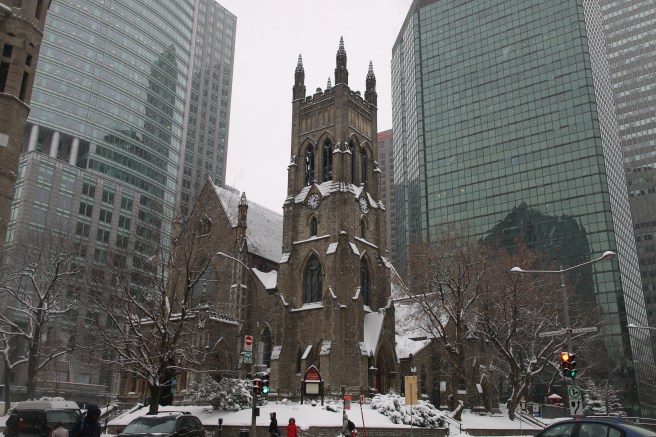
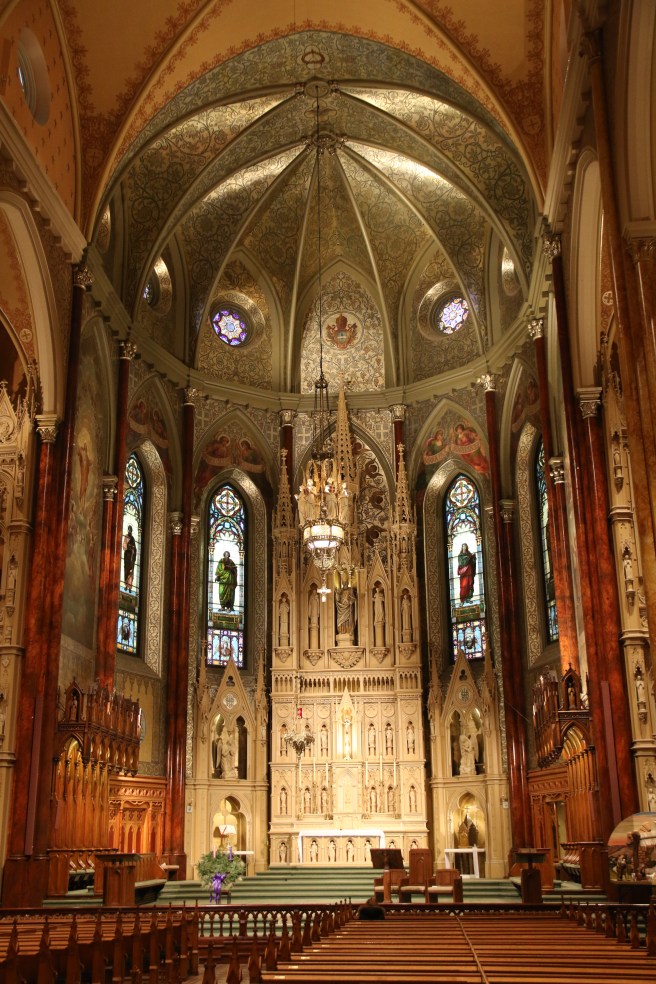
The last story was set in The Cathedral of the Holy Trinity, which was consecrated in 1804 and was the first Anglican Cathedral built outside the British Isles. We were able to sit in the pews inside the Cathedral (in the dark except for one candle) as the story was told. Apparently the Cathedral is haunted by a ghost. The ghost is a female who has been spotted by many people, especially organists who generally play at night when the building isn’t used for other things. At one time, the papers of the organist have been blown around on the floor, even though there is a screen to stop this happening. In the upper balcony is a seat reserved for the Royal Family, who have sometimes visited. And Queen Elizabeth the Second is said to have commented to the bishop of having seen a women in black walking around on a visit in the 1960s. There are a number of stories as to the woman’s history. One is of a nun who became pregnant, knew she would be unable to retain her position and so sacrificed the baby and buried it in the grounds of the Cathedral. When one of the ghost experts visited and spent some time in the Cathedral, after an organist raised this, he said that the ghost meant no harm and that to placate it the organist just needed to bring childrens’ toys with him when attending. The organist quit instead. Other stories of who the ghost is relate to the cholera epidemic. This covered a period 1832 to 1866, when there were a number of short epidemics. The story goes that a woman was so scared of catching the epidemic that she refused to go outside (cholera passed from person to person contact). When her husband had to go away for two days, he stockpiled enough for her and so she locked the door when he left and refused to open it for anyone. When the husband returned, his neighbours informed him that his wife had died from cholera and so they buried her. He refuted their claims as he said she would never go outside, or come to the door, so it could not have happened. Their belief that it did happen made him more upset, and he demanded that they unbury her so he could see for himself. They dug her up and found that she had died, but there were many scratching marks inside the container she had been buried in. The belief then was that she was so worried about cholera, that when her neighbours knocked on the door to check on her, she went into a shock where she was temporarily paralysed (it has been confirmed as possible), the neighbours thought she had died, and so they buried her alive.
So that was a spooky end to an interesting tour of the haunted properties and spooky stories, just in time for me to wander back to my hostel and jump into bed.

















 mattravoblog