Today is my last full day in Montreal, and my trip was to Parc Olympique (buildings mainly built in early 1970s to host the 1976 Summer Olympic Games). The buildings include:
- the Olympic Stadium (which after the Olympics became the home for various sporting teams, including Major League Baseball, Canadian Hockey, North American Soccer League, and now the Major League Soccer as home of the Montreal Impact;
- the Biodome (built as the velodrome for the 1976 Games);
- the Rio Tinto Alcan Planetarium (opened in 2013 – built to replace the Montreal Planetarium which closed in 2011.
Across the road are the Botanic Gardens, so that was also part of my plans.
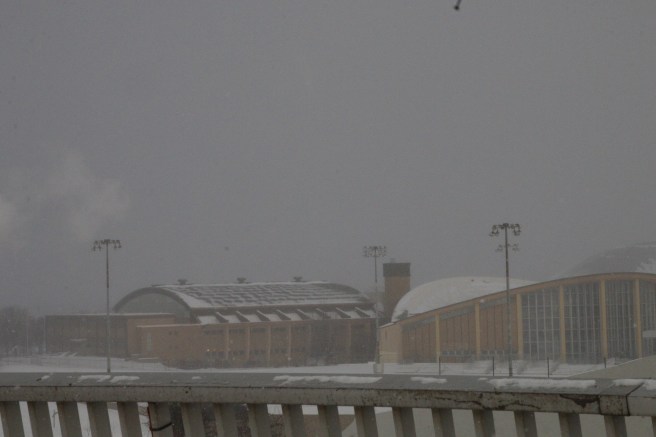
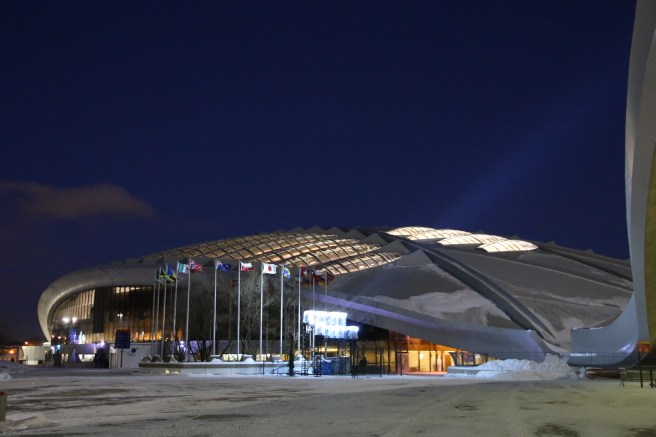
I caught the train out to the Parc Olympique, and decided to head for the Botanical Gardens first, as they were furthest away, plus they and the Biodome closed at 5pm and I wanted to see through them both prior to that time. The photo here is partially the Olympic stadium with the Biodome in the background.

Visiting a botanical garden in winter, when there is a lot of snow, may sound like a silly idea, since there’d be no flowers, or water ponds / fish, etc. – everything would be (and was) covered in a good 30+ centimetres of snow. But they did have both an Insectarium and a Greenhouse open, and I wanted to see those.
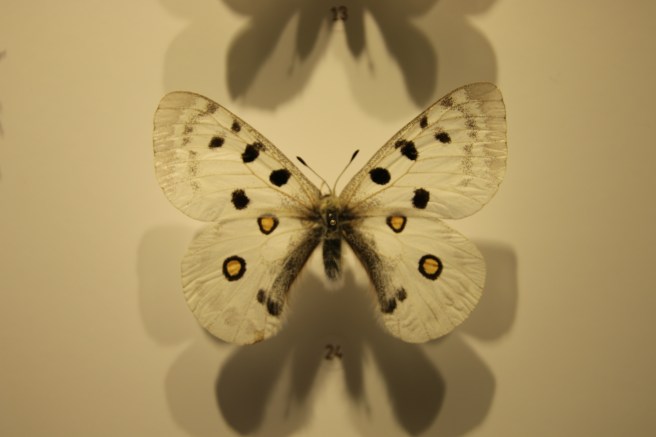
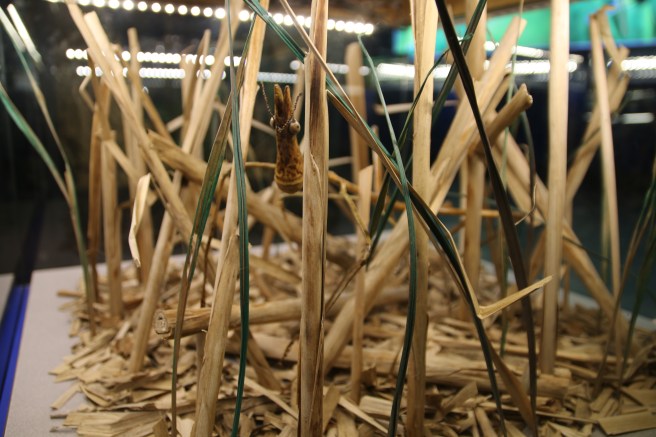
I got into the Insectarium and went over to the bugs and butterfly section. As usual these are made up of display cases filled with insects pinned to the back board. I always like to see the butterflies and moths given their delicate nature, multiple colours and designs. I especially like the ones with what look like eyes on their wings. The displays were split between insects from tropical, temperate, and other zones as well as those that are generally out during the day separate from those out at night. I did enjoy browsing through the different zones and the glass cases with live insects of different sizes (including spiders and ant colonies).

I then headed over to the greenhouses. Like most of these that I have seen, it started with a tropical rainforest (which reminded me of the forest areas north of Cairns in Queensland), and then moved into different zones. Given the greenhouse was around 500 metres from the insectarium, my camera showed its displeasure of moving from very cold to the warmish temperatures and humidity you get with tropical gardens, by deciding to constantly fog up and therefore be of no use in this area. So I took it out of the bag and just let it slowly settle to the appropriate temperature – and used my iPhone to take some photos.
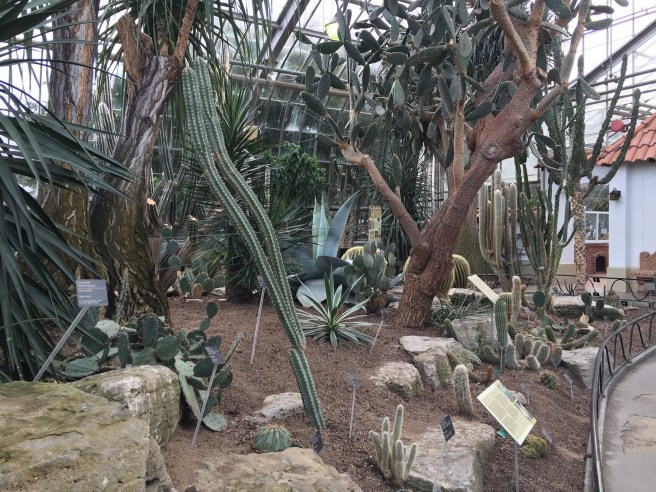
One of my favourite sections was in the arid zone, where there were a significant number of succulent species. I had not realised that the trade in these items had gotten so large that it has made it onto the Convention on International Trade in Endangered Species of Wild Flora and Fauna. I have been wanting to start a succulents as well as a native wildflower section in my garden next year, so I’ll be more wary of where the plants come from.
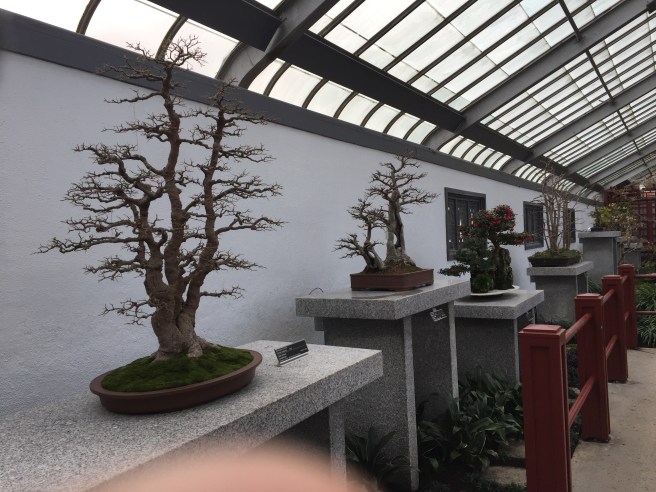
After this section I went into a zone that included bonsais and a Japanese and a Chinese garden. I was surprised to read that bonsai actually came from China (as penjing) and were introduced into Japan around 1000 years ago. The Chinese version apparently can have more than just one plant, sometimes a mini-garden, and sometimes miniature furniture. The Chinese penjing plants are also allowed to grow a little wilder than the bonsai, apparently. So I sat down for around 15 minutes to contemplate nature.
After I left the greenhouses, I headed back to the Olympic stadium. It was about 300 metres away but took a little over half an hour as a severe snowstorm with strong winds decided that that was the perfect time to come down. Luckily after about 5 minutes I came across an enclosed bus-stop to rest in.
Once I got back to the site, I entered the Biodome.
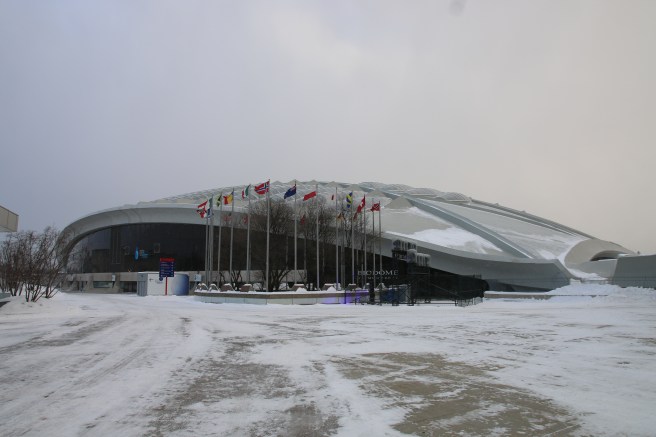
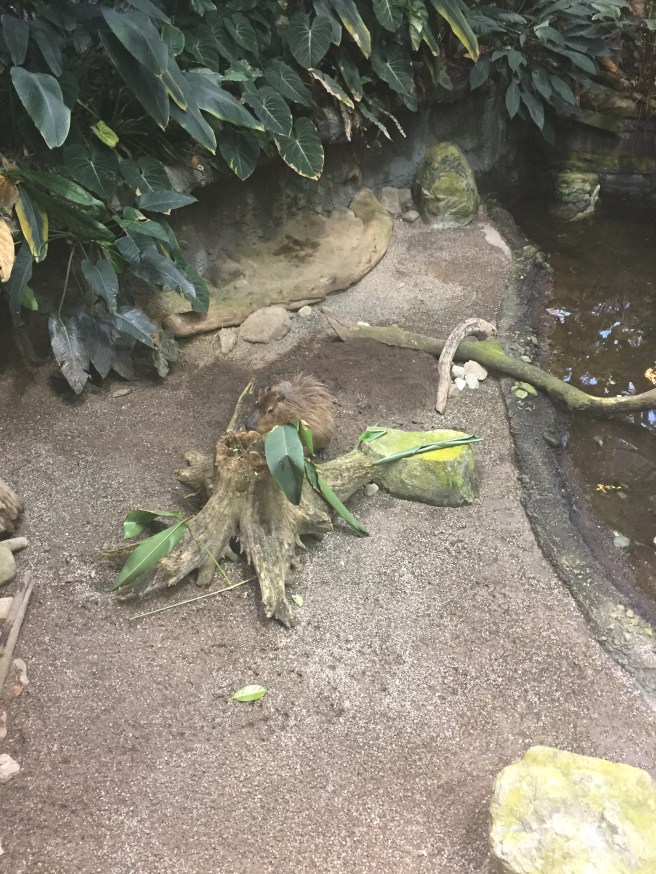
The Biodome has four sections with the aim to recreate the ecosystems from the Americas: tropical rainforest, maple forest, Gulf of Saint Lawrence, Laborador coast, and Sub-Antarctic islands. It houses over 4500 animals from over 250 species, and includes 500 plant species. It was a very interesting tour, starting with the tropical rainforest (again) but this time with a range of animals including beavers and capybaras (a large rodent – hiding behind the tree trunk below) – again my camera decided to fog up so I took iPhone photos here too.
This section of the biodome (the Gulf of Saint Lawrence) had a range of animals, plants and aquariums in it to show a broad range of what it is like. I then headed into the aquarium section, which had a massive curved tank, I would estimate around 10 metres wide and 12-15 metres deep (front to back), and around 3 metres from the floor to the top of the tank. It had a wide range of fish of all different sizes (it wasn’t the only tank in the biodome), with a rocky section in the middle. There was a school of fish that swam around the aquarium, and so I took as video of them that I am thinking of putting to music. They took around 1 minute and 20 seconds to get from one side of the tank to the other.
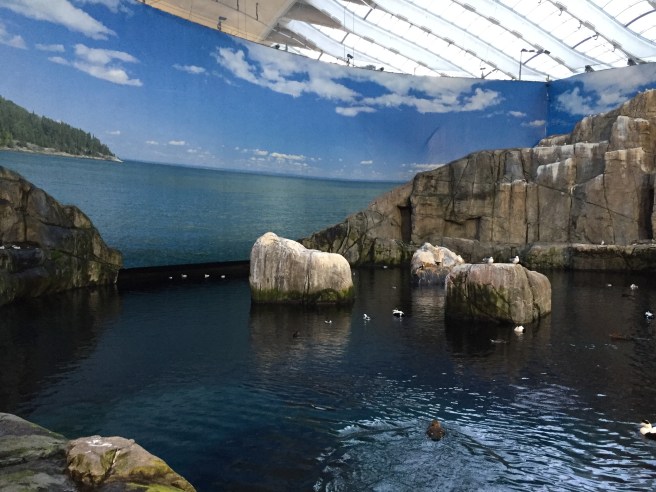
The next section was set up with an “ocean” and rock mounds in the water, with a large mural of the ocean, sand and some hills as a background, with many seagulls and other birds inside. This one you would walk through, and some of the birds flew onto the wooden planking as I walked across. I reminded me of the beach (and I guess it was the area that represented the Sub-Antarctic islands). There was also some seating in this area, but no touch screens like in the previous sections to learn more about the plants and animals.
All in all, a very interesting experience and well worth a visit. When I exited the biodome, it was 4.30pm, and my first Planetarium exhibit was not starting until 5.30pm, so I had something to eat at the biodome café and then headed outside to take photos of the buildings with the sun down. I made the major mistake of deciding to leave my gloves off for this period, so I could take photos without having to take my gloves off and on and off and on, etc. . The air was extremely cold, and by the time I had finished taking photos, I couldn’t move my fingers, they were like ice. I raced into the Planetarium with visions of having to amputate some fingers off both hands, and it took 15 minutes of rubbing and massaging them inside before they would work again. I can now partially imagine how bad it is for those people who freeze to death on Mount Everest and other spots in the cold.

Whilst waiting for the first Planetarium exhibit (it would be a film) I wandered around the lobby and looked at the various bits of asteroids, mars rocks, etc. that they had in cases. There were some interesting stories of the finding of some of these fossils and bits of rock, as well as a replica of a piece that was around 275 million years old. Next I sat down at a screen with a lever and a button, and drove the Mars Rover vehicle around on the screen (with visuals of being in a crater on Mars) looking for water. It was quite fun, and I can imagine in a decade or so as Virtual Reality makes these games more real.
I then headed into the first of the theatres to watch a 25 minute film titled “Asteroid: Mission Extreme”, narrated by Sigourney Weaver. The theatre had a semi-spherical roof, with one row of seats on the rim and a bunch of bean bags in the middle. I chose to lay on a bean bag and look up at the screen. The premise of the film was that asteroids as well as posing a threat to humankind, also create an opportunity. With specialists having decided that humans cannot take a trip to Mars and return, due to the inability to take along the amount of fuel required for the return trip – could asteroids be used as supply points for future space missions? They could include some bits of infrastructure and either be cut through or blown through to access water, and convert it into hydrogen, or they could be like a mini-space station storage facility which could then be used to access the fuel – obviously needing the asteroids to be going in the right direction and travelling past at the right time to access the fuel. It is believed this may be necessary for us to colonise new worlds.
After that finished, I headed out to the café for small carton of milk to drink and then awaited the next exhibit. It was in another theatre, which also had a semi-spherical room, but with seats in about 5 circles, on an angle to look up at the screen. This exhibition was narrated by a gentleman in the middle of the room next to a large spherical object. It turns out that this was a large projector, and was used to project the Montreal night sky onto the roof / screen. It looked so clear, much better than you’d get looking outside even on a clear night. Two other projectors then overlaid other information, including the constellations, the milky way and various planets, and showing the different ways to find where you are and to find the planets at night. It was extremely interesting, however I’m still happy to use maps and GPS to find my way around. But I may look at taking some photos of the sky in the Pilbara when camping just to see how they go.
After this, I headed back to the hotel and went to bed.
 mattravoblog