Today, I did nothing. To be technically correct, I didn’t do nothing; after breakfast I stayed in my hotel room, edited part of my photo catalogue, updated my blog, read the newspaper, watched television and chilled out. Then I went to bed.
Month: December 2016
December 29, 2016 (Thursday)
Today is Niagara Falls Day. I was picked up by the small bus at 9.15am and dropped off to get onto the full size coach. Which was full, so my camera gear went in the luggage compartment under the coach.
Then we headed off on the two hour drive to the Falls. The driver, Alex, advised that we would be visiting a wine school (the only one in Canada) for some wine tasting, then head off to Niagara Falls, and then visit a village called Niagara on the Lake on the return trip.
On the way, Alex talked about some of the history of Toronto as well as the falls.
Some of the information about Toronto he gave:
- Toronto is pronounced Toronno
- 13% of the population is chnese
- 55% of the population is not from Canada
- The current birthing rate to Toronto residents is 1.3, only half of that in New York, and so they need to accept immigrants just to keep things running
- Since 2004, housing prices have gone up by over 10% per year
- There is a section of apartments (called condominiums in Canada) just south of the city that was fields in 2004; it now has a significant number of condo apartment towers
- But as is happening in Australia, these are not full of people, 11,000 of them are owned by foreigners, many not resided in so the government is looking at options for them as they have increased prices of properties but are not adding to the economy (sounds like Australia and other countries where the middle class Chinese are investing)
- The average cost of a house in Toronto is just under $1m
- 280,000 immigrants entered Canada last year
- Toronto has 6 chinatowns, 3 little Indians and these areas continue to expand
- Toronto has minimal public transport outside the city centre
- It is very expensive to live in Toronto or Montreal, although Quebec City is cheaper
- Millions of Canadians spend Christmas and the New Year with their family, and then head off to Florida for winter
Relating to Niagara Falls and waterways
- The 5 great lakes in USA / Canada hold 22% of the world’s fresh water
- Canada has 3 million fresh water lakes, mainly in the north where there are few people but plenty of land
- The escarpment from which the water flows to Niagara is 2000 kilometres long and is 400 million years old
- The falls at full strength can flow at the rate of 6100 cubic metres per second
- It flows at an average of 2400 cubic metres per second because of the number of pipes taking the water out above the Falls to generate electricity (75% of the water is piped off). Ontario gets 65% of its power from nuclear, and 25% from hydro stations.
- The power station is 11 kilometres downstream from the Falls with the water travelling downwards for the first 10 km and uphill for the last 1km, using the pressure from the downflow to push the water up the last 1km
- 80% of the tourists visit in the period of May to September, 20% in the remainder of the 7 months
We reached the wine school and went into their shop to sample 3 types of wines. The first I had was an unoaked chardonnay, the second a rose, and the third was an ice wine. They were all very tasty. The wine school was opened around 6 years ago by Prince Charles. It is the only wine school in Canada. The wines are reasonably priced compared to normal wineries and shop wine due to them using unpaid students to do much of the work. They have two courses, a 2 year course on the winemaking side, which can then be followed up by a course on the business side of winemaking. They accepted 20 students in 2016, out of 2000 who applied.
Co-located on the same (very large) site is also a microbrewery school (which took 40 students in 2016 out of 6000 applications, and a horticulture school.
After our sampling, we headed back to the coach and got into the bus for the 20 minute ride to the Niagara Falls. It turns out that there were two Falls, and American side and a Canadian side. The well known horseshoe Falls are the Canadian Falls. There is also a less popular “straight” waterfall that are the “American Falls”. These being held by the Canadians versus the Americans are an outcome of the war of 1812 (which lasted between 1812 and 1815) between the Americans and the British and its North American colonies.
The basis of the war was pretty complex, with the outcome at the end being that when the land got divided up at the end, Canada as a British colony got the horseshoe falls and the Americans got the other. 95% of tourists come to the Canadian side (where you can see both sets of Falls – the American one is less than a kilometre from the other) rather than the American side where you can only see part of the horseshoe falls.
So we reached the famed Niagara Falls and were given 2 hours and 20 minutes to do what we wanted before being collected by Alex in the coach.
I took off and managed a series of photos over the next two hours, at different speeds and aperture settings. The first few were from the river at the back of the Horseshoe Falls, then from the side, and finally from the front. I also took a few of the American Falls and the bridge next to it. The mist covering the centre of the Niagara Falls themselves was marginally disappointing as it would have been nice to see the whole waterfall without it, but that’s what waterfalls do. It was great to visit the Falls after seeing so much about them as a kid. I even took a half dozen selfies (mostly in the rain). Also, what looks like a long narrow bridge right to the back of the river above the Falls, is not a bridge. It is actually the “control tower” which moves up and down, pushing water into the 13 tunnels.

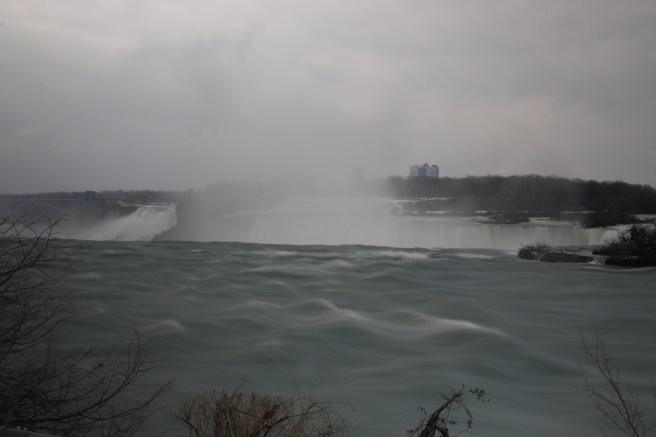
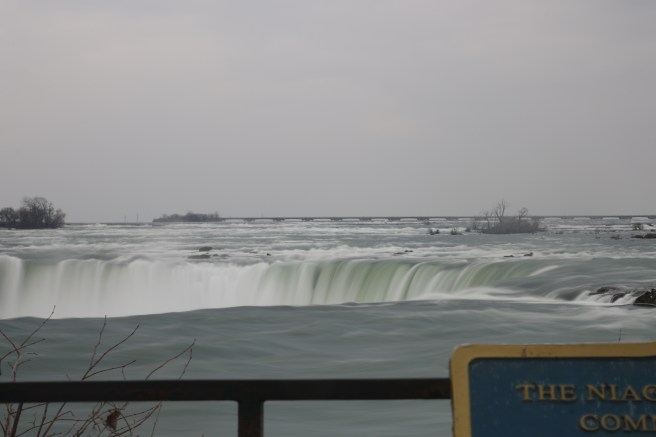
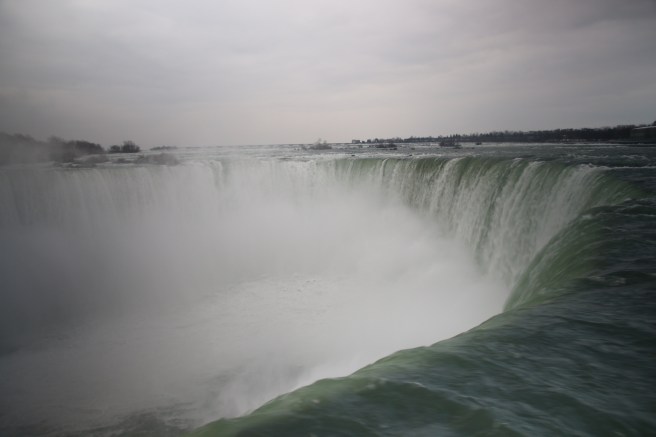
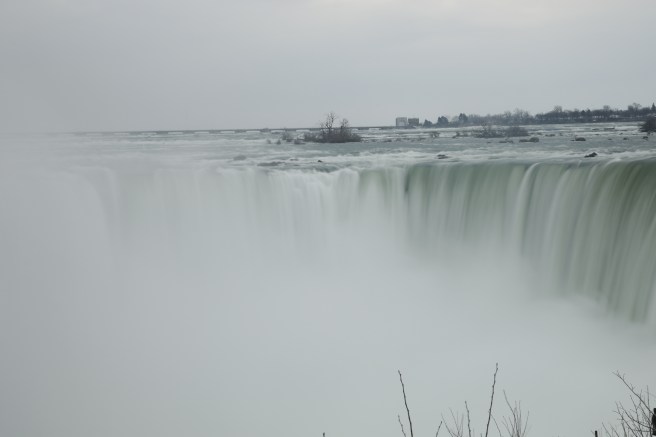
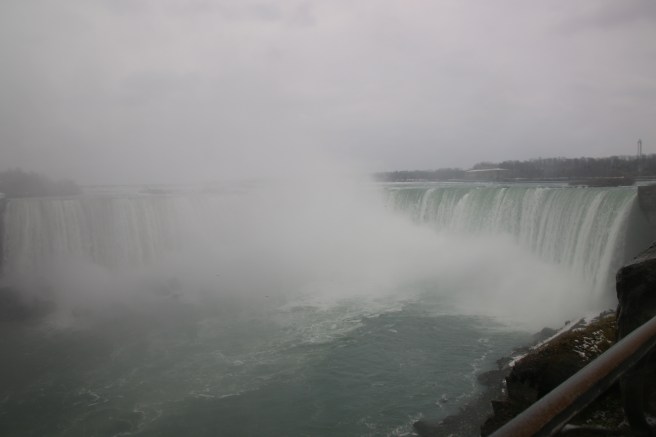
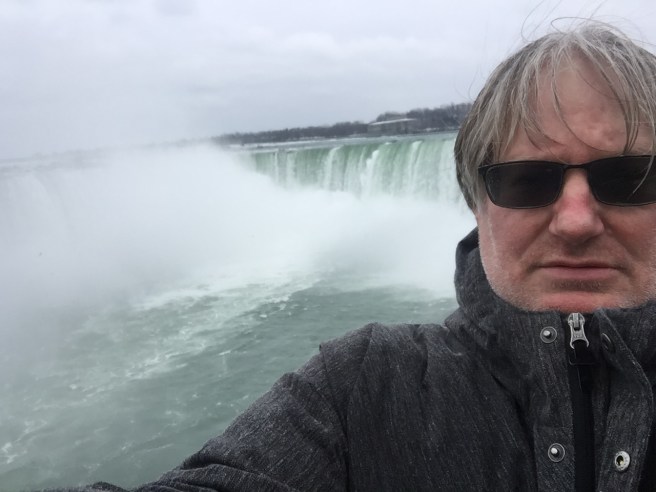
On the way from the Niagara Falls, we stopped off at a corner of the river below the Falls, and looked across at Lewiston, New York State. Alex gave us the story of when, during the 1812 war, the Americans over on the New York State side (they had 4500 troops) launched an attack on the Canadians (they had 200 troops). The Americans were confident that they would overpower the Canadians due to their significant mismatch in numbers. However, they only had 13 rowboats. And someone forgot to check the water speed. So when they put their rowboats into the water, the boats and troops sped quickly down to the water given the water pressure. So the Canadians won because the Americans had lost their boats and couldn’t get across the water. We then hopped back into the coach and headed to Niagara on the Lake.
We then reached Niagara on the Lake. This is a quaint little village on Lake Ontario that tourists visit for icecream, chocolate and festivals (I bought the first two). The properties in Niagara itself are worth around $200K, those in Niagara on the Lake are worth around $850K. The houses aren’t very old, they are built in the style to look like they were built decades ago with gables etc., rather than the straight-line generic style of houses presently built in other places.

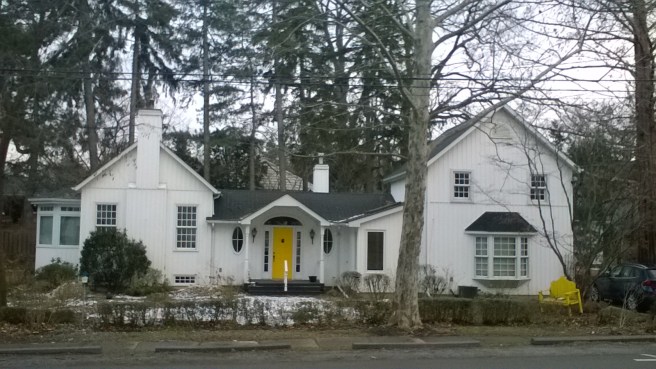
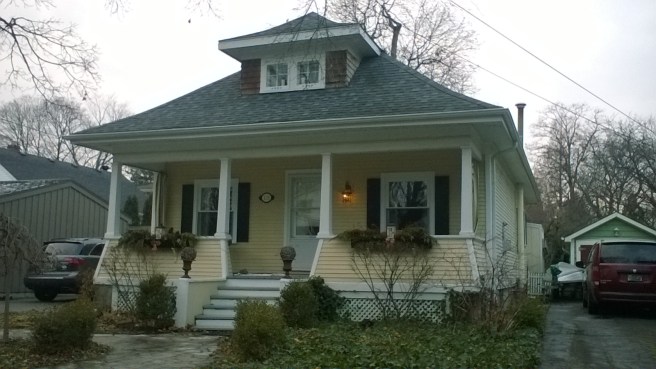
We had 40 minutes to wander through the village, I also headed down to the waterfront for 10 minutes to see Lake Ontario.
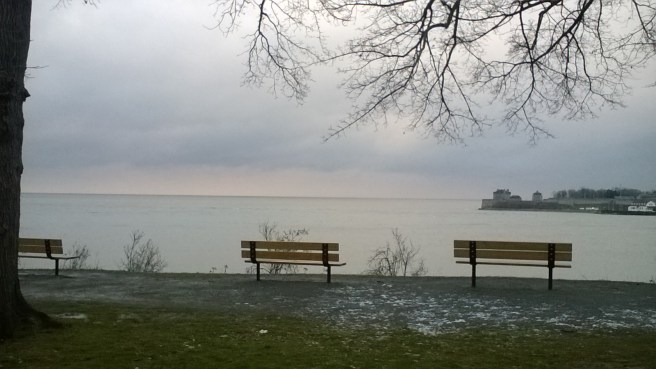
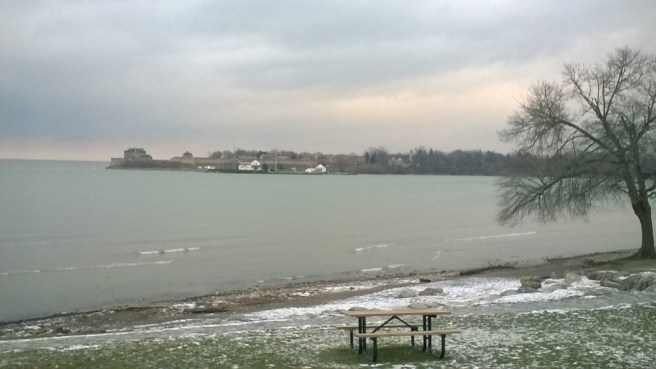
I then traipsed back to the coach, hopped on and we took the drive back to Toronto. I was dropped off a couple of streets from my hotel, and then got back there, unpacked and left all my wet gear out to dry overnight. I then jumped into bed.
December 28, 2016 (Wednesday)
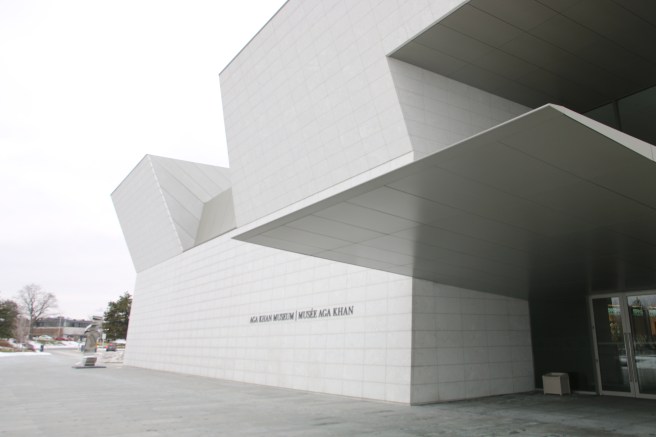
This morning I headed off to the Aga Khan Museum. It took one tram followed by a bus, and one hour, to get there.
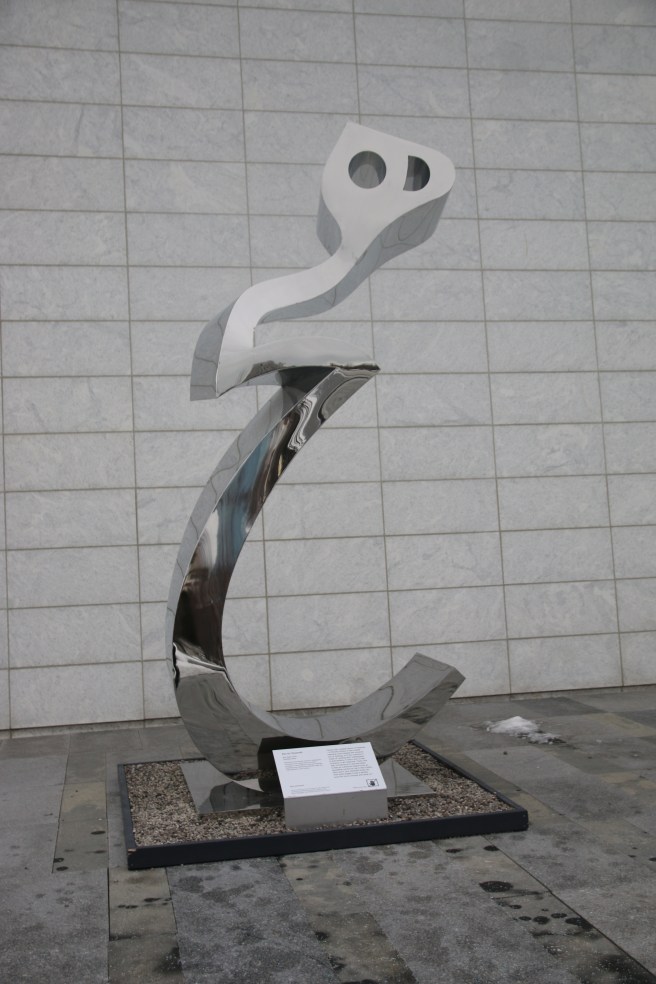
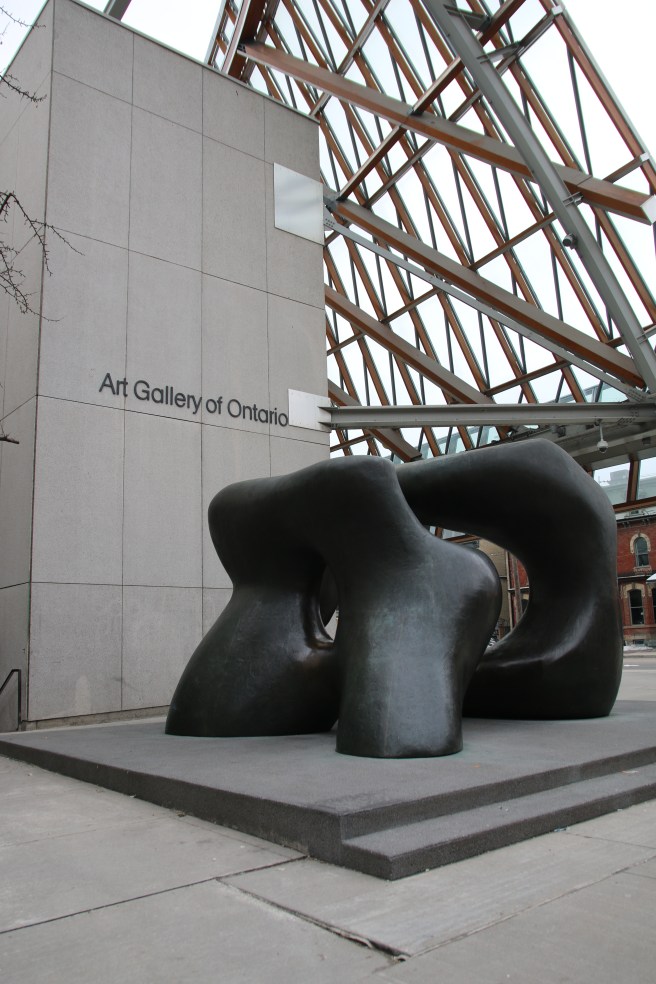
The sculpture outside is called “Big Heech” and was created in 2014 by Parviz Tanavoli. The artist states: “Heech has multiple layers of meaning – in Persian Sufism it has a great meaning: God created the universe out of nothing, so if the universe is made of nothing then nothingness is everywhere, in every part of the universe, in all creatures. That’s one way of looking at it, and the other is that as a physical shape it has an appealing volume to me; it has a head, eyes and a very beautiful body. So from both angles it was a perfect word for me to choose and work on”.
The museum is made up of three main exhibit spaces, as well as a shop, café, education centre, restaurant, patrons lounge, and auditorium. The exhibits at the museum display various artworks and artifacts from various periods based mainly around the middle east, and how they have changed over time.
The one on the first (ground) floor is the permanent exhibit. The two on the second floor are temporary exhibitions.
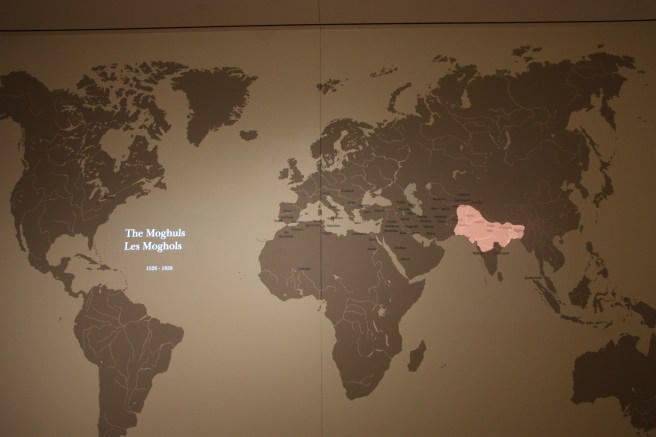
On one wall, the permanent exhibit shows a map of the world, with timed overlays of different periods over the centuries.
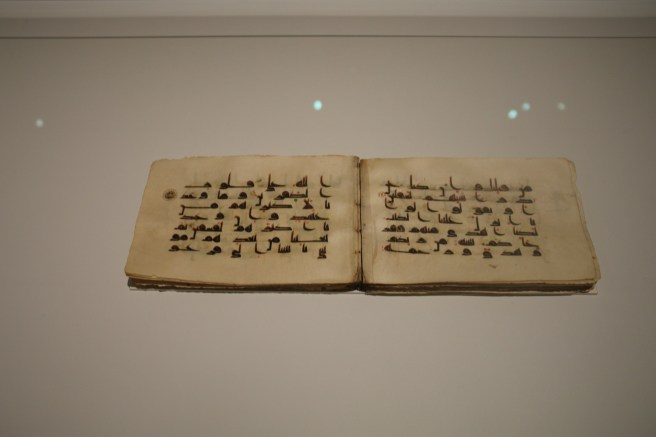
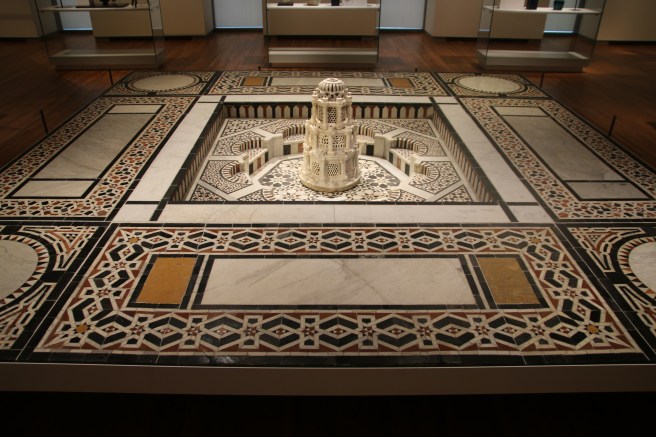
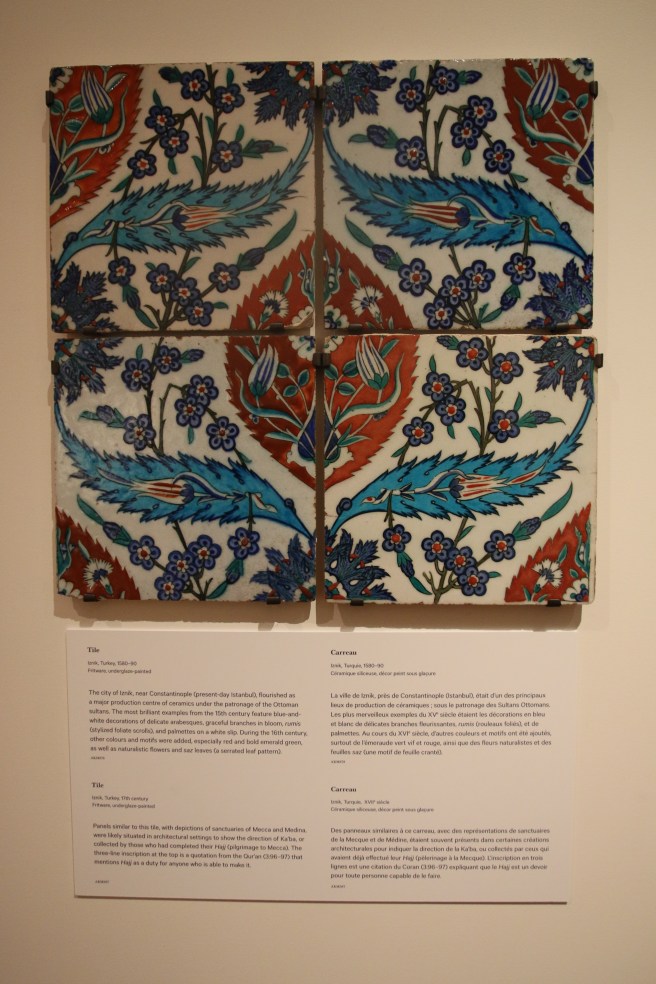
As I walked through there were various exhibits in glass cases or on the floor. The below photos show (a) a copy of the Qu’ran from 9th to 11th century, (b) a Fountain – marble and sandstone mosaic from Syria – 16th century and later (the fountain is original), (c) Tiles – from Iznik, Turkey 17th Century design, and (d) a painted drawing for a book – “Young woman in Indian dress” signed “Shaykh Abbasi” from Isfahan, Iran dated 1683.
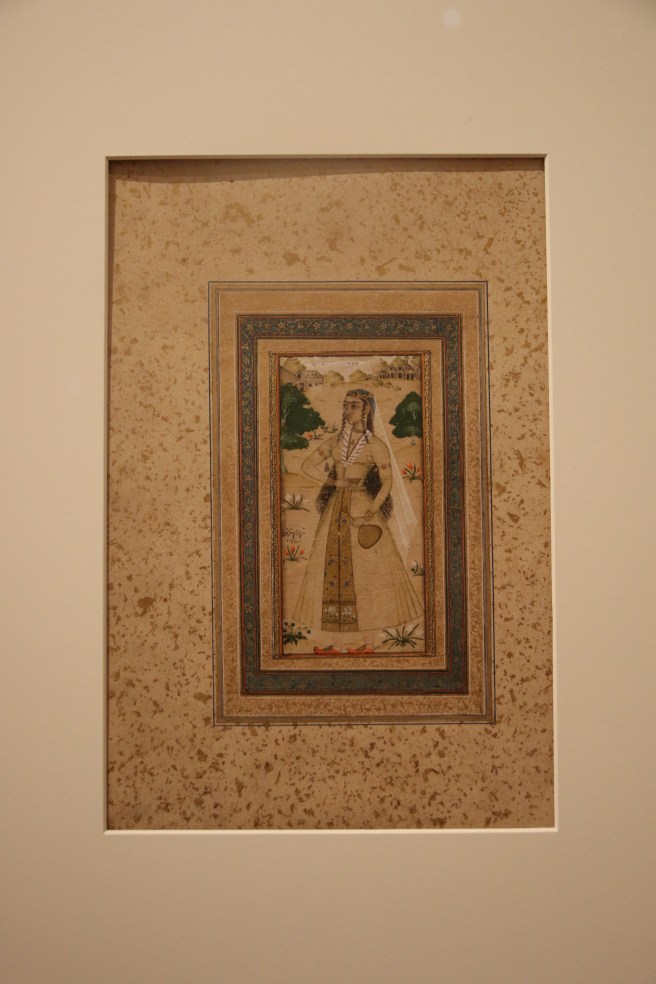
There were also small storyboards for different countries and eras, discussing the various artistics / architecture, books, textiles, and so on occurring in those different ages, including the cross-pollination of different art styles etc. and how they travelled through different countries and cultures.
After finishing in that area, I put my camera away and headed to the two upstairs exhibits (no photography was allowed).
The first exhibit I went into was entitled “Syria – A Living History”. The display held 5000 years of artifacts. It talked about the Tale of the Deluge from 5000 years ago, told in the first Epic of Gilgamesh. It was this flood that Noah was added to later in the Qu’ran and the Bible.
The history of Syria talked about it first being Aram, the land of Aramaeans. And how it developed over time, being on the major trade routes (Incense Road, Persian Royal Road, and the Silk Road), which then led to the development of different cultures, as well as the different battles that occurred over time.
The displays included various buildings shown as they would have looked over time, as well as a tablet display (which was picked up and walked around in a set space, viewing what the room in Aleppo looked like with different rugs and paintings of stories from the Old and New Testaments. There were many different artefacts on display. The main lessons from the displays were around the intercultural impact of art, bringing different styles through trading and the changing peoples and multiple religions in different countries over different time periods.
The second display related to the Alhambra (The Red Castle) palace and fortress in Granada, Spain. The initial portion was originally constructed in the 9th Century as a small fortress, and was then renovated and expanded in the 13th Century in the Moorish architecture style. It then has a long history of being utilised by different rulers, who added to the site over time, until today when it is a major tourist attraction. There is a scale model of the site and the buildings, and would be one of the most popular tourist attractions in Spain.
In 2010, Alvaro Siza and Juan Domingo Santos were successful in an international competition to design a “New Gate of Alhambra”. Siza had visited Alhambra in 2009 and created various journal entries around his imagining of the design. The first part of the display gave the history from 300AD to the present, with the second half being around Siza’s ideas, musings and designs, with design maps, sketches, 3D models etc. It was quite fascinating to see design take shape from the very first ideas, through to scale models of the finished product, and a few books Siza has written.
After this, I headed back to the bus stop to take my reverse journey back to the hotel. The Aga Khan Museum is really worth the time to visit for anybody interested in history and art or archaeology.
After a short rest I rugged up, grabbed my camera kit and headed off to the ferry terminal. After waiting a while, I caught a ferry across the river to Wards’ Island. Toronto has a few islands which together are called the Toronto Island Park, with ferries going to three of them. Only one, the one to Wards’ Island, is open in winter. It’s part of their National Park but people live on it.
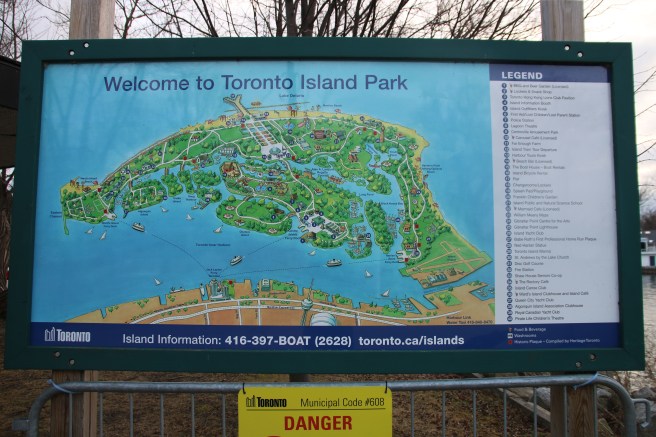
The islands have beaches, a massive fun park (closed in winter along with most forms of tourism entertainment) and bridges interlinking the various islands. The reason I took the ferry across was to take some photos of Toronto City as the sun went down. I gathered a range of shots with different times and apertures as well as some to stitch together later (hopefully). I really enjoyed watching the sun go down and the lights as they came on. There were also a few planes getting into some of the shots due to the Toronto airport being on the Eastern side of the Islands, to my left as I looked back – as well as a helicopter coming into land in the city. Herewith a few of my efforts.
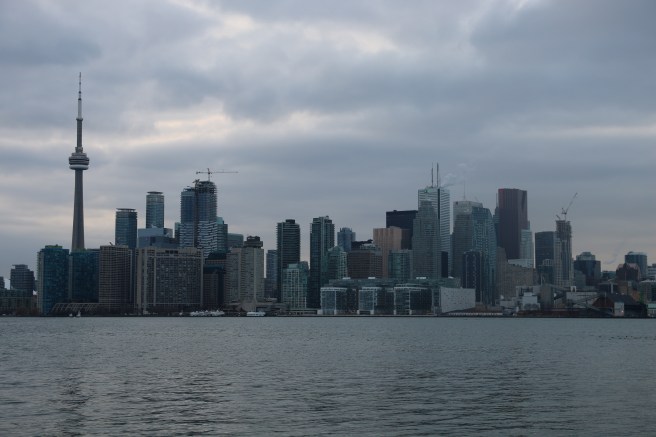

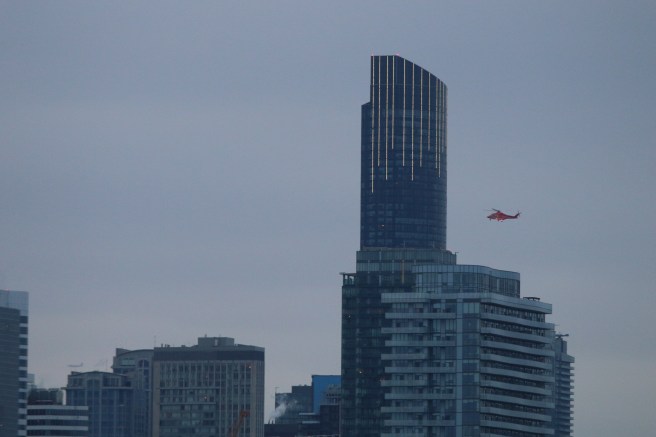
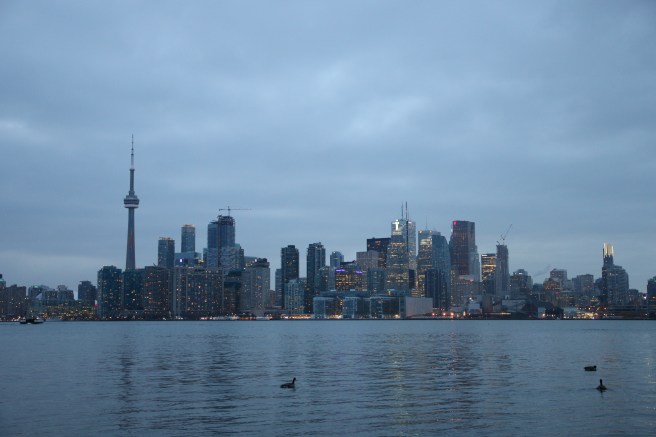
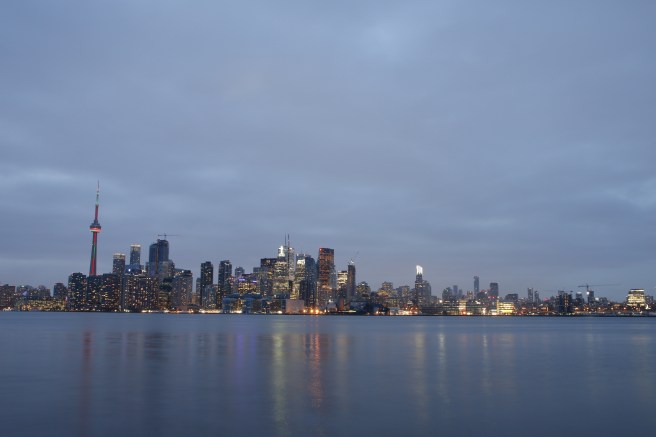
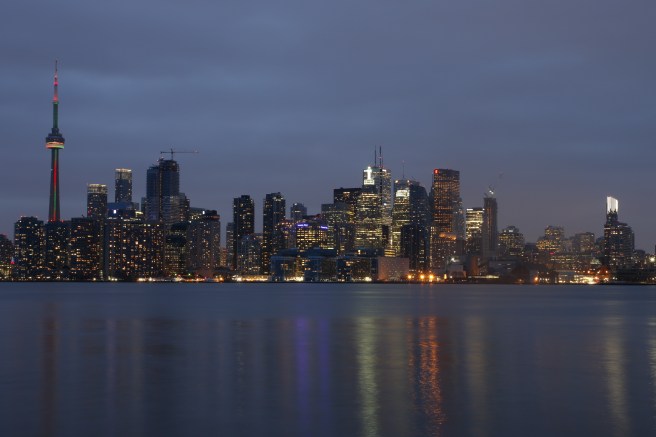
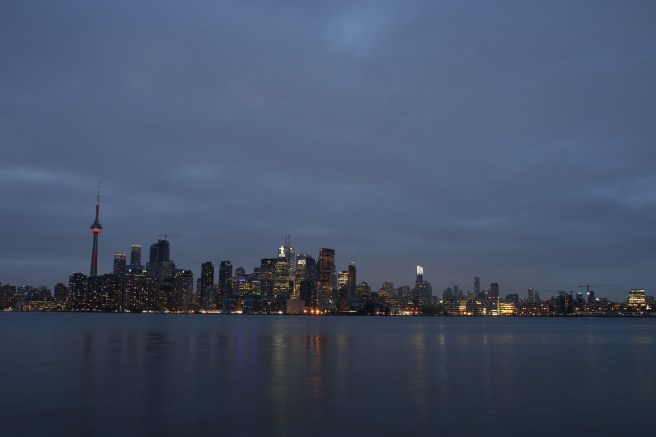
By 5.40pm I had all the shots I wanted so I wandered back and caught the 6pm return ferry. On the walk back to my hotel, I wandered past the ice rink and tried to take some photos, but there were so many people on the ice that there was less movement in the shots than just large blobs of dark colours.
So I headed back to Trump International Hotel and took a photo of the mosaic I mentioned a few days ago, as well as the plaque from the artist. It’s a really well put together mosaic.
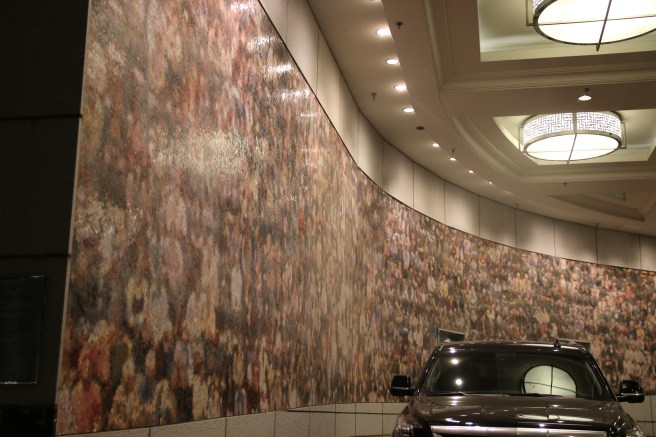
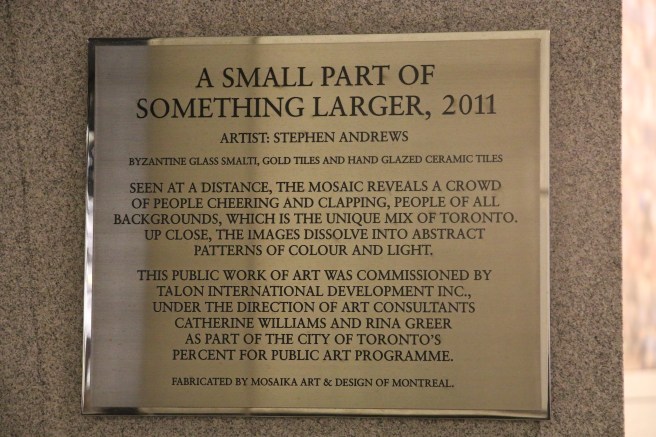
After that, I headed back to my hotel.
December 27, 2016 (Tuesday)
Today was a pretty busy day.
I headed to the Dundas East mall to obtain my hop on hop off city sightseeing bus ticket and then hopped onto the bus. Today I planned to visit an old castle / mansion, museum and an art gallery, and with the distances, the hop on hop off bus seemed the best way to get around.
The first stop was Casa Loma. There was quite a queue to get inside. As I waited outside in the cold and wind, I thought that this was surprising for an old castle. However when I got inside I saw they had lots of Christmas events and displays for children, so I could see why parents would take their kids.
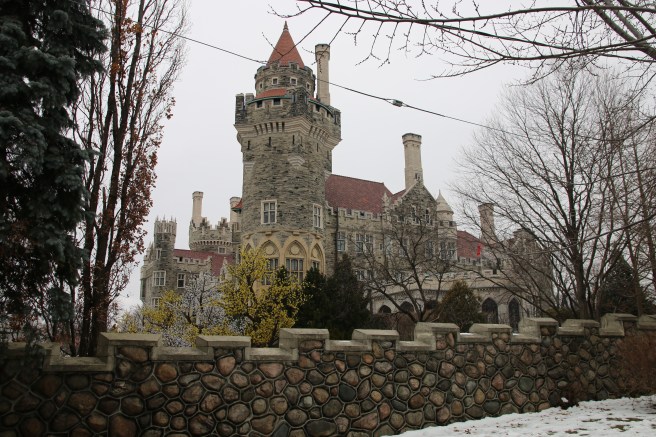
Casa Loma (meaning Hill House – and known in Toronto as “the Castle on the Hill”) was built in the period 1911-14 in what it calls a “Gothic Revival” style. It sits around 150 metres above sea level. The main and second floor serve as a museum to the property itself, and its uses over time; with the third (top) floor now the museum of The Queen’s Own Rifles of Canada. Note: In Canada, the ground floor is called the first or main floor, and the one above it is the second floor, unlike back home where the first floor is the one above the ground floor. The builder of the property, financier Sir Henry Pellatt (he was knighted in 1905), had been a rifleman in the Queens Own Rifles, joining in 1876 at the age of 17 and rising to the Commanding Officer role. During the owners time in the property, it was used for many grand occasions for the city.
The owner had a huge sale of property after the First World War due to the increased rates and taxes being charged, and the rest of the cost of living at that time. This allowed him to remain in the property for a little under 10 years before he had to move out. It then went through various hands and for various roles, including for research during World War 2. It underwent a significant decade and a half renovation until 2012 and, as had occurred on and off since the late 1920s, became the tourist destination that it now remains. I’ve included some photos below, including of the newspaper article regarding the sale, and a picture of the male owner’s shower (he and his wife had separate bedrooms, bathrooms and offices). The shower cubicle had six separate taps for the different faucets.
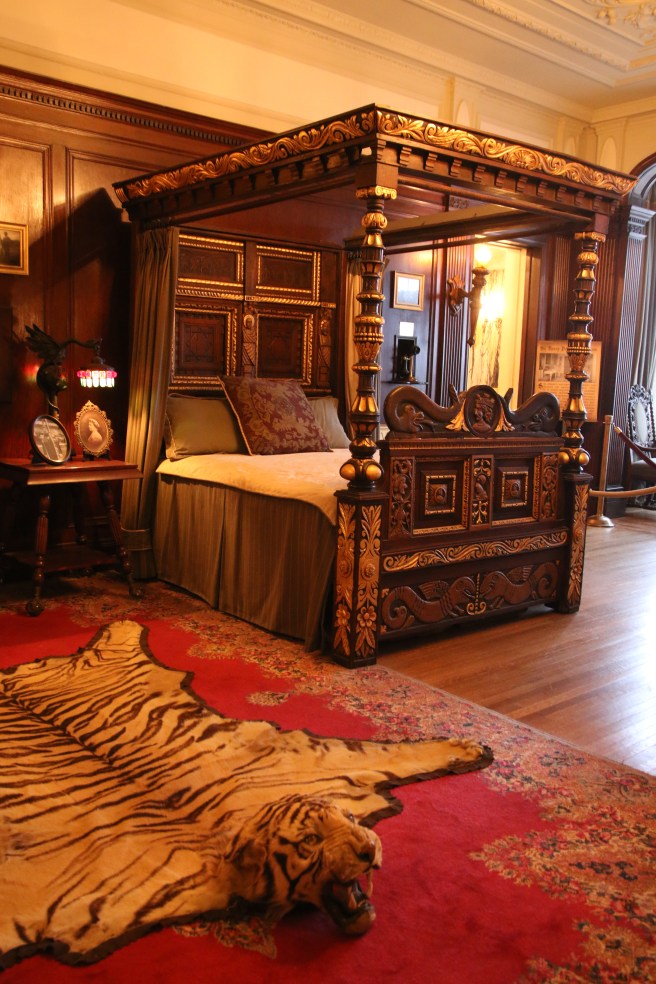
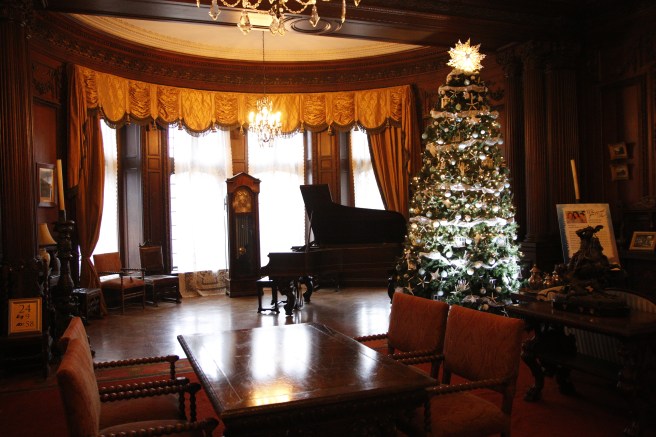
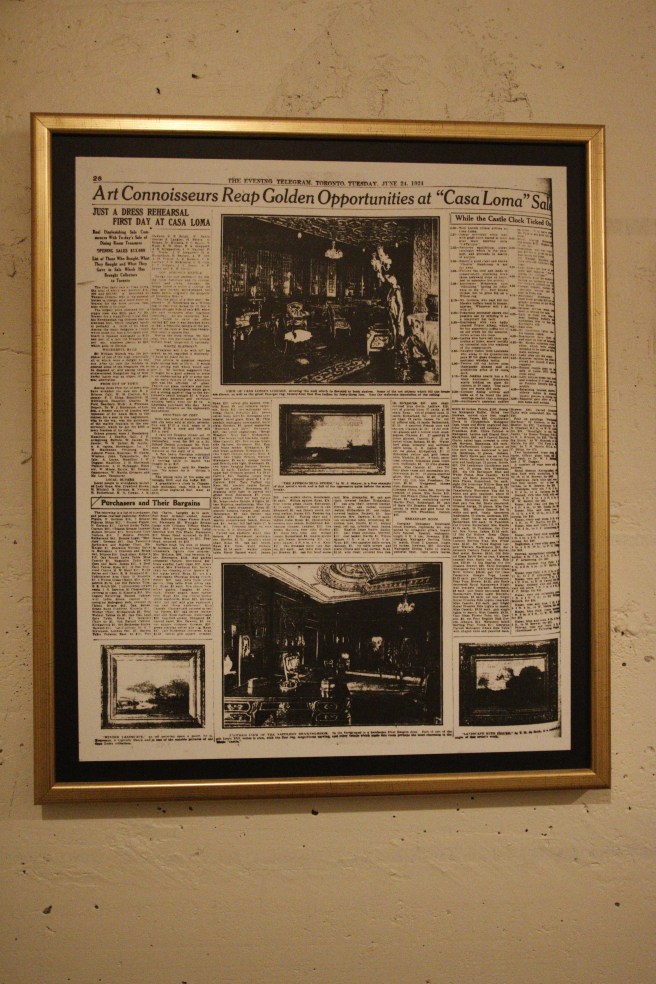
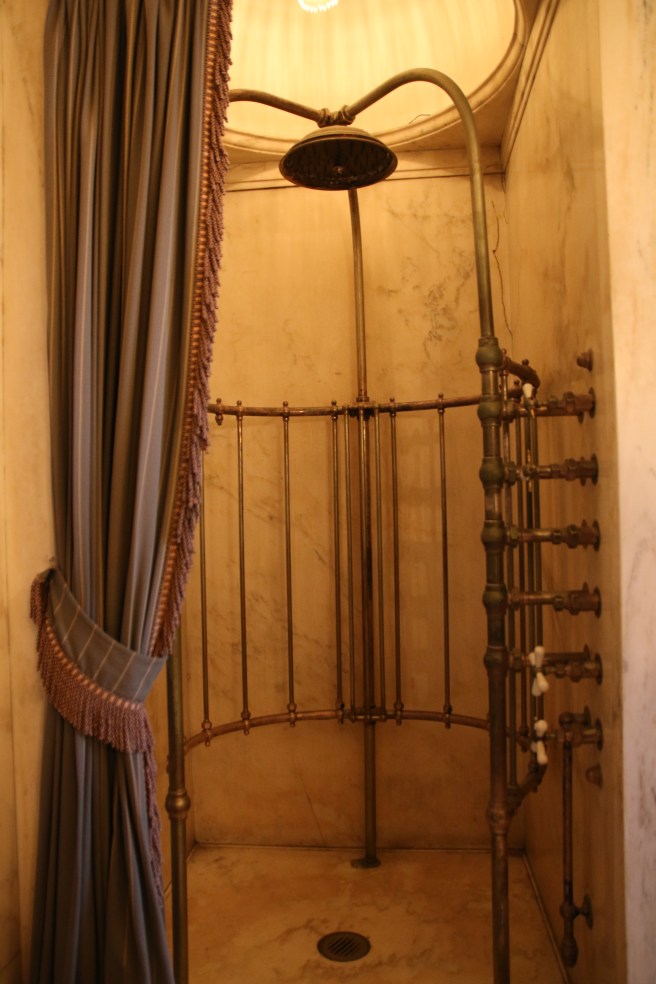
After viewing the property throughout and heading up the narrow stairs to the spires, I headed back to the bus stop to await the next hop on hop off bus. I alighted at the Royal Ontario Museum (known as ROM). It was obvious that I had chosen a day when most of Toronto wanted to head out and see the sights, because the queue here was quite long. It took about 25 minutes to get my ticket. Herewith the entrance to the ROM.
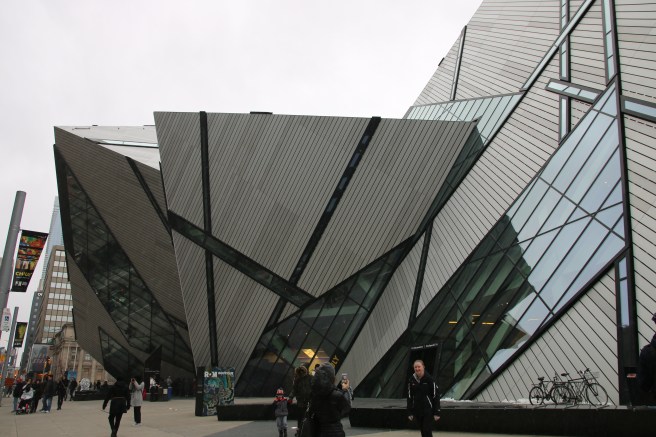
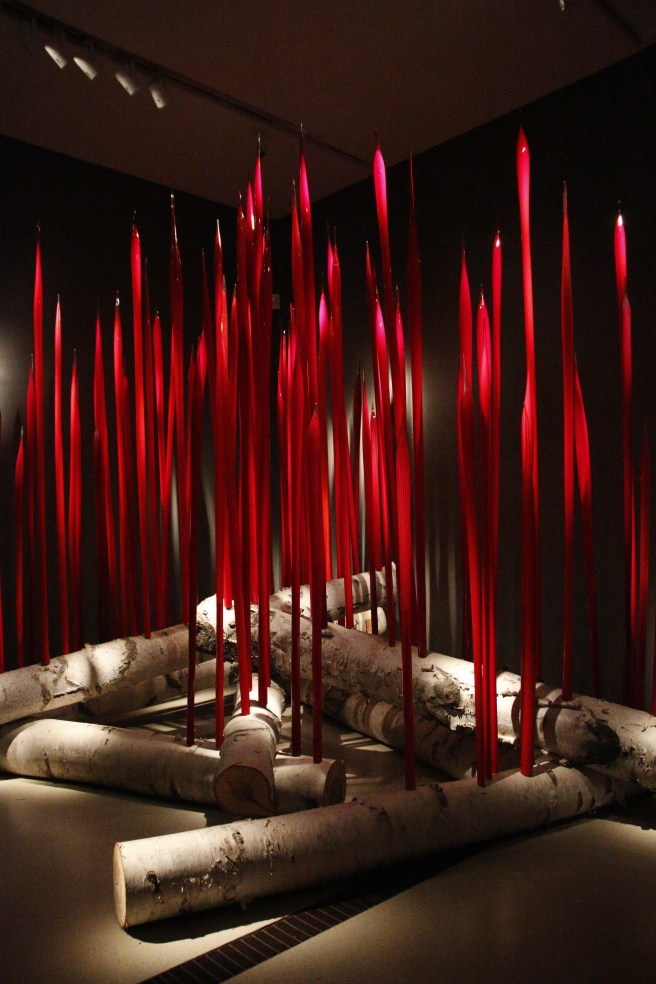
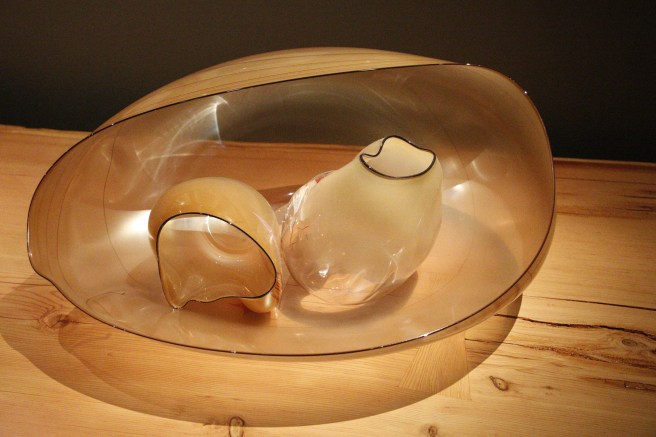
The number one exhibition at the museum was the Chihuly display. Dale Chihuly is an American glassblower and sculptor. The exhibition explores the life, work and global impact of Mr Chihuly. In the late 1970s he experienced first a car accident which left him blind in one eye, and then later a bodysurfing accident which left him unable to hold a glass blowing pipe. So he then became more of a producer / entrepreneur who was able to step back and design the sculptures and installations, whilst using others as glassblowers to make the various items. The colours and complexity of he and his team’s various works are particularly stunning to see first hand. Given half the population of Toronto was in the same room as me, and the other half was outside trying to get in, I sadly had no chance to use my tripod to take really good timed shots of the works. They were so much more full of life than I have been able to capture.
The first sculpture below is called Laguna Torcello, dated 2012. Mr Chihuly wrote that whilst his works look like they come from nature, he doesn’t see specific images and set out to make them.
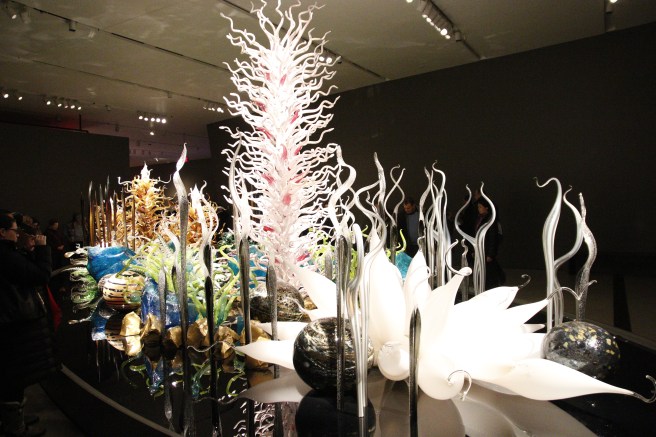
I’ve tried different camera settings to get close to the best shots without people in front and trying to reflect close to the colour of the glass items, which means the surrounds may be darker or lighter than it really was. For example, of the first of these next series (Sapphire Neon Tumbleweeds, 2016), if the surrounds were any lighter, then the light tubes would turn out white. However I think these settle reasonably well.
Mr Chihuly’s Seattle Boathouse studio holds a range of baskets and blankets made by Northwest Native Americans. The baskets inspired a display of glass baskets made as part of his Northwest Room, 2012 installation. The last photo is one of those baskets.

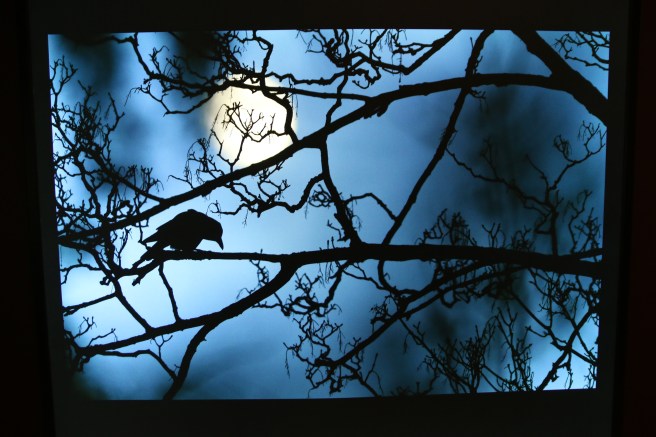
I left that exhibition to head into the “Wildlife Photographer of the Year” exhibit. The competition consists of a number of categories, and different age groups. There is also an overall winner of the Adult and Junior categories. There are some magnificent photographs, especially from the juniors. Some were inspired by birds, some by bears, or lambs etc. The stories that went with the photos seem to as much inspire the choice of winner as the photographs themselves. Many spent quite some time at different sites, waiting for the right one to come along, and it did.
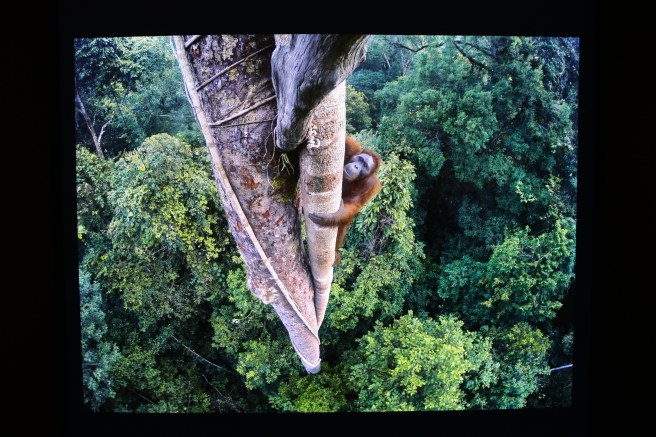
Below are two of my favourites. The first was taken by leaving a camera (in one spot in a national park where rangers dump carcasses) for just under six months, and setting the camera to take a photo around once every minute. The second was taken by a junior who was walking through the Swiss Alps. I like the playfulness. The final two are the overall winners, the first by a junior (16 year old Gideon Knight in the UK) taken at a park near his home, and the second by a biologist and photojournalist (Tim Laman in Borneo) working with his wife on the Gunung Palung Orang-utan Project.


After that, I went for a browse in the “Art, Honour and Ridicule” display of the ASAFO Flags of Southern Ghana. ASAFO flags are visual representations of military organisations used in Fante communities known as “Asafo”. The Fante are one of the many culturally and linguistically related groups known as Akan. The Fante live along the coast in Central and Western Ghana. Each Asafo – company – has their own flag. The primary roles of the Asafo were to exert power, exercise political influence and maintain conduct within their community.
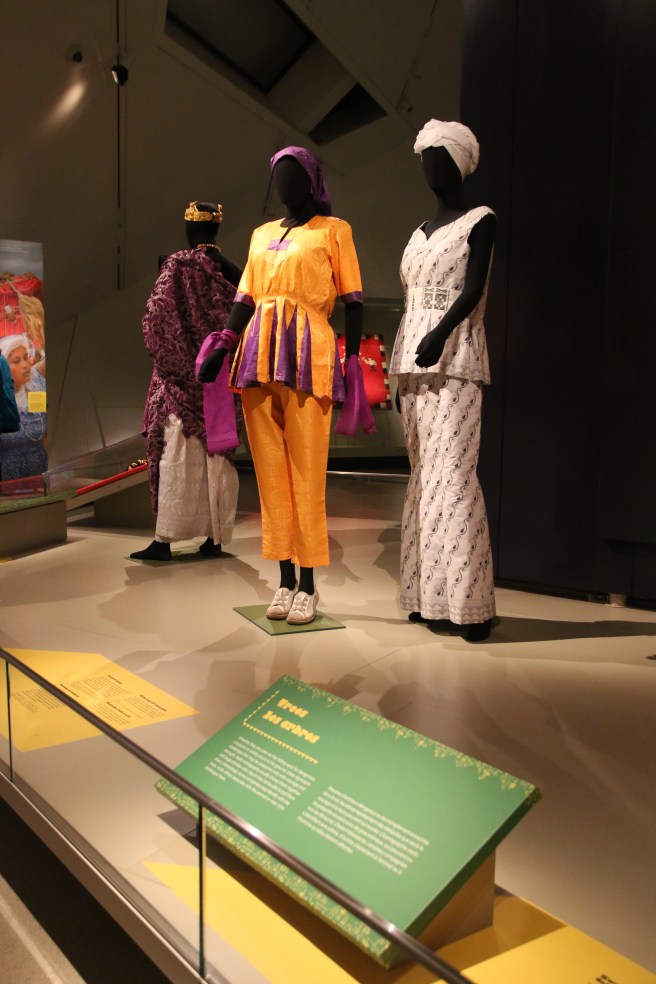
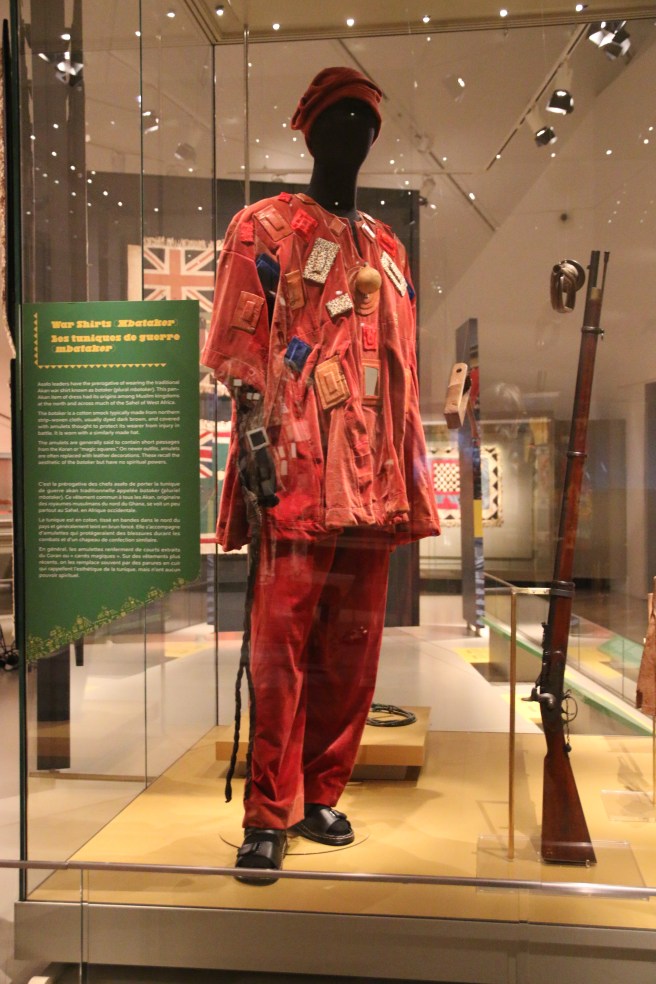
The flags were interesting, however I was more interested in their dress, and how they display the various parts of their Asafo in what they wear. According to the display, Asafo members manifest their sense of pride and company spirit through their dress. Each member’s choice of dress reflects and interesting mixture of uniformity and individuality. Whilst companies and subgroups wear specific colours and sometimes ensembles made of identical textile patterns, a great deal of variation is accepted in what people wear. This reflects the sense of multiplicity and self-fashioned belonging as well as keeping with the grassroots character of Asafo associations.

After this display, I left the ROM and headed back to the bus stop for the next bus. I hopped on and then back off again a couple of kilometres further down, at the Art Gallery of Ontario (the AGO).
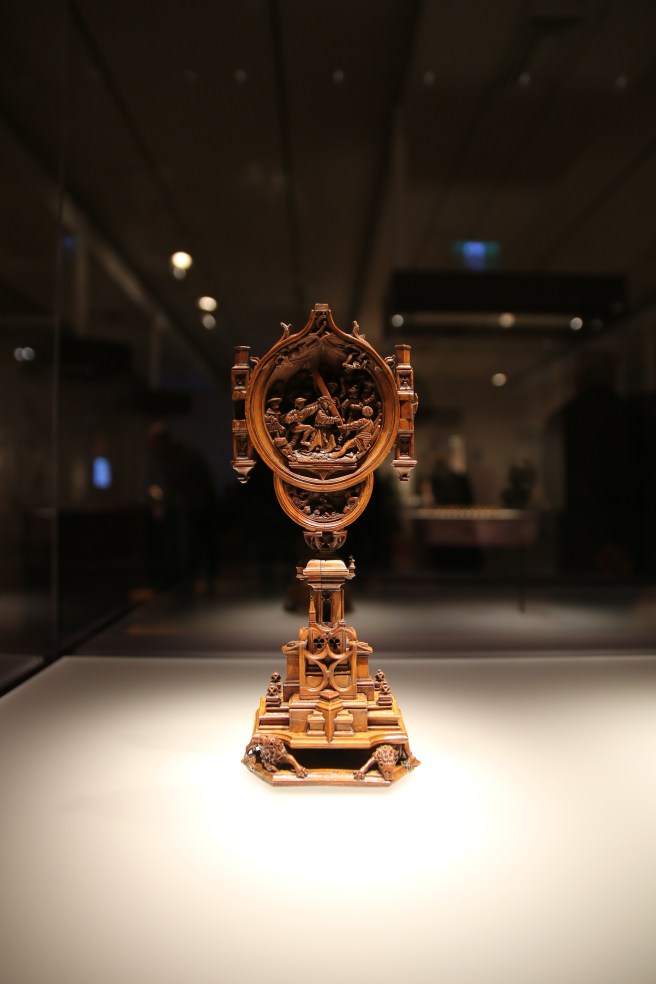
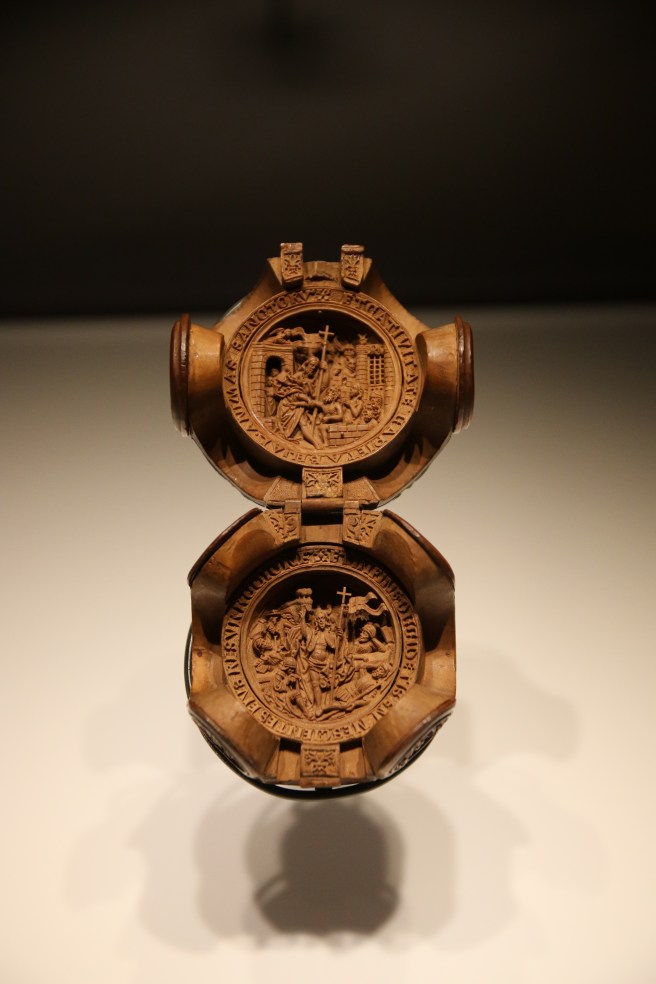
I first went into the Small Wonders exhibit. This was a display of Gothics Boxwood Miniatures. It was fascinating to see the small six of these miniatures carved from blocks of wood with such fantastic small details. One of the videos of a current woodcarver talking about the work that goes into this indicates that it would take him upward of two years to make one of these. Getting the wooden box from two blanks to be carved into the circular shape is reasonably easy with a lathe, but to do the fine work would be time consuming, if he could work out even how to do it. These items were made in the 1500s and 1600s. Here are a couple of examples, followed by a photograph of a set of workman’s tools from the 1600s. I can only imagine trying to use those tools to come out with these miniatures.
The first miniature below is about 10 centimetres tall, whilst the second is of two round halves, each around 3 centimetres in diameter.

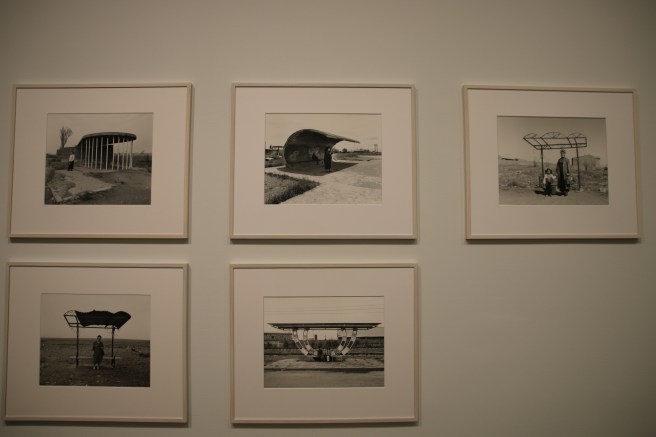
After that, I headed into the AIMIA-AGO Photography Prize exhibit. The set up is four spaces, each with photos and backstories of the four finalists, with the public to vote on the winner. Herewith a few photos (black and white) from the winner, Ursula Schulz-Dornburg, with a theme of the built environment and its place in society.
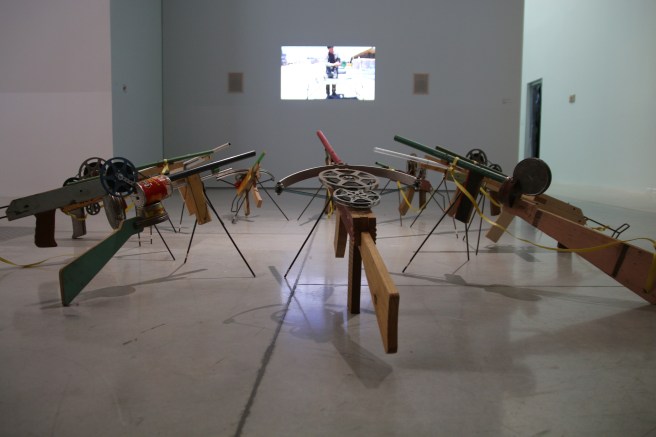
From that exhibit I headed into one called “Francis Alys: A Story of Negotiation”. Mr Alys is a Belgian artist who has lived in Mexico for the past 30 years. According to the display “His poetic work engages with urgent social issues through painting, drawing, sculpture, performance, video and photography. A Story of Negotiation presents three of Aly’s large-scale projects”.
The first photo below is from the display Reel-Unreel, where in 2013 he was embedded as a war artist in Afghanistan. The second is a screen shot of a video called “The Bridge” which he filmed in 2006 that explores border politics between Havana, Cuba and Key West, Florida. In this video, he has arranged for a “bridge” to be built from Havana going North and Key West going South to bridge the gap. He did not tell each side what he was doing at the other side, and on the day of the “installation” he had around 30 boats from Key West and around 100 boats from Cuba. They all lined up tied by rope to each other, and then departed after a period of time. You could certainly tell which were Cuba’s boats (mainly small wooden row boats with a few inboards) and the USA boats (medium size fiberglass mainly.
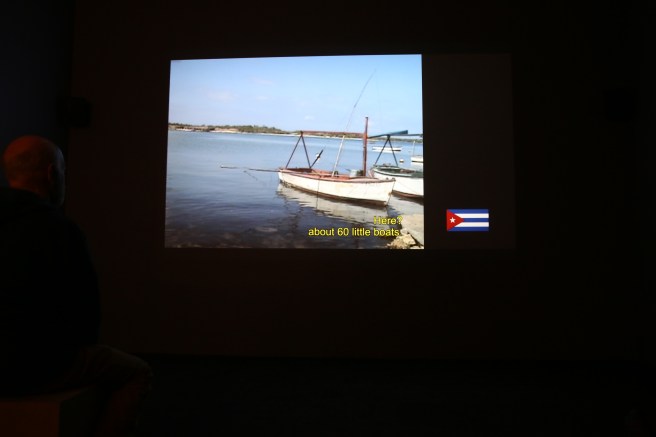
After viewing that exhibit, I had to wait around for 1 hour to access the final exhibit “Mystical Landscapes”. Due to the popularity, I had been given a 5pm timeslot, with the rest of the museum closing at that time. So I headed to the AGO bar for a beer and some bar snacks, and then headed back at 5pm. There was no photography allowed in this exhibition.
There was a very large number of paintings with landscapes at night and during the day. Some of the paintings were by Vincent Van Gogh, Paul Gaugin, Claude Monet, Edvard Munch, and some of the others I have not heard much of but liked were by Paul Nash, Felix Vallotton, and Emily Carr. There were over 100 paintings and paper works, and they gave a fascinating display of the different feelings and mystique of different landscapes at varying times of the day and night, and the impact that these had on artist and art professionals. We had the option of an audio player to listen into, and around a quarter of the people had them (as did I), however with the number of viewers I generally didn’t get the time to listen to the audio before being pushed between paintings. I did however take the time to look at some of the paintings in depth.
My favourites on display were Van Gogh’s “Starry Night over the Rhone at Arles”, Edvard Munch’s “The Sun”, Emily Carr’s “Sea and Sky”. They showed a different range of colours and brushstrokes but were to me quite peaceful.
After leaving the AGO, I headed back to my hotel.
December 26, 2016 (Monday)
On Boxing Day, after breakfast I got all my wet weather gear on (forecast was rain all day, and they were right) and headed over to the Eaton Shopping Mall which is in a central area about 5 blocks from my hotel. On one side is the Eaton shopping centre, another side is the cinema complex with another shopping complex, with more shops around and a square in the middle, where the information centre for Toronto sits. This is also where the jump on jump off sightseeing bus commences its route. I had bought a ticket for this tour, but since it is Boxing Day (and a Monday) most of the places I wanted to go were closed. So, given the copious amount of rain, I just wandered around inside the malls. There were thousands of people, given the Boxing Day sale is rebadged as Boxing Week sale here. But it was good to see the different variety of things available without actually spending any money.
I had bought a ticket for the hockey tonight, so figured I wouldn’t get much of a meal and therefore decided to have lunch. This is probably only about the third lunch this month – I’ve been eating enough breakfast to see me through until late afternoon so haven’t needed to. I decided to head for the Hard Rock Café. I ordered a pork burger with mashed potato and a glass of stout. It certainly was tasty. And the stout worked a treat given the weather.
I then headed down to the waterfront. I am going to take one of the ferries to the islands later this week so wanted to spec it out. Given the dark clouds and sporadic rain, the photos weren’t great but I am looking forward to getting out to the islands to explore them.
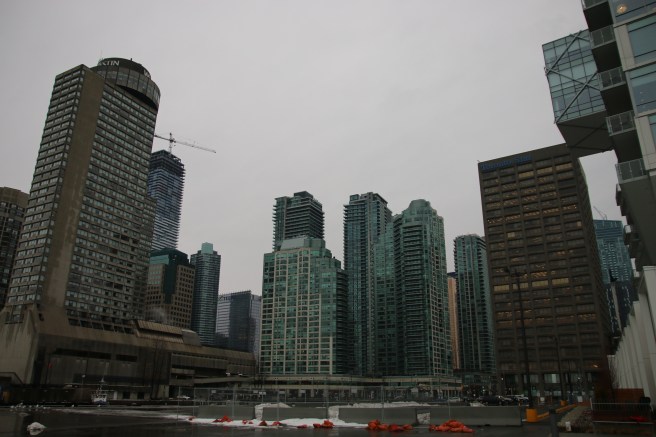
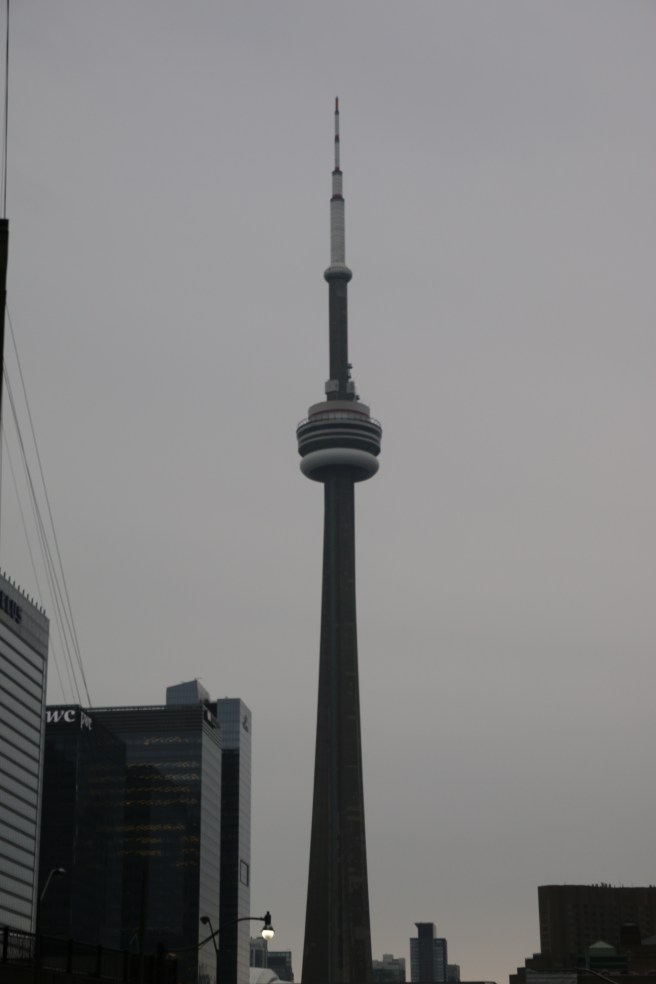
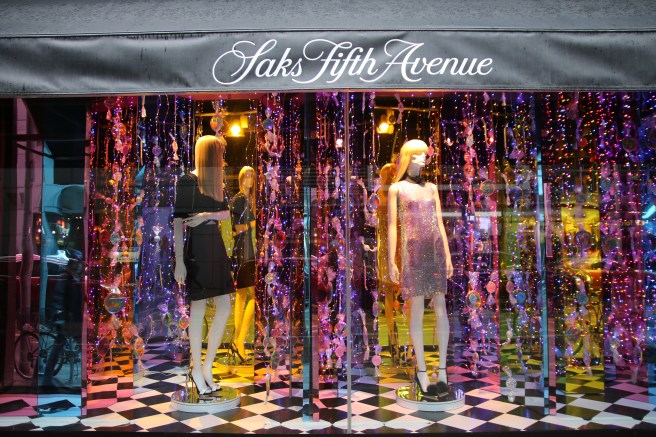
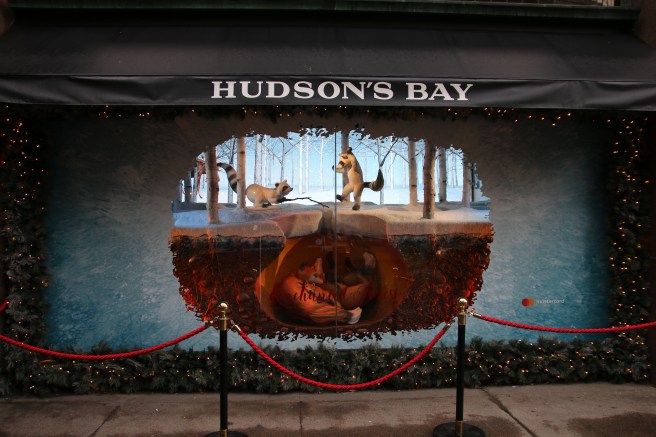
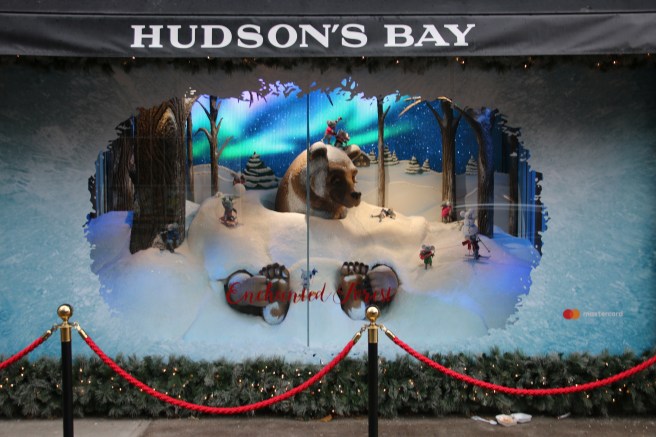
After the waterfront, I headed back towards my hotel. On the way I came across some more store fronts that looked interesting. There is so much done up for kids over the Christmas period here. Not surprising probably, given the population size. And you can see how much the kids (and their parents) enjoy them.
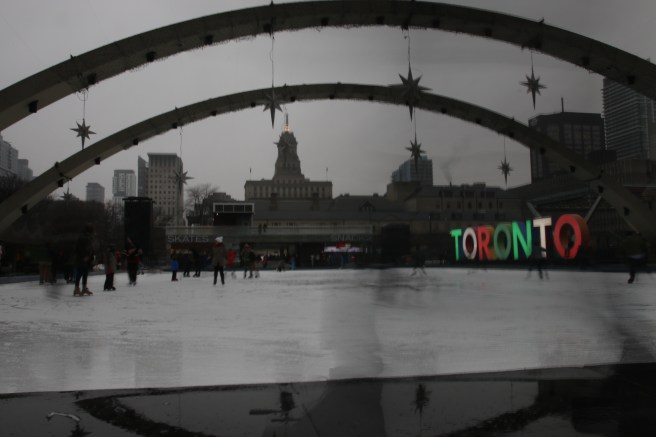
After which I wandered past the ice rink in the city centre. So I took a few snaps at 0.5 seconds to see what came out. The second is taken in pouring rain so less people are on the ice.

I watched some TV in the hotel until 7pm, an hour before the hockey was due to start, so I then headed off again. It was windy and raining quite strongly, so by the time I got to the Air Canada Centre, I was soaked below the waist. I went in, through the various security checks, and got up to my seat. Herewith the ice hockey rink from there. No cameras are allowed into any hockey matches, but so many people have smart phones so it’s okay that way.
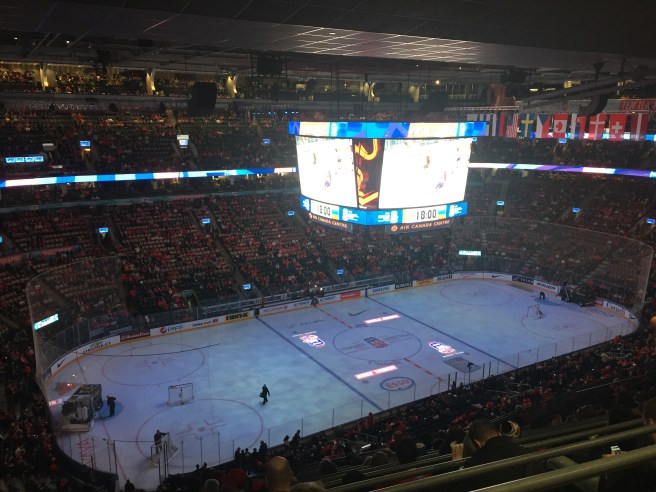
The hockey tournament I am attending is for the 2017 World Junior Hockey Championships. It is shared between a few countries. This year it is being held in Canada (at the Bell Centre in Montreal and the Air Canada Centre in Toronto). Canada may have got it as 2017 is Canada’s 150th anniversary of Confederation. Prior to Confederation, the old (province of) Canada consisted of Ontario and Quebec. On 1 July 1867, Nova Scotia and New Brunswick (British colonies) were united with the old Canada into the new Canada. Over time there have been a number of changes, with Canada currently consisting of 10 provinces.
Back to the hockey. So I have tickets for the match between Canada and Russia – not surprisingly the stadium was packed. And vocal.
There was a bit of a ceremony, with various speeches from apparently important people displayed on the screens in the centre.
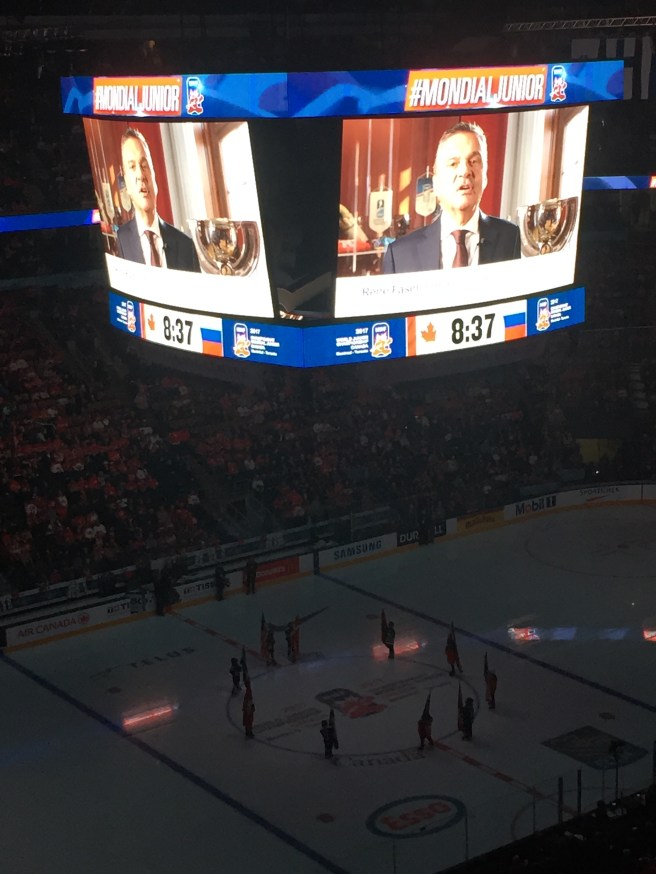
A few kids were standing in a circle holding flags from the competing countries, and with 4 and a half minutes to go, the Canadian team skated out. And everyone went wild.
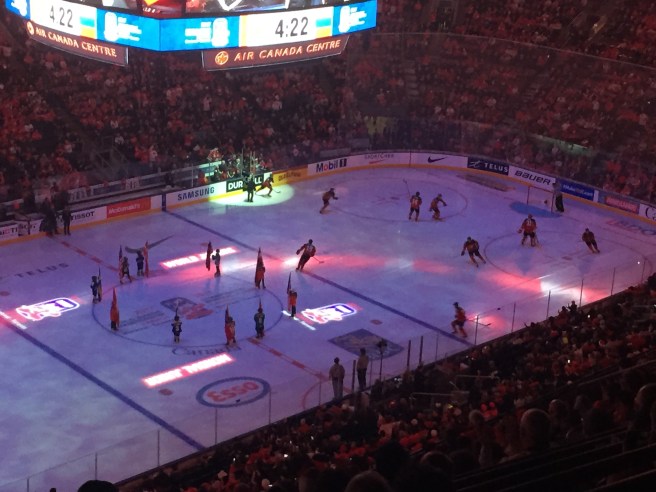
Then we all stood up for the singing of the Canadian National Anthem. The singer was flanked by two Royal Canadian Mounted Police officers.
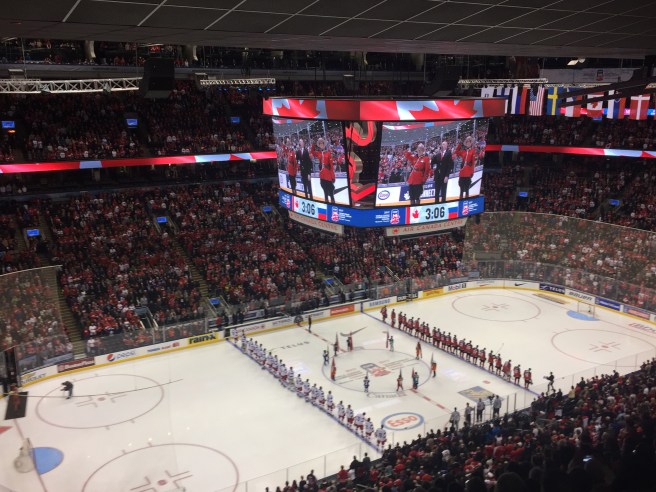
Then the game started. And after just 3 minutes into the first period, Canada got its first goal. So of course everyone went crazy.
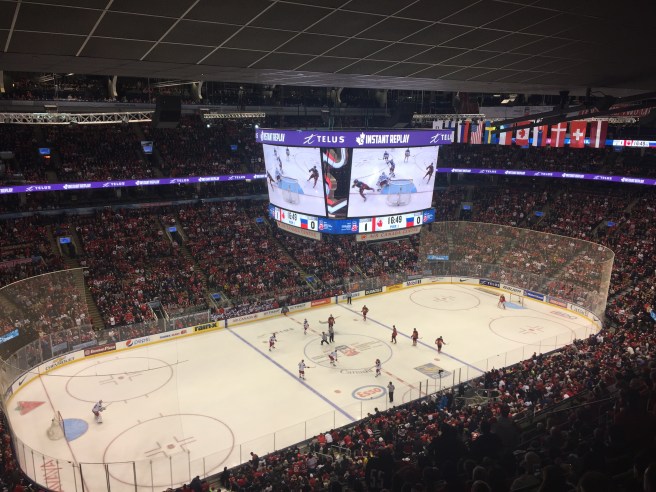
Background (what little I have worked out): The game of ice hockey is played for 3 periods of 20 minutes each. But with stoppage the periods go for around 40 minutes each. There is a break of around 16 minutes between each period. Each team has 6 players on the ice, including one goalkeeper. Players who get penalised for various indiscretions get to spend 2 minutes off the ice, without replacement. This means that one team will have 4 players (excluding goalie who stays in goal) against the other team’s five, so there is two minutes of significant pressure on the team with less players. It is quite a skilled game.
In the end, it was a great game, with Canada beating Russia 5 to 3.

Then there was another ceremony at the end for the best players.
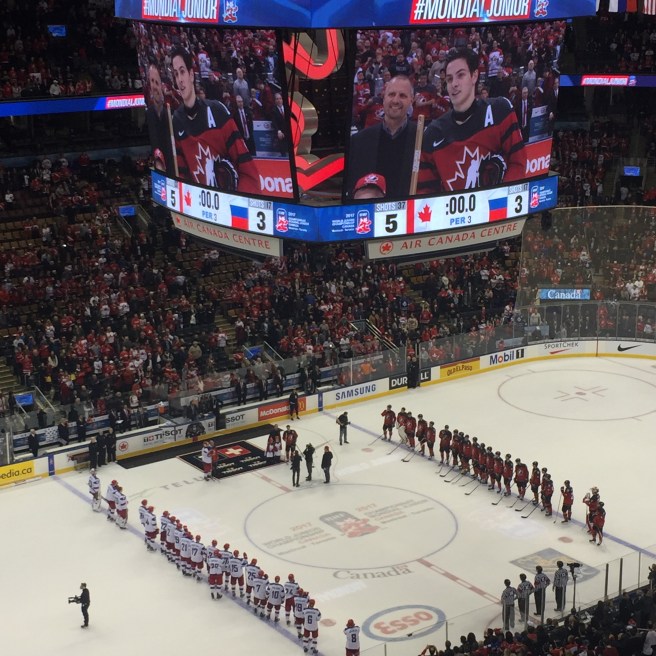
I thoroughly enjoyed myself tonight. After the ceremony, I headed back to the hotel and hung up all my wet clothes to dry, had a shower and went to bed.
December 25, 2016 (Sunday)
Happy / Merry Christmas!
I got up this morning, and was very surprised to see that Santa had found me!
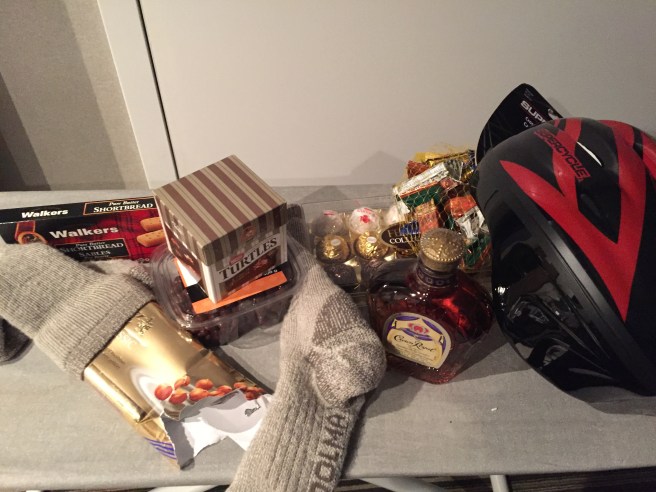
I loved the fact that he had found me, but I was concerned that he had given me such sugar filled gifts. I guess that’s what the bicycle helmet was for, to work off all the sugar on one of the hire bikes in Toronto. As well, it looked like a reindeer had gotten into one of the chocolate packets. Plus, because I had obviously forgotten to leave out a stocking for him, he used a couple of my camping socks. That was okay, but it would have been better if he’d found a couple of clean ones in my suitcase rather than used the pair that I wore yesterday. But I guess he was pretty tight for time. I will certainly enjoy the whiskey and cheeses.
After opening my Santa gifts, I went to breakfast, after which I got to speak with Aunty Carol, and wish her a very Merry Christmas, and then I got to tell her about my trip, and we talked about the state of politics and business in Australia and the USA. That’s always interesting because we don’t always see eye-to-eye, but we are very respectful. I wouldn’t have it any other way.
So I lay down for 5 minutes, and got up 4 hours later at 2pm. I decided I was too tired to do anything more so I just watched Television for the rest of the day.
December 24, 2016 (Saturday)
Got up, had brekky, read the paper, shopped for some consumables to cover the holiday period in case cafes etc are closed, went for a walk, found out about bike hiring from the multiple bike stations then planned what I want to do for the next week.
Could not get into any of the Christmas Day lunches I wanted to (have tried since midweek) so organised dinner at TOCA in Ritz Carlton at the 8.15pm sitting Christmas Eve (tonight).
Thus I spent the afternoon relaxing and reading, then headed out at 7pm to walk to TOCA for dinner, with time enough to stop off and take some photos. I got out of the hotel and looked up into the sky – and this is what I saw.
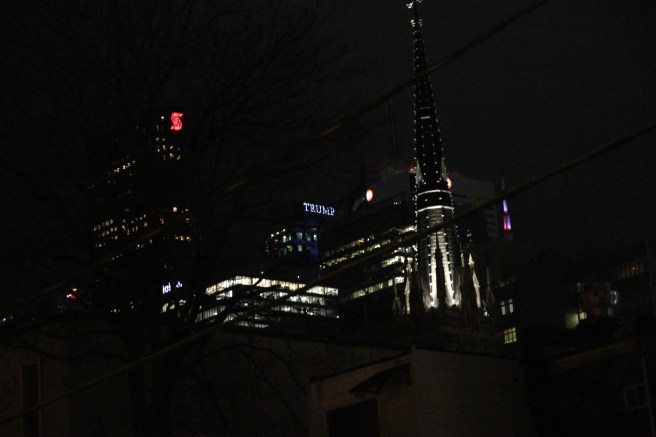
It’s a Christmas Eve sign! The Trump-meister, President-elect of the USA, has a building here in Toronto. I really have to stop in on the way to dinner. Here it is in all its finery.
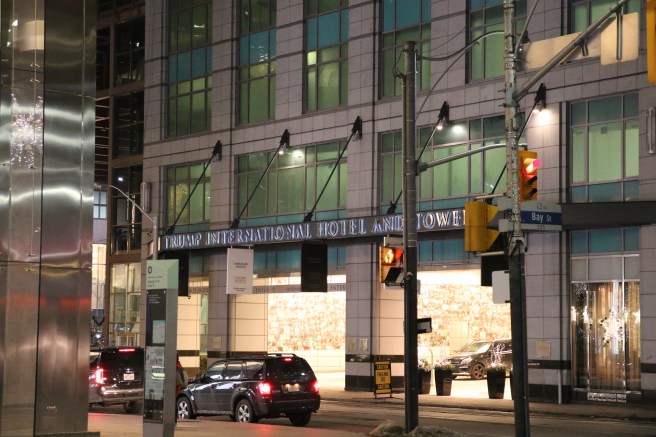
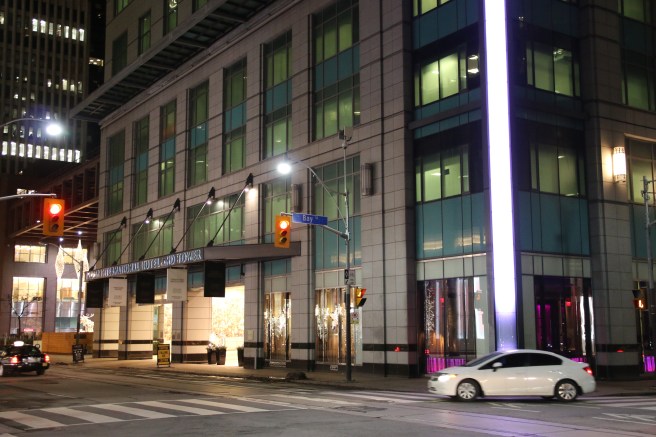
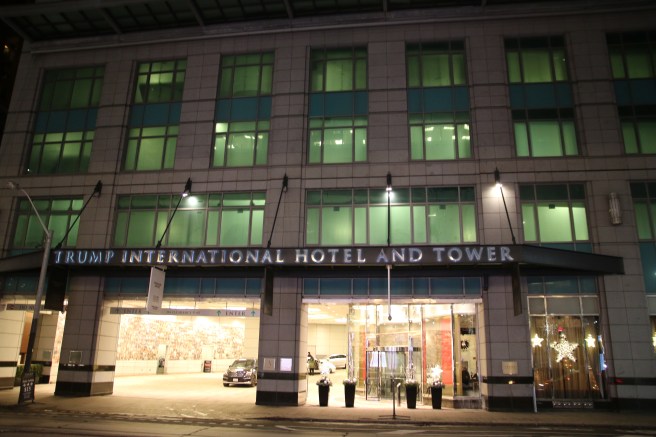
To be honest, it was pretty underwhelming. I did a little research (after I got home). Construction commenced in 2007 and was opened in early 2012. Like many buildings in Toronto, there is a hotel at the bottom and lots of condominiums above, with the building being 57 or 65 stories depending on who you believe. Trump Corp does not own this building. The Trump Corp has licenced its name to the developers of this site, and a Trump company has the contract to manage the building – nothing to do with the construction. The above information comes from some internet research, so it must be accurate.
The one interesting feature of this building is the mural that can be seen at the left of the first and third photos where the indoor cars are. It is actually a large mosaic which from afar is of a crowd of people of different colours and ages all waving their hands. Here are some Christmas lights from some of the nearby properties.
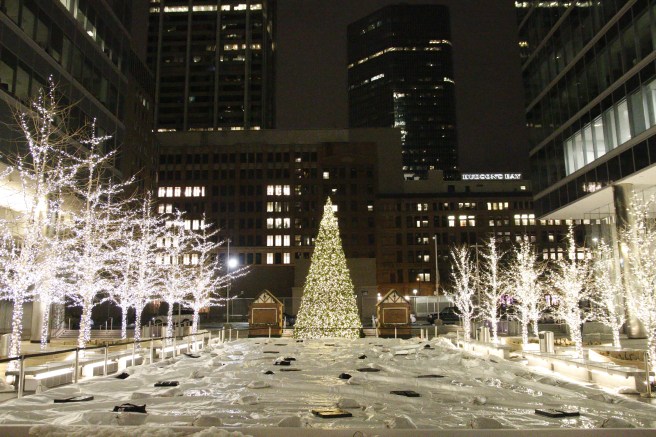

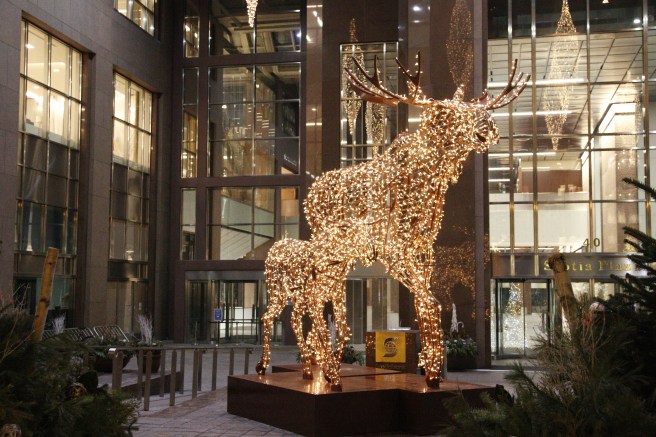
I really like the two shots below, where the lights reflect into the glass walls of the building. They would be better with a tripod, but still I like the effect.


After browsing the area, I reach the Ritz-Carlton in time for dinner. I had to wait a few minutes for my table to be ready, and after I was seated I was given a New York Times newspaper to read. The meal was a set 4 course meal, and I chose a Mission Hill (British Columbia) 2013 Pinot Gris to accompany it. Being an upmarket restaurant, the first two courses were small but artistically put together and professionally presented. For the main course and dessert I served myself (roast Turkey and vegetables followed by dessert including cheeses), so that’s where I made my money back. It was a lovely evening and the staff were very attentive.
After dinner, I wandered back to the area near where my hotel is, to the St Michael’s Cathedral.
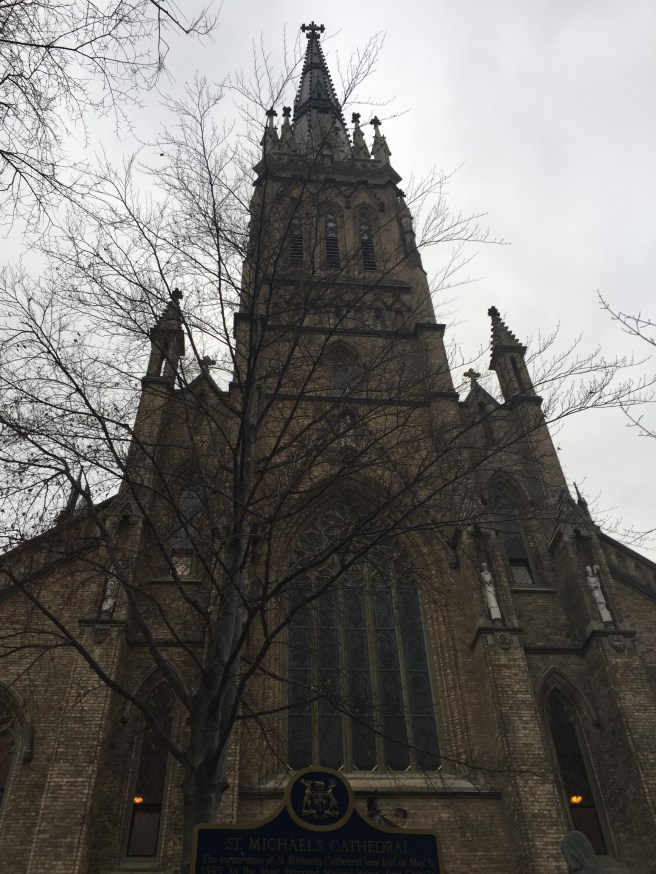
The cathedral was built in 1848 and is the principal church for Canada’s largest Catholic archdiocese. The church was holding a choir session from 11pm until midnight, prior to the midnight mass; so I had planned to attend the first half hour before calling my father and family for Christmas (Toronto time is 13 hours behind Perth, so 12.30pm in Perth was the time I agreed with Dad).
The choir started on time, although the first 5 minutes was just the organist performing “Christmas in the Old Mary Church, Krakow, Opus 31, No. 3”. I was seated right at the back due to having to leave early. So it was interesting to watch the organisation of the seating. There were 4 security people inside the church. They wandered up and down the aisles looking for spare space for people coming in. They would have 6 or 7 persons waiting against the back wall and would find them seats in amongst others, and then some more would come in and do the same. The singing went well, but the quality was nowhere near as good as the Royal School of Church Music that my Dad and Jacky were involved with.
So at 11.30pm, I headed outside the Cathedral to make my phone call. Out the front of the cathedral, the two sets of metal gates were locked, and being patrolled by a couple of security guards. There were a large number of people outside along the footpath. Because there are so many homeless I wondered whether they were all lined up, but there were far too many so I was perplexed. I called Dad, and got to wish him, Jacky and Chris my brother Merry Christmas. It was good to speak with them. My twin brother Gerard was too unwell to attend Dad’s Christmas Day lunch, so I called him after getting off the phone with Dad etc. I was able to speak with him and wish him all the best too.
Then I headed back to my hotel. I was ushered out through the side gate by a security person and found out what was happening. There were police and security at the one gate, and a queue of around 110 people outside. They were lined up to get into the cathedral, but they were only letting in a couple of people in as a couple of others would leave. Who knew choir music was so popular? Having the police involved in helping organise the attendance arrangements for the Cathedral was what surprised me. I’ve seen them involved in traffic management, but this was a first.
Anyway, I then headed home and then left a Christmas voice message for my Aunty Carol who would have been out for Christmas lunch. Then I went to bed to see if Santa was able to find me so far from my home.
December 23, 2016 (Friday)
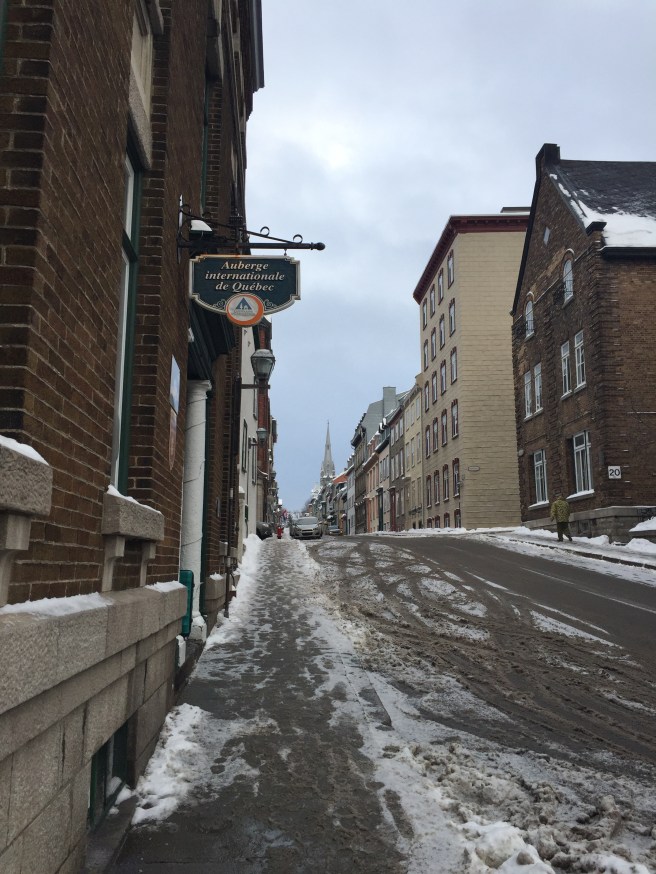
Today had minimal action. I packed my bags for the hotel, using a small weighing device to ensure I met the 23 kilogram limit for each of my two suitcases, and 11 kilogram limit for my large carry-on bag (the backpack with all my camera gear). I got the suitcases to 22.9kg and 22.7kg, and the camera backpack to 11.1kg. I thought that was pretty good. I took a couple of photos outside the hostel, including this one, as a goodbye.
I then caught a taxi to Gare du Palais, the Via Rail terminal, booked in my suitcases and awaited my trip. I also took a photo of the entrance to the terminal, where I stood a week earlier in the dark awaiting a taxi when I arrived. What a great week it has been.
The first leg of my trip was from Quebec City to Montreal. I was in an aisle seat so had no chance to take photos through the window. And I felt really sleepy anyway so just closed my eyes and listened to Christmas albums. When we got to Montreal, there was a 30 minutes period before the next train (Montreal to Toronto) departed. So I found out where the departure gate was and headed there. The queue was already at least 60 metres, snaking through half of the terminal. It was the longest of all the train queues, so I got in line with everyone else. I the end we boarded pretty quickly and left on time. By then it was dark and again I had an aisle seat. The trip took 4.5 hours, so I used the time to do some Sudoku and listen to a few lessons from the Great Courses’ Behavioural Economics course. Very interesting.
We ended up getting to Toronto around 10 minutes after the ETA, but that wasn’t a big deal although some thought it was. I checked out my suitcases and caught a taxi to my hotel (the Comfort Inn City Centre) and checked in. I was glad to get into the room, have a shower and drop onto the bed. The mattress and pillows were great. I watched a bit of the news (mainly about the UN vote of 14-0 that USA abstained, regarding the Israeli settlements in the West Bank; the USA President-elect Trump’s intervention in that decision; and a decision by the Prime Minister of Canada to purchase some fighter jets and why retired military generals think it’s a bad idea). Like our morning and late news, there seem to be only 3 or 4 news articles that just get repeated constantly.
So I switched the TV off and went to sleep.
December 22, 2016 (Thursday)
Again this morning, it was overcast and snowing when I got out of bed for breakfast, so I grabbed a few more sets of 5 minutes of snow flakes coming down to watch later. At the same time I sat and watched the snow, mesmerised. I also know this may be the last time I see snow coming down, apart from my planned skiing trips – as there hasn’t been much happening in Toronto, and Vancouver has only just had its first snow in 1000 days. So I made the most of it. After brekky, I headed up the street to a church steps to grab some more clips, so of course it started to rain. This meant no more snowflake clips as I can capture rain anywhere. Plus the benefit of the snow flakes is seeing each individual one. With rain you don’t get the same effect
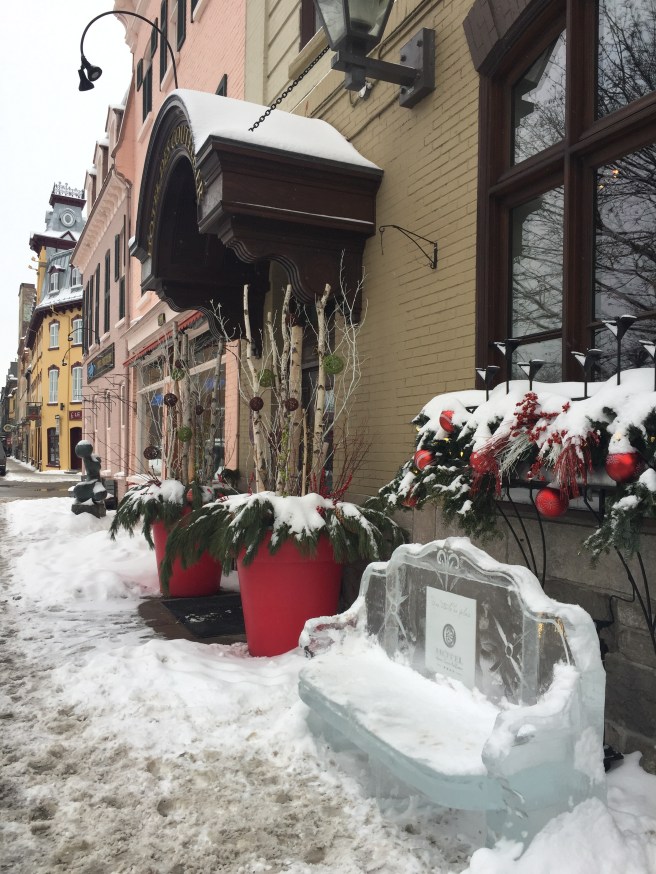
So I headed back to the hostel to start to plan the packing for tomorrow’s trip. After that I headed out for an hour and a half walking around and taking a last look at the various buildings of Quebec City. On the way I spotted this bench outside of Hotel des Coutellier. I scratched it and it is actually made of ice. It’s the same as one that Chris and I sat on in Melbourne’s ice bar. So I had to get a photo.
I ended up at the shore front near the port, just watching the ice floating around with snow on it, and the ferries cutting through the ice. This was the third day in a row doing this, but I’ve found it not only quite meditative but also interesting to watch.

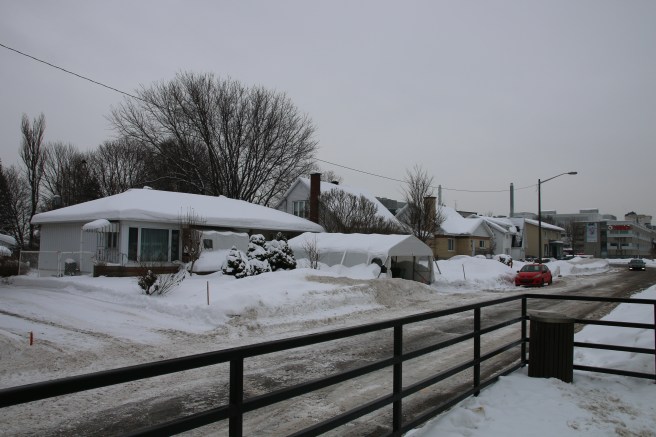
After that I headed out to the photo store to pick up my camera that I left with them on Monday. I picked up my camera and talked about the black mark with the technician. He was able to tell me about a couple of marks he thought may have been causing the problem, so I’m hoping that has fixed the problem. At the bus stop I took a photo of the houses nearby. You’ll see that there is a tent like (temporary) structure for a car in front of one of the houses. There are plenty of these around Quebec City and the suburbs nearby that I have travelled through. According to our tour guide from earlier, the council sets a date in November when these re allowed to be erected, and another in February when they have to be taken down. So they cannot be used all year round. It’s interesting because a number of hotels have them up to cover pathways etc.
On the way back to the hostel I stopped for a while to watch the ice skaters at Place D’Youville. If I can find an ice rink with a 1.3 – 1.4 rail or fence on the outside I might give it a go myself. I just need the rail to push along at the start to get my bearings before I fall over and fracture some bones.

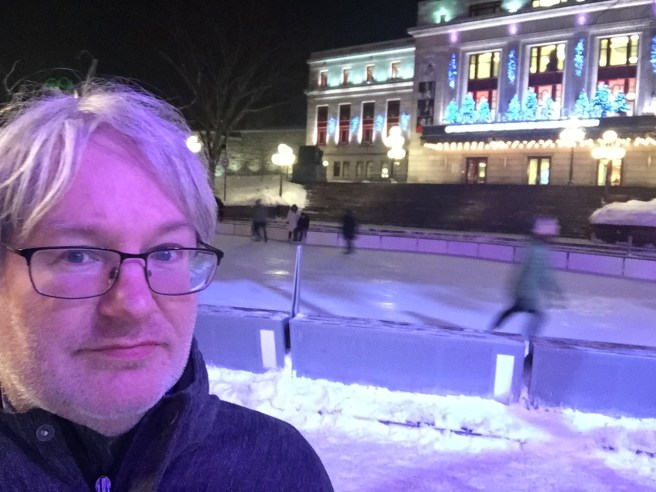
After that I headed to a café for dinner. For my last dinner in Quebec City, I started with a Fresh onion soup (which had a crust of cheese and onion over the liquid), then finished with a beef burger with a side of fries, washed down with two glasses of Napa Valley (California) Grenache. A tasty meal. I then headed back to the ice rink for another couple of photos, now that the sun had gone down and the lights were on, including this selfie.
I then headed back to the hostel to update a couple of days of my blog with CC and cola, before heading off to bed.
December 21, 2016 (Wednesday)
Today was very overcast and had snow showers all morning. So I used my camera’s video facility to grab a few minutes of snow flakes floating down, so I can watch them when back in Karratha! I’ll do the same for another few days. Unfortunately, because the clouds are light grey, I cannot see the snowflakes against the clouds, and so have to have a dark backdrop to see them. Which means that I cannot use the picturesque open areas, I need to use buildings. So I did a couple of videos outside my hostel window. They came out pretty okay I think.
Then leaving the camera at the hostel, I took off for a 5 kilometre walk around the old city, just soaking up the old buildings (and the rain because that was what was coming down by that time).
By the time I got back to the hostel it was 1pm. So I prepped my full camera backpack and headed down to the wharf to take a ferry across the river to the ferry port close to Desjardins. I wanted to wait until the sun started to go down, so I could take some photos of Quebec from the other side of the river. Again given my narrowest lens is 50mm, I know I’ll have to stitch some shots together but that’s not going to be too difficult. And getting shots of La Chateau Frontenac (the most photographed hotel in the world, apparently) would be nice.
The sun was out, there was only around 25% of the sky covered in clouds as I left my hotel. What could possibly change? So off I went. I took a long way just so I didn’t get to the ferry terminal until 2pm (sun going down at 3.45pm). The terminal was great and I got to watch a couple of ferries come and go. The ferry crossing and getting to the wharf is very interesting given the strength of the water. The ferry will take a relatively straight trajectory off the wharf on the other side and then turn towards the QC (Quebec City) side. With the river coming in, it goes a few hundred metres away and then just seems to sit there and let the river carry it back. In reality it is slowly inching its way forward, but it’s coming in sideways. And it stays sideways until close to the end, when the front end is against the wharf and roped, then it brings the back of the ferry in. On the way out, the back section remains roped until after the front has gone close to a 90 degree angle from the wharf. And it’s a large 4 storey ferry with vehicles at the bottom, 2 levels for passengers and then the bridge.
I am also really fascinated by the ice chunks floating up and down the river, with piles of snow on top. And the ferry “ploughing” through the ice. Memerising to watch. These photos are across to where I am heading.

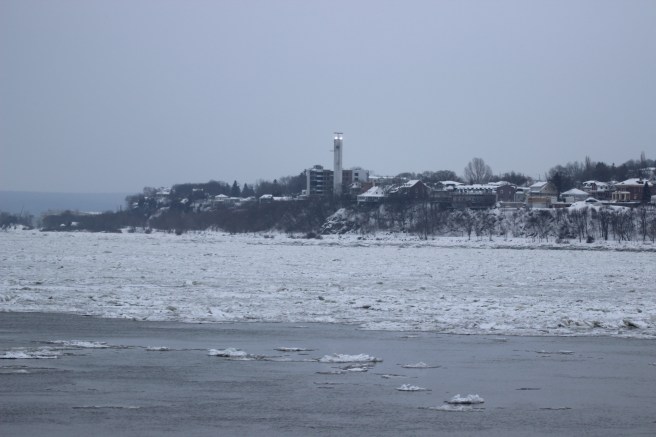
So by the time I got onto the ferry at my side, the skies had clouded up, and by the time I disembarked at the other side, there were strong showers about which created an inability to see more than about a kilometre. Of course that would happen. There was nowhere to set the tripod and camera up inside the terminal unless I wanted to shoot through glass, so I headed out to the side of the terminal opposite from where the snow showers (which converted to rain showers and then after a while back to snow showers) were coming from. It was a really nice, partly sheltered spot next to what looks to be a park or a carpark that was covered in snow.
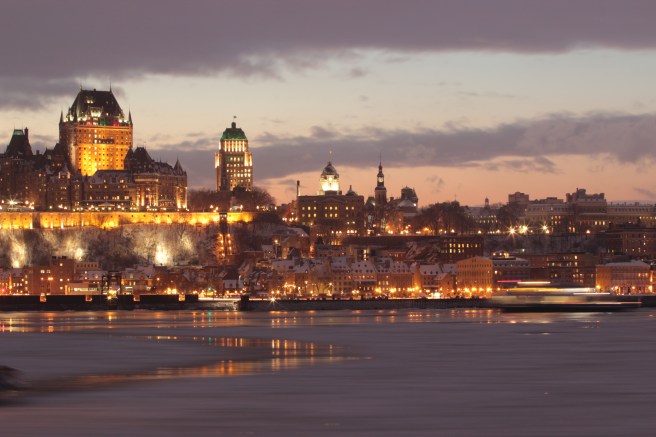
Eventually the showers stopped, the sight cleared and the lights of the buildings started to come on. So I took a few handfuls of photos. I got to play around with the different time, aperture, ISO and white balance settings on the camera too. Here are a few shots with the changing time. It’s likely not hard to work out which is La Chateau Frontenac.
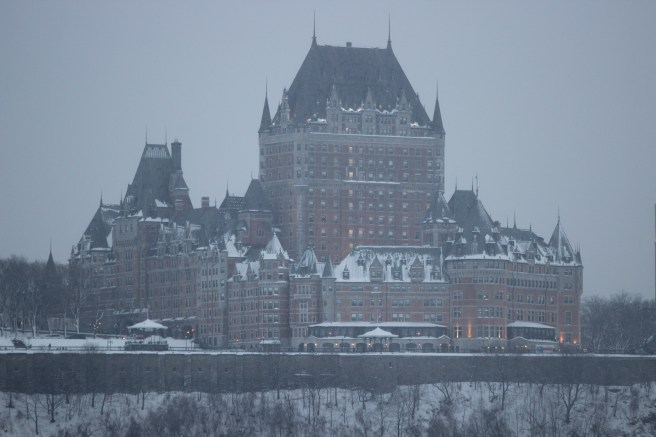
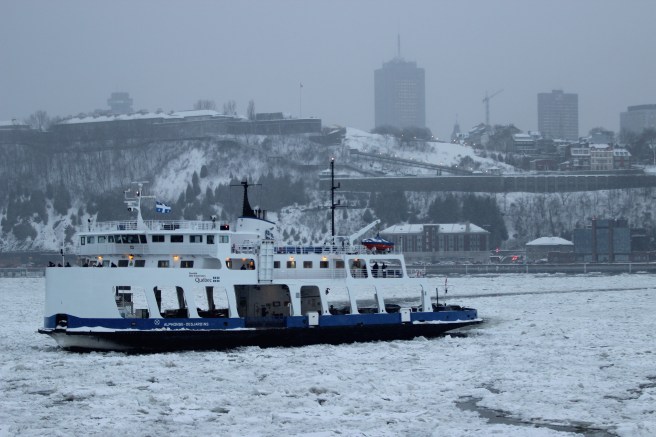
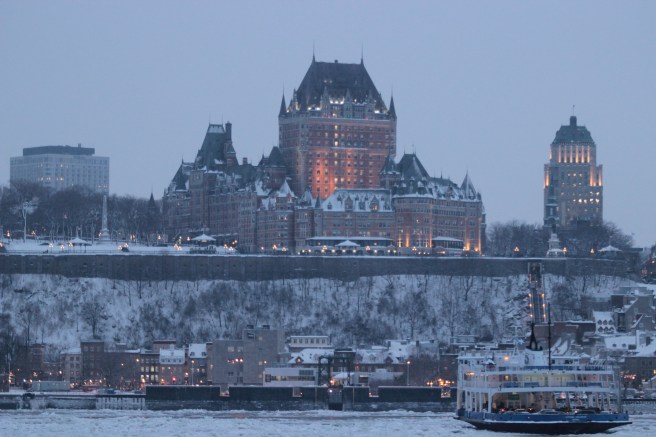

For the first shot below, the shutter is open for 2 seconds, and for the next two it is open for 5 seconds. I changed the aperture from 4.5 for the first shot to 10 for the next two, hence they are darker. I like the first one because the ice in the water is not as smoothed out. It’s fun to play with the camera settings!
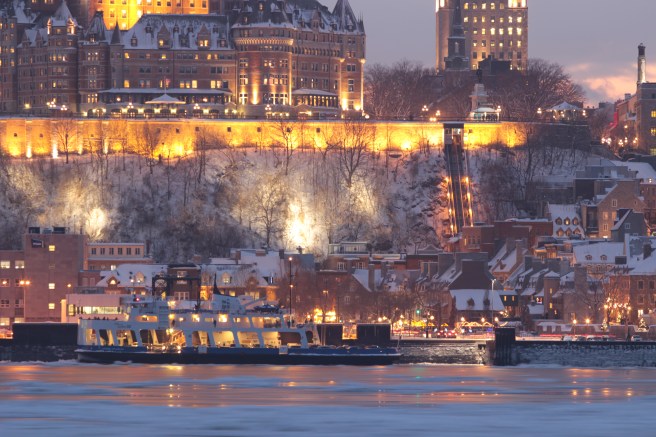
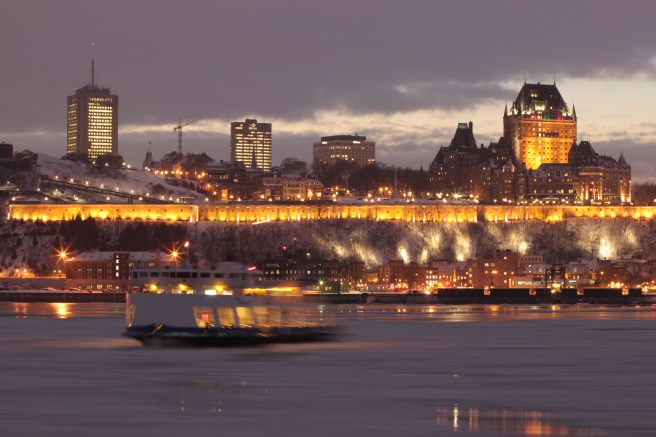
After these I took the next ferry back to QC, and took some photos back of the other side. Both of these two below had the shutter open for 20 seconds, hence the lines where the ferry travels in the first photo. The second photo has a brighter area due to the light from the moon which was coming up.
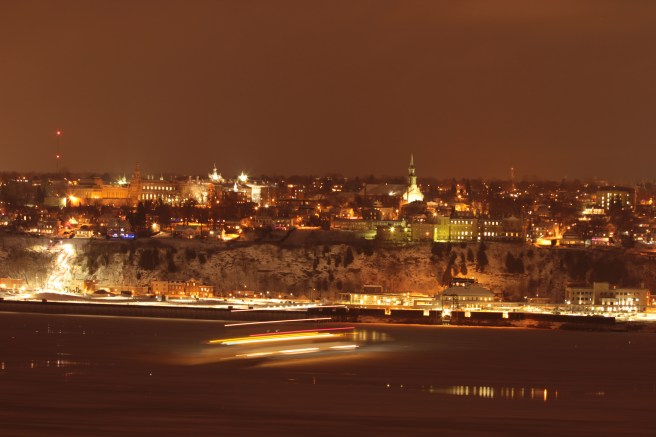

I headed back to the hostel after these photos as the second cameras battery was running flat. Then off to bed I went.
 mattravoblog